

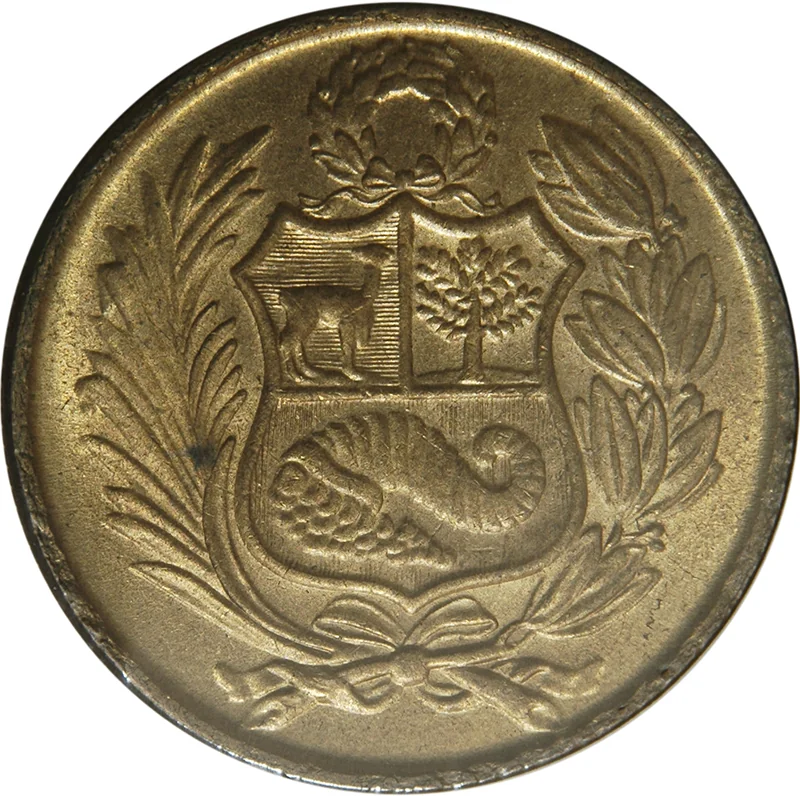
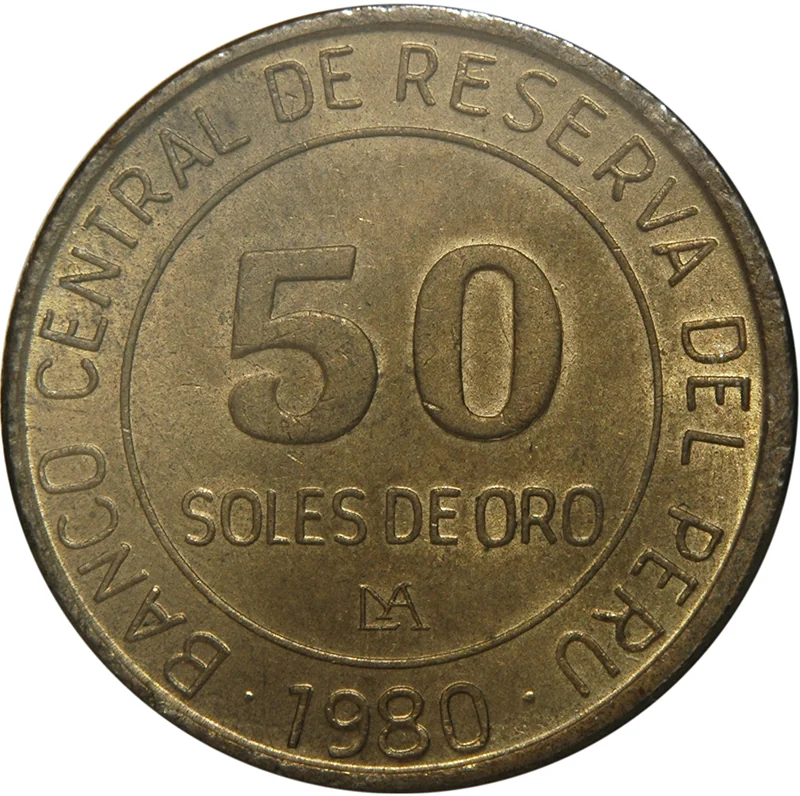
50 soles – Peru
Add to wishlist
Peru
Context
Material
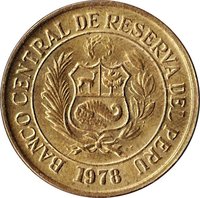
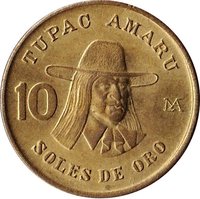
Diameter: 28 mm
Weight: 9 g
Thickness: 2 mm
Shape: Round
Composition: Aluminium bronze
Magnetic: No
Technique: Milled
Alignment: Coin alignment
flip
References
KM: #
Numista: #3265
Value
Exchange value: 50 PEH
Mintings
| Year | Mint Mark | Mintage | Quality | Collection |
|---|---|---|---|---|
| 1979 | — | 1,323,000 | ||
| 1980 | — | 452,573,000 | ||
| 1981 | — | 19,923,000 | ||
| 1982 | — | — | ||
| 1982 | LIMA | 18,471,000 | ||
| 1983 | — | 8,175,000 |
Historical background
In 1979, Peru was in the midst of a profound economic and political transition, marked by a severe currency crisis and hyperinflation. The decade had been defined by the left-wing military government of General Juan Velasco Alvarado (1968-1975), whose policies of nationalization and heavy state spending, followed by the 1970s oil shocks, left the economy with large fiscal deficits and a massive external debt. By the second administration of General Francisco Morales Bermúdez (1975-1980), the situation had deteriorated sharply. The Peruvian sol, which had been relatively stable, began a rapid devaluation, losing over 60% of its value against the US dollar in 1978 alone, while inflation skyrocketed to an annual rate of nearly 70%.
The currency instability was a direct symptom of deep structural problems: the government financed its deficits by printing money, leading to a vicious cycle of inflation and devaluation. This period, known as the "lost decade" for Latin America, saw Peru grappling with IMF-imposed austerity measures (el paquetazo) in 1978, which included subsidy cuts, price liberalization, and a devaluation intended to stabilize the economy. These harsh measures sparked widespread social unrest and strikes but were deemed necessary to secure international loans and curb the hyperinflationary spiral. The currency was effectively in a state of managed float, with frequent official devaluations that failed to keep pace with the black-market exchange rate.
Politically, 1979 was a pivotal year as the country moved toward a return to civilian rule. A Constituent Assembly, elected in 1978, was finalizing a new constitution that would come into force in 1980. The economic turmoil and currency crisis formed the dire backdrop for this democratic transition, creating immense pressure on the future civilian government to restore stability. The profound instability of the sol in 1979 set the stage for the even more catastrophic hyperinflation that would engulf Peru in the late 1980s, making this period a crucial, though painful, chapter in the nation's modern economic history.
The currency instability was a direct symptom of deep structural problems: the government financed its deficits by printing money, leading to a vicious cycle of inflation and devaluation. This period, known as the "lost decade" for Latin America, saw Peru grappling with IMF-imposed austerity measures (el paquetazo) in 1978, which included subsidy cuts, price liberalization, and a devaluation intended to stabilize the economy. These harsh measures sparked widespread social unrest and strikes but were deemed necessary to secure international loans and curb the hyperinflationary spiral. The currency was effectively in a state of managed float, with frequent official devaluations that failed to keep pace with the black-market exchange rate.
Politically, 1979 was a pivotal year as the country moved toward a return to civilian rule. A Constituent Assembly, elected in 1978, was finalizing a new constitution that would come into force in 1980. The economic turmoil and currency crisis formed the dire backdrop for this democratic transition, creating immense pressure on the future civilian government to restore stability. The profound instability of the sol in 1979 set the stage for the even more catastrophic hyperinflation that would engulf Peru in the late 1980s, making this period a crucial, though painful, chapter in the nation's modern economic history.
🌱 Very Common