

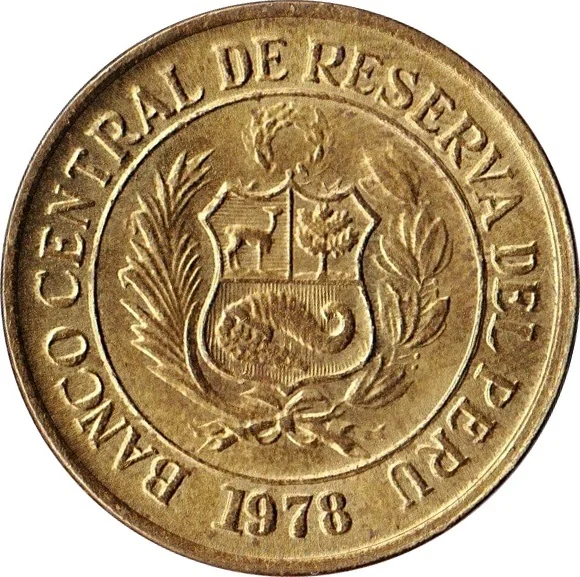
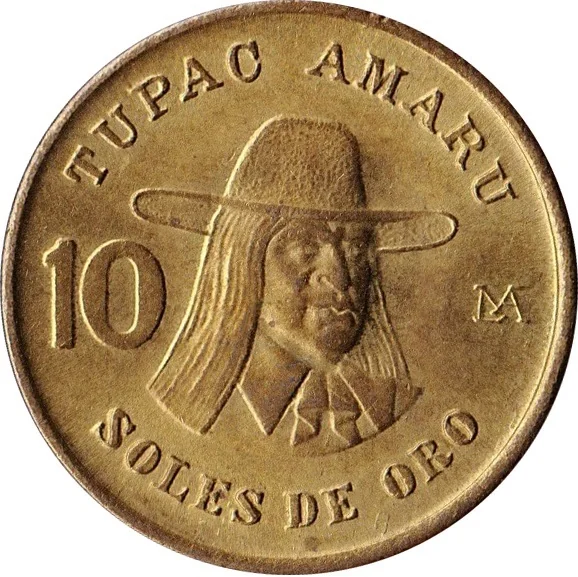
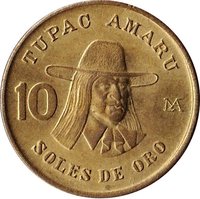
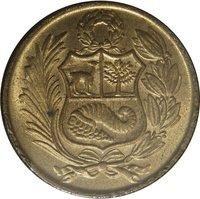
Obverse
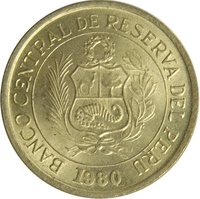
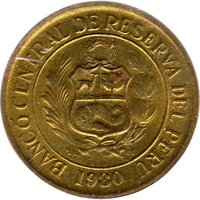
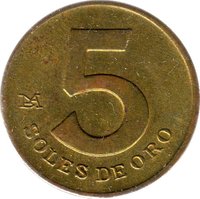
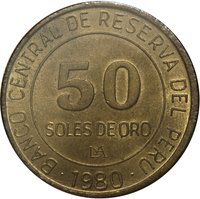
Reverse
Edge
Plain
Categories
| Person> Military leader |
| Object> Hat |
| Symbol> Cornucopia |
| Symbols> Coat of Arms |
Mints
| Name | Mark |
|---|---|
| Lima | — |
Mintings
| Year | Mint Mark | Mintage | Quality | Collection |
|---|---|---|---|---|
| 1978 | — | — | ||
| 1979 | — | 82,220,000 | ||
| 1980 | — | 99,595,000 | ||
| 1981 | — | 25,660,000 | ||
| 1982 | — | 61,035,000 | ||
| 1983 | — | 15,820,000 |
Historical background
By 1978, Peru was in the midst of a severe economic and currency crisis, the roots of which lay in the populist policies of the military government of General Juan Velasco Alvarado (1968-1975). His administration had pursued massive state-led industrialization, financed by heavy foreign borrowing and expansive monetary policy, while maintaining an artificially overvalued exchange rate. This overvaluation, managed through strict controls, created a thriving black market for dollars, masked growing fiscal deficits, and eroded export competitiveness. When the 1973 oil shock hit and global commodity prices fell, Peru's external debt became unsustainable, setting the stage for a balance of payments crisis.
The situation came to a head under the successor government of General Francisco Morales Bermúdez. By 1978, inflation was soaring—reaching over 70% annually—and the Peruvian sol was in freefall. The central bank's foreign reserves were nearly depleted from defending the unsustainable fixed rate. In response, the government was forced to implement a major devaluation and adopt a crawling peg system, a managed devaluation designed to gradually align the official exchange rate with market realities. This was a central component of a stabilization agreement with the International Monetary Fund (IMF), which provided crucial financing in exchange for austerity measures, including cuts to subsidies and public spending.
The 1978 currency devaluation and IMF program marked a pivotal turn toward economic liberalization, but came at a significant social cost. The immediate effect was a sharp increase in the cost of living, as imports became dramatically more expensive, fueling social unrest. This period of economic hardship directly influenced the concurrent political transition, as the government was simultaneously convening a Constituent Assembly to return the country to civilian rule. Thus, the currency crisis of 1978 was not merely a financial event; it was a catalyst that underscored the failure of the previous economic model and forced a painful restructuring that shaped Peru's political and economic trajectory for the following decade.
The situation came to a head under the successor government of General Francisco Morales Bermúdez. By 1978, inflation was soaring—reaching over 70% annually—and the Peruvian sol was in freefall. The central bank's foreign reserves were nearly depleted from defending the unsustainable fixed rate. In response, the government was forced to implement a major devaluation and adopt a crawling peg system, a managed devaluation designed to gradually align the official exchange rate with market realities. This was a central component of a stabilization agreement with the International Monetary Fund (IMF), which provided crucial financing in exchange for austerity measures, including cuts to subsidies and public spending.
The 1978 currency devaluation and IMF program marked a pivotal turn toward economic liberalization, but came at a significant social cost. The immediate effect was a sharp increase in the cost of living, as imports became dramatically more expensive, fueling social unrest. This period of economic hardship directly influenced the concurrent political transition, as the government was simultaneously convening a Constituent Assembly to return the country to civilian rule. Thus, the currency crisis of 1978 was not merely a financial event; it was a catalyst that underscored the failure of the previous economic model and forced a painful restructuring that shaped Peru's political and economic trajectory for the following decade.
🌱 Very Common