

100 soles – Peru
Add to wishlist
Peru
Context
Years: 1980–1982
Issuer: Peru
Issuing organization: Central Reserve Bank of Peru
Period:
(since 1822)
Demonetization: 1 January 1985
Total mintage: 100,000,000
Material
Diameter: 30 mm
Weight: 11.7 g
Thickness: 2.3 mm
Shape: Round
Composition: Copper-nickel
Technique: Milled
Alignment: Coin alignment
flip
References
KM: #
Numista: #2633
Value
Exchange value: 100 PEH
Obverse
Description:
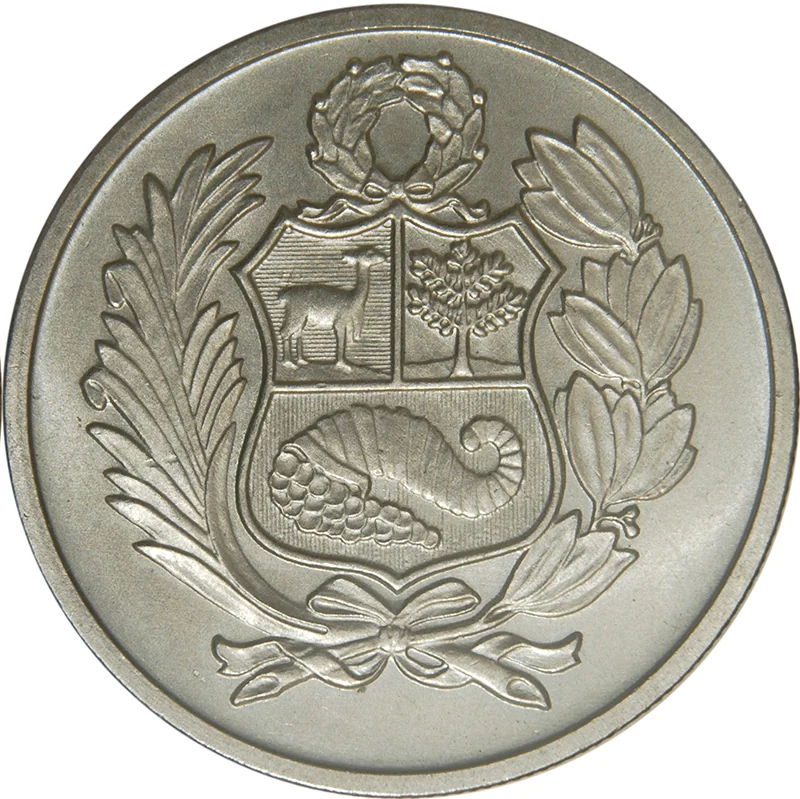
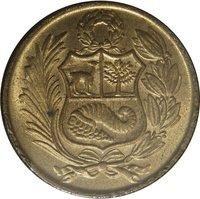
Coat of Arms with laurel and olive branches.
Script: Latin
Reverse
Description:
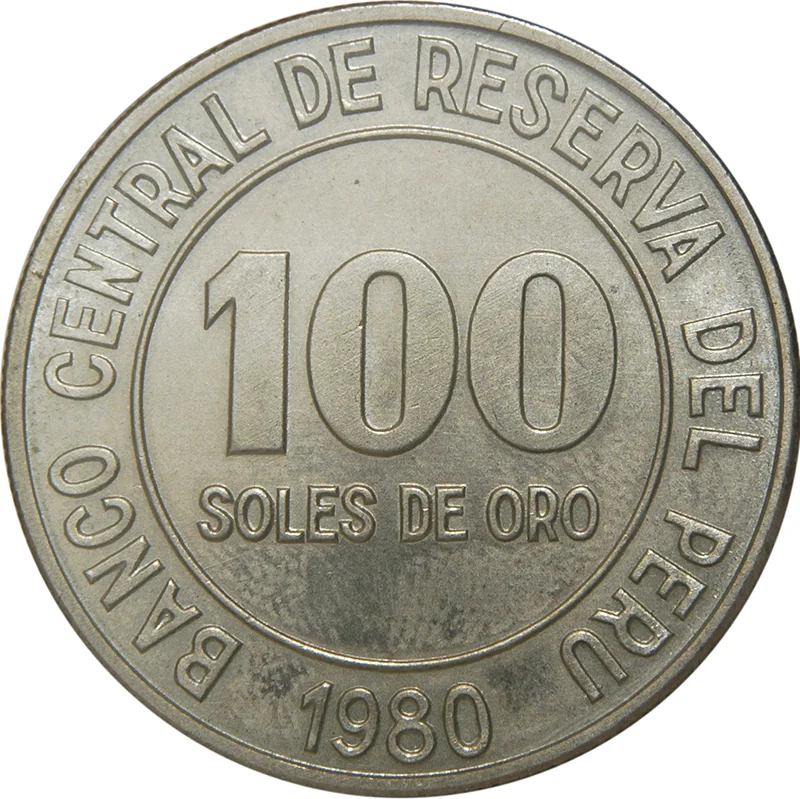
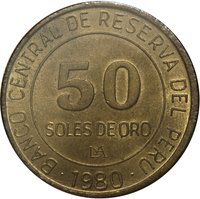
Circle's worth
Inscription:
BANCO CENTRAL DE RESERVA DEL PERU
100
SOLES DE ORO
1980
100
SOLES DE ORO
1980
Script: Latin
Edge
Milled
Categories
| Symbols> Coat of Arms |
| Symbol> Cornucopia |
Mintings
| Year | Mint Mark | Mintage | Quality | Collection |
|---|---|---|---|---|
| 1980 | — | 100,000,000 | ||
| 1980 | — | — | Proof | |
| 1982 | — | — |
Historical background
Peru entered the 1980s under a fragile democratic transition, with Fernando Belaúnde Terry returning to the presidency after a period of military rule. The economic landscape he inherited was already strained by the legacy of state-led policies, but the situation was manageable. The national currency, the sol, was relatively stable, though inflation was a growing concern, ticking up from 66% in 1979 to around 60% in 1980. The external context was challenging, with rising global interest rates and falling prices for Peru's key exports, setting the stage for a balance of payments crisis.
However, the underlying structural weaknesses were profound. The economy suffered from pervasive subsidies, a large and inefficient public sector, and heavy dependence on volatile commodity exports. Crucially, Belaúnde's government initially pursued an expansionary fiscal policy, financed by printing money and accumulating external debt, while simultaneously removing price controls. This contradictory mix of loose monetary policy and a sudden shift to free-market prices, without fiscal discipline, proved disastrous. It ignited an inflationary spiral that would define the decade.
Thus, 1980 marked the critical tipping point from moderate inflation to hyperinflation. The currency situation deteriorated rapidly as confidence in the sol evaporated. By 1982, inflation surged to 72%, beginning a relentless climb that would culminate in hyperinflation exceeding 7,000% by the end of the decade. The 1980 currency situation, therefore, is best understood as the calm before the storm—the final year of relative stability before policy missteps and external shocks unleashed an economic catastrophe that would ultimately lead to the currency's collapse and its replacement by the inti in 1985.
However, the underlying structural weaknesses were profound. The economy suffered from pervasive subsidies, a large and inefficient public sector, and heavy dependence on volatile commodity exports. Crucially, Belaúnde's government initially pursued an expansionary fiscal policy, financed by printing money and accumulating external debt, while simultaneously removing price controls. This contradictory mix of loose monetary policy and a sudden shift to free-market prices, without fiscal discipline, proved disastrous. It ignited an inflationary spiral that would define the decade.
Thus, 1980 marked the critical tipping point from moderate inflation to hyperinflation. The currency situation deteriorated rapidly as confidence in the sol evaporated. By 1982, inflation surged to 72%, beginning a relentless climb that would culminate in hyperinflation exceeding 7,000% by the end of the decade. The 1980 currency situation, therefore, is best understood as the calm before the storm—the final year of relative stability before policy missteps and external shocks unleashed an economic catastrophe that would ultimately lead to the currency's collapse and its replacement by the inti in 1985.
🌱 Very Common