

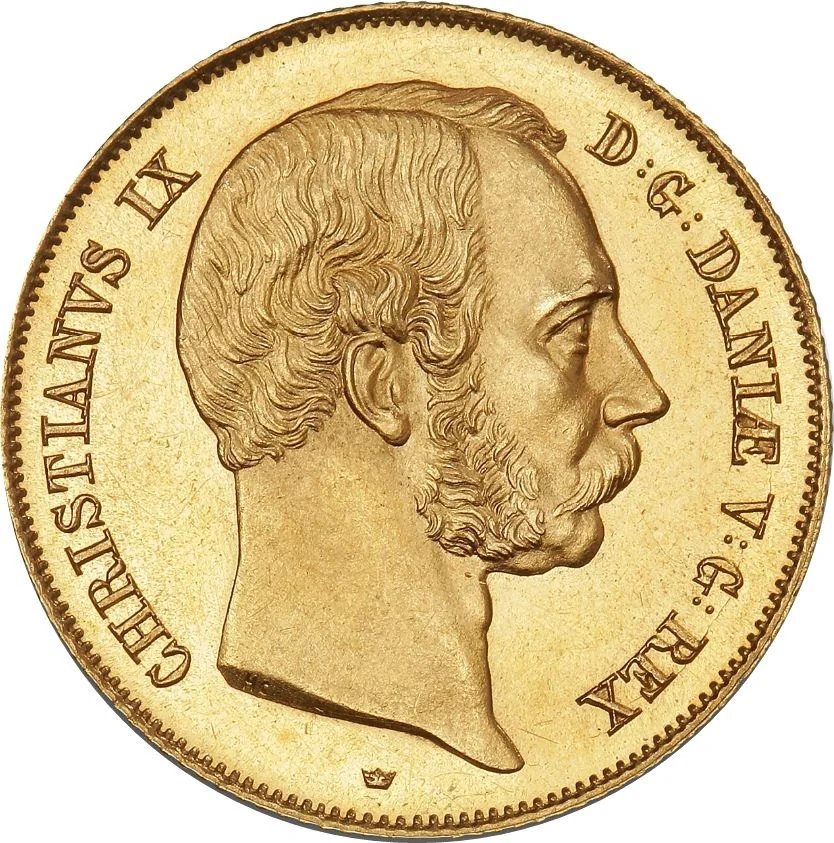
2 Christians d'Or – Denmark
Denmark
Context
Material
References
KM: #Click to copy to clipboard773
Numista: #326480
Value
Bullion value: $1980.92
Obverse
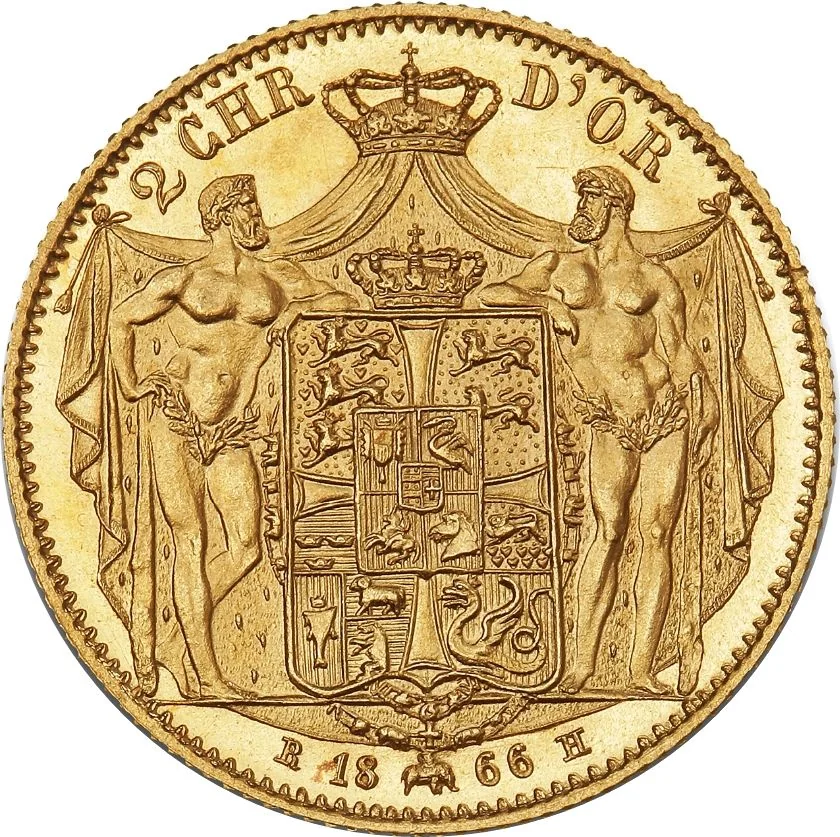
Reverse
Description:
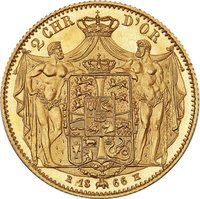
Crowned grater shield with the Arms of Denmark and territories, supported by club-armed wildmen. A crowned mantle appears behind the shield and supporters. Value is above, date below.
Inscription:
2 CHR D'OR
R 18 | 66 H
R 18 | 66 H
Script: Latin
Edge
Reeded
Mints
| Name | Mark |
|---|---|
| Royal Danish Mint | ♔ |
Historical background
In 1866, Denmark’s currency system was in a state of transition, firmly embedded within the Scandinavian Monetary Union (SMU) established just two years prior in 1873. This union, formed with Sweden (and joined by Norway in 1875), created a common gold standard, replacing the earlier silver-based rigsdaler. The new currency, the krone (crown), was introduced at a rate of 1 krone = ½ rigsdaler, with 1 krone subdivided into 100 øre. The primary goal was to stabilize trade and economic relations across the region by guaranteeing the free circulation and equal value of Danish, Swedish, and later Norwegian coins.
Despite the formal union, the period around 1866 was marked by practical challenges. While coins circulated freely, each nation retained its own banknotes, which were not automatically legal tender across borders. This created a complex environment for larger transactions and banking. Furthermore, the commitment to a strict gold standard meant Denmark's money supply and economic policy were increasingly tied to international gold flows, a shift from the more flexible silver standard. This imposed a discipline aimed at curbing inflation but also limited monetary tools during economic downturns.
The broader context for this monetary reform was Denmark's painful national recovery following its defeat in the Second Schleswig War of 1864. The loss of the duchies of Schleswig, Holstein, and Lauenburg was a profound economic and psychological blow. The adoption of the modern krone and the Scandinavian Monetary Union can thus be seen as part of a concerted effort to modernize the Danish state, stabilize its economy, and strengthen its ties within Scandinavia as a counterbalance to the influence of larger European powers, particularly Germany. The currency system of 1866, therefore, represented both a practical financial framework and a symbol of Denmark's reorientation in the wake of territorial and political upheaval.
Despite the formal union, the period around 1866 was marked by practical challenges. While coins circulated freely, each nation retained its own banknotes, which were not automatically legal tender across borders. This created a complex environment for larger transactions and banking. Furthermore, the commitment to a strict gold standard meant Denmark's money supply and economic policy were increasingly tied to international gold flows, a shift from the more flexible silver standard. This imposed a discipline aimed at curbing inflation but also limited monetary tools during economic downturns.
The broader context for this monetary reform was Denmark's painful national recovery following its defeat in the Second Schleswig War of 1864. The loss of the duchies of Schleswig, Holstein, and Lauenburg was a profound economic and psychological blow. The adoption of the modern krone and the Scandinavian Monetary Union can thus be seen as part of a concerted effort to modernize the Danish state, stabilize its economy, and strengthen its ties within Scandinavia as a counterbalance to the influence of larger European powers, particularly Germany. The currency system of 1866, therefore, represented both a practical financial framework and a symbol of Denmark's reorientation in the wake of territorial and political upheaval.
✨ Legendary