

1 Austral – Argentina
Argentina
Context
Year: 1989
Issuer: Argentina 
Period:
(since 1861)
Currency:
(1985—1991)
Demonetization: 1 March 1992
Total mintage: 57,400,000
Material
Diameter: 20.2 mm
Weight: 1.55 g
Thickness: 2 mm
Shape: Round
Composition: Aluminium
Standard: Gold twentieth ounce
Magnetic: No
Technique: Milled
Alignment: Coin alignment
flip
References
KM: #Click to copy to clipboard100
Numista: #3264
Value
Exchange value: 1 ARA
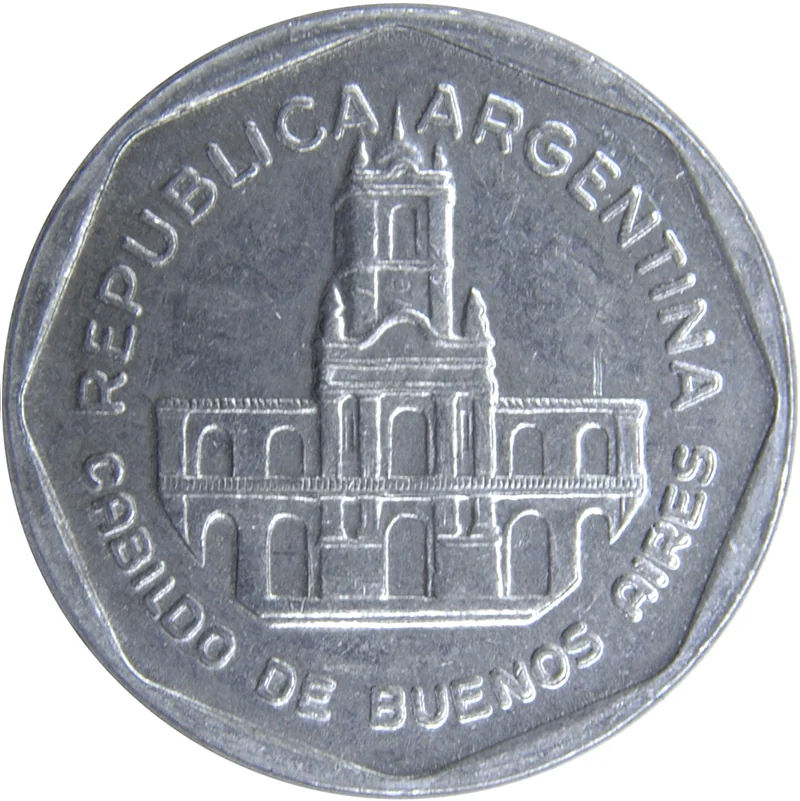
Obverse
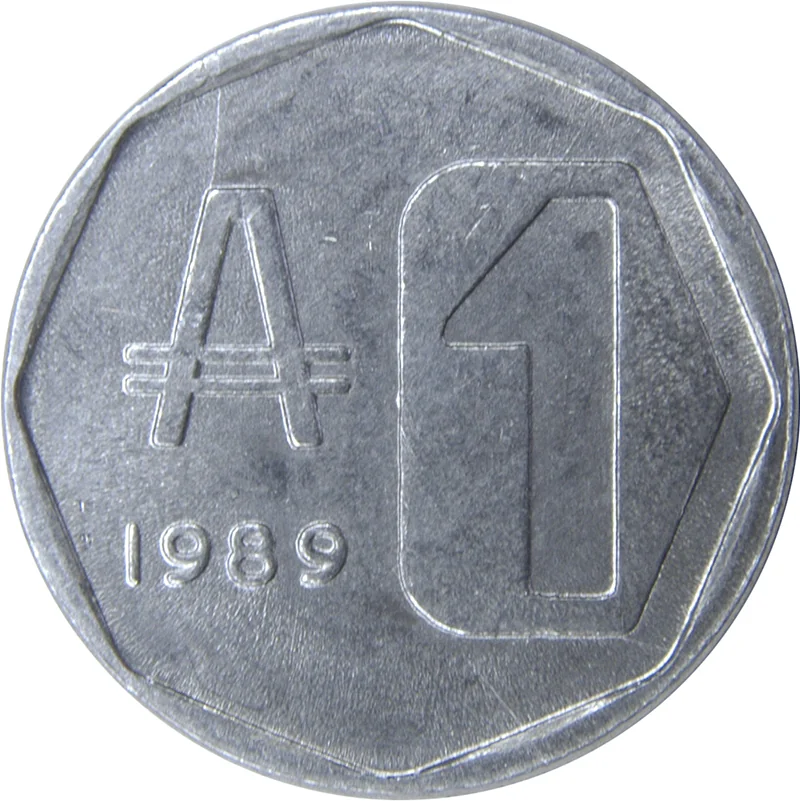
Reverse
Description:
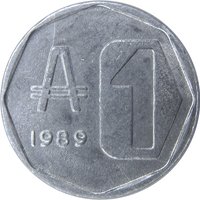
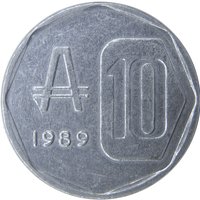
Large right numeral, double-lined "A" left, date below.
Inscription:
₳
1989 1
1989 1
Script: Latin
Edge
Plain
Mintings
| Year | Mint Mark | Mintage | Quality | Collection |
|---|---|---|---|---|
| 1989 | — | 57,400,000 |
Historical background
Argentina in 1989 was engulfed in one of the most severe hyperinflationary crises in modern economic history, marking the catastrophic culmination of decades of fiscal mismanagement and political instability. The year began with the austral, the currency introduced in 1985 to replace the discredited peso, in freefall. Inflation reached an almost incomprehensible annual rate of over 3,000%, effectively erasing savings and wages on a weekly basis. The Central Bank had lost all control, printing money at a staggering pace to finance massive government deficits, while a vicious cycle of price increases, devaluation, and wage demands paralyzed the economy.
This monetary chaos created a surreal daily reality for Argentines. Prices in shops changed multiple times a day, and the concept of long-term planning vanished. People rushed to convert their australes into US dollars or tangible goods the moment they were paid, as the currency's value evaporated by the hour. The economy became profoundly "dollarized" in practice, with many large transactions and contracts indexed to the US dollar, further undermining faith in the national currency. The social fabric frayed under the strain, leading to widespread looting of supermarkets and profound civil unrest.
The crisis reached its political zenith in mid-1989, forcing President Raúl Alfonsín to resign months early and hand power to President-elect Carlos Menem. This hyperinflationary explosion was not merely a monetary event but a full-scale collapse of the national monetary system, discrediting the austral entirely. It set the stage for the radical convertibility plan of 1991, which would peg the new peso one-to-one with the US dollar in a desperate bid to restore stability, illustrating how the trauma of 1989 fundamentally reshaped Argentina's economic policy for decades to come.
This monetary chaos created a surreal daily reality for Argentines. Prices in shops changed multiple times a day, and the concept of long-term planning vanished. People rushed to convert their australes into US dollars or tangible goods the moment they were paid, as the currency's value evaporated by the hour. The economy became profoundly "dollarized" in practice, with many large transactions and contracts indexed to the US dollar, further undermining faith in the national currency. The social fabric frayed under the strain, leading to widespread looting of supermarkets and profound civil unrest.
The crisis reached its political zenith in mid-1989, forcing President Raúl Alfonsín to resign months early and hand power to President-elect Carlos Menem. This hyperinflationary explosion was not merely a monetary event but a full-scale collapse of the national monetary system, discrediting the austral entirely. It set the stage for the radical convertibility plan of 1991, which would peg the new peso one-to-one with the US dollar in a desperate bid to restore stability, illustrating how the trauma of 1989 fundamentally reshaped Argentina's economic policy for decades to come.
🌱 Very Common