

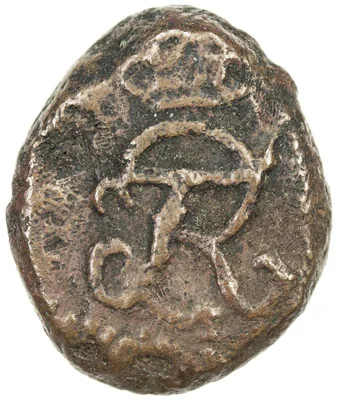
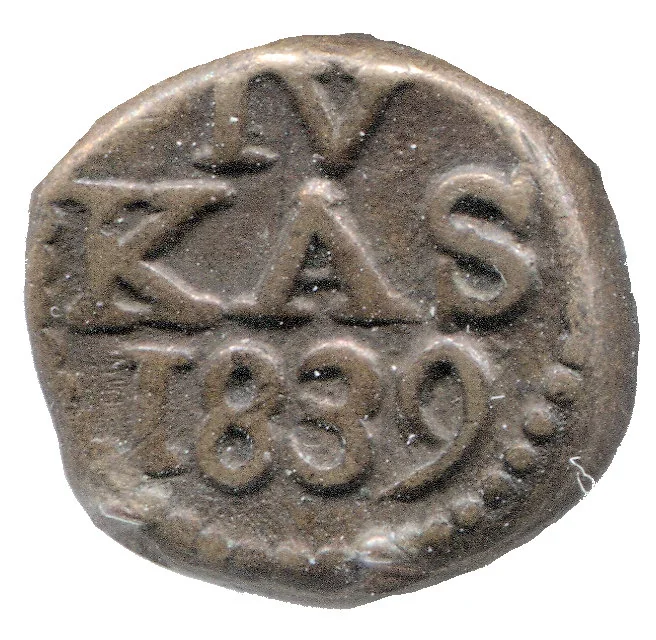
4 cash – Danish India
Add to wishlist
India
Context
Years: 1817–1839
Country: India
Issuer: Danish India
Ruler: Frederick VI
Currency:
(1730—1818)
Demonetized: Yes
Material
References
KM: #
Numista: #32390
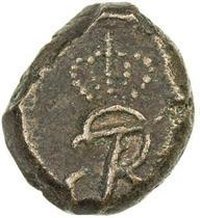
Obverse
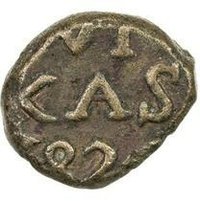
Reverse
Edge
Mintings
| Year | Mint Mark | Mintage | Quality | Collection |
|---|---|---|---|---|
| 1817 | — | — | ||
| 1824 | — | — | ||
| 1825 | — | — | ||
| 1830 | — | — | ||
| 1831 | — | — | ||
| 1832 | — | — | ||
| 1833 | — | — | ||
| 1834 | — | — | ||
| 1837 | — | — | ||
| 1838 | — | — | ||
| 1839 | — | — |
Historical background
In 1817, the currency situation in Danish India, comprising the small trading enclaves of Tranquebar (Tharangambadi) on the Coromandel Coast and Serampore (Frederiksnagore) in Bengal, was complex and marked by a reliance on external monetary systems. Denmark had maintained a presence in India since the 17th century, but by the early 19th century, its commercial and political influence was waning, especially in the shadow of the expanding British East India Company. Consequently, the Danish administration did not issue a dominant, exclusive coinage for local use. Instead, the daily economic life of these settlements was saturated with a variety of foreign silver coins, most notably the Spanish dollar (8 reales) and its regional derivatives, alongside a multitude of Indian silver rupees from neighboring powers.
The official Danish currency, the rigsdaler, was theoretically in use but played a minimal role in everyday transactions. The real circulating medium was a chaotic bazaar of coins, valued by their intrinsic silver weight and fineness rather than their face value. This necessitated constant assay and exchange, leading to inefficiency and friction in trade. To bring order, the Danish authorities periodically published official exchange rate bulletins, fixing the value of major foreign coins like the Spanish dollar and the British Indian rupee against the rigsdaler. However, these rates often struggled to keep pace with fluctuating market values and the frequent arrival of coins of varying quality.
This monetary landscape reflected Denmark’s diminished role as a colonial power. With the British rupee becoming the de facto standard across large parts of India, and with Danish trade declining, there was little economic incentive or administrative capacity for Copenhagen to impose a unified currency. The situation in 1817 was thus one of pragmatic adaptation, where Danish India functioned within a regional monetary sphere dominated by others, relying on a patchwork of foreign silver to facilitate its commerce, while its own currency remained largely a unit of account for administrative bookkeeping.
The official Danish currency, the rigsdaler, was theoretically in use but played a minimal role in everyday transactions. The real circulating medium was a chaotic bazaar of coins, valued by their intrinsic silver weight and fineness rather than their face value. This necessitated constant assay and exchange, leading to inefficiency and friction in trade. To bring order, the Danish authorities periodically published official exchange rate bulletins, fixing the value of major foreign coins like the Spanish dollar and the British Indian rupee against the rigsdaler. However, these rates often struggled to keep pace with fluctuating market values and the frequent arrival of coins of varying quality.
This monetary landscape reflected Denmark’s diminished role as a colonial power. With the British rupee becoming the de facto standard across large parts of India, and with Danish trade declining, there was little economic incentive or administrative capacity for Copenhagen to impose a unified currency. The situation in 1817 was thus one of pragmatic adaptation, where Danish India functioned within a regional monetary sphere dominated by others, relying on a patchwork of foreign silver to facilitate its commerce, while its own currency remained largely a unit of account for administrative bookkeeping.
💎 Very Rare