

25 francs cfa – Western African States
Add to wishlist
Context
Years: 1970–1979
Issuer: Western African States
Issuing organization: Central Bank of Western African States
Currency:
(since 1958)
Demonetized: Yes
Total mintage: 39,284,800
Material
References
KM: #
Numista: #1373
Value
Exchange value: 25 XOF
Obverse
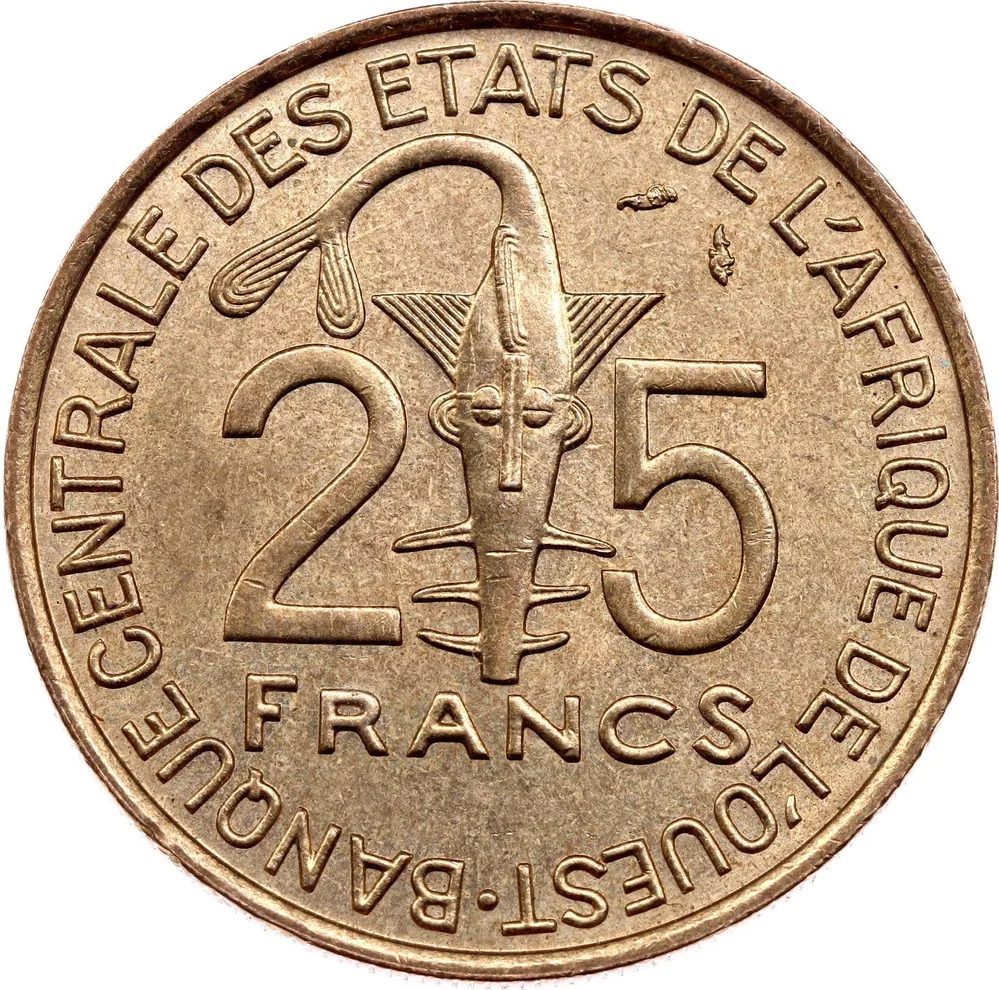
Description:
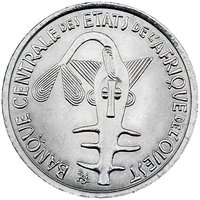
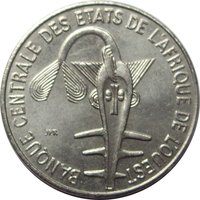
BCEAO emblem and value
Inscription:
25 FRANCS
BANQUE CENTRALE DES ETATS DE L'AFRIQUE DE L'OUEST
BANQUE CENTRALE DES ETATS DE L'AFRIQUE DE L'OUEST
Translation:
25 FRANCS
CENTRAL BANK OF THE WEST AFRICAN STATES
CENTRAL BANK OF THE WEST AFRICAN STATES
Script: Latin
Language: French
Engravers: Gabriel Bernard, Lucien Bazor
Reverse
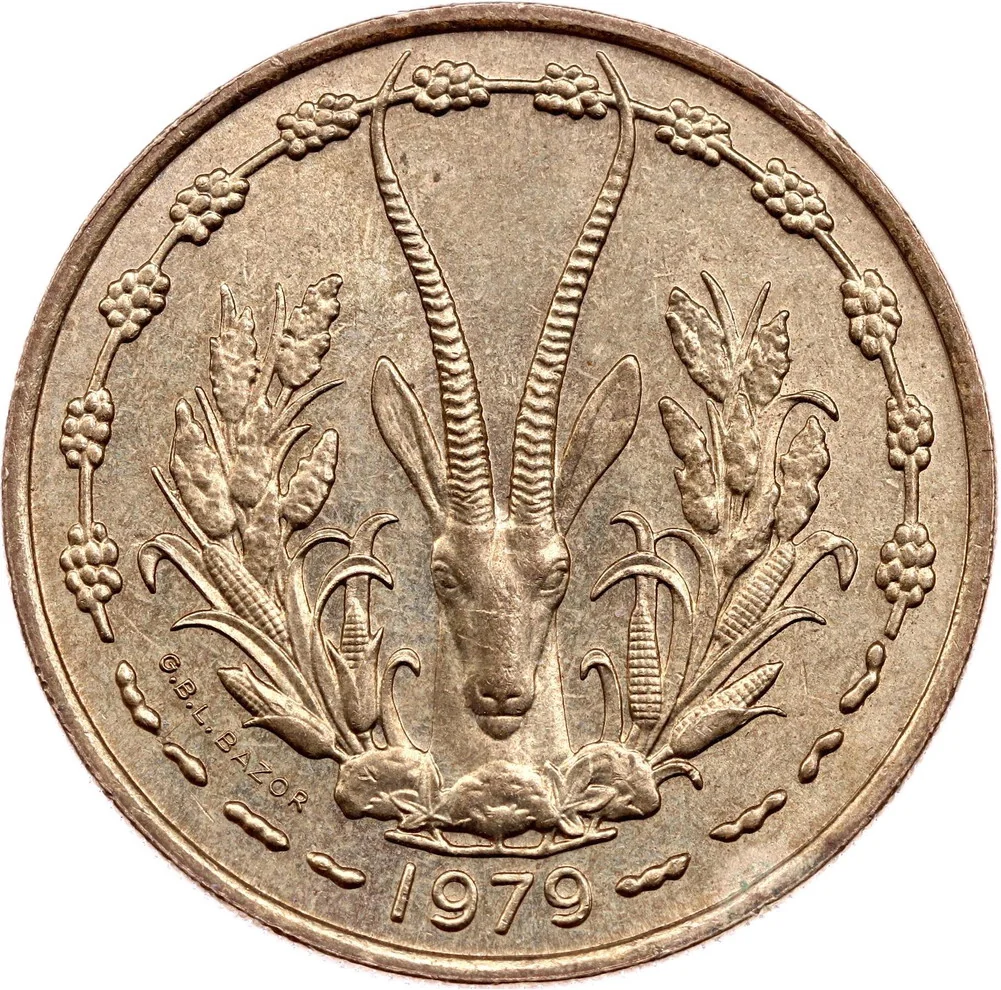
Description:
Swift antelope
Inscription:
G.B.L. BAZOR
1976
1976
Script: Latin
Engravers: Gabriel Bernard, Lucien Bazor
Edge
Reeded
Mints
| Name | Mark |
|---|---|
| Monnaie de Paris | — |
Mintings
| Year | Mint Mark | Mintage | Quality | Collection |
|---|---|---|---|---|
| 1970 | — | 7,000,000 | ||
| 1971 | — | 7,003,200 | ||
| 1972 | — | 2,001,600 | ||
| 1975 | — | 5,035,200 | ||
| 1976 | — | 6,244,800 | ||
| 1978 | — | 6,796,800 | ||
| 1979 | — | 5,203,200 |
Historical background
In 1970, the currency landscape of West Africa was predominantly shaped by the legacy of French colonial rule and the early years of post-independence monetary cooperation. The core of the region's system was the CFA franc, shared by two distinct monetary unions: the West African Monetary Union (UMOA) and the Central African Monetary Union (UMAC). The CFA franc, which stood for Communauté Financière Africaine, was pegged at a fixed rate to the French franc (50 CFA francs = 1 French franc) and was fully convertible, with its reserves guaranteed by the French Treasury. This arrangement provided monetary stability and facilitated trade with France, but it also meant that member states ceded significant control over their monetary policy to a board with strong French influence.
For the seven UMOA members in 1970—Ivory Coast, Dahomey (now Benin), Upper Volta (now Burkina Faso), Niger, Senegal, Togo, and Mali (which had rejoined in 1967 after a brief exit)—the system offered advantages of a common, stable currency across borders. However, it also drew criticism for potentially limiting economic sovereignty and tailoring the zone's economy to French interests. Meanwhile, other major West African states like Nigeria, Ghana, and the anglophone nations maintained their own independent currencies, such as the Nigerian pound (soon to be replaced by the naira in 1973), creating a fragmented monetary map in the region.
Thus, the year 1970 represents a period of entrenched post-colonial monetary structures. The CFA franc zone was stable but controversial, embodying a continued close economic linkage to the former colonial power. This stood in contrast to the more nationally oriented currencies of the larger anglophone economies, setting the stage for future debates about regional integration, monetary sovereignty, and economic development paths that would persist for decades.
For the seven UMOA members in 1970—Ivory Coast, Dahomey (now Benin), Upper Volta (now Burkina Faso), Niger, Senegal, Togo, and Mali (which had rejoined in 1967 after a brief exit)—the system offered advantages of a common, stable currency across borders. However, it also drew criticism for potentially limiting economic sovereignty and tailoring the zone's economy to French interests. Meanwhile, other major West African states like Nigeria, Ghana, and the anglophone nations maintained their own independent currencies, such as the Nigerian pound (soon to be replaced by the naira in 1973), creating a fragmented monetary map in the region.
Thus, the year 1970 represents a period of entrenched post-colonial monetary structures. The CFA franc zone was stable but controversial, embodying a continued close economic linkage to the former colonial power. This stood in contrast to the more nationally oriented currencies of the larger anglophone economies, setting the stage for future debates about regional integration, monetary sovereignty, and economic development paths that would persist for decades.
🌱 Very Common