

1 franc cfa – Western African States
Add to wishlist
Context
Years: 1976–2011
Issuer: Western African States
Issuing organization: Central Bank of Western African States
Currency:
(since 1958)
Total mintage: 151,477,000
Material
References
KM: #
Numista: #2629
Value
Exchange value: 1 XOF
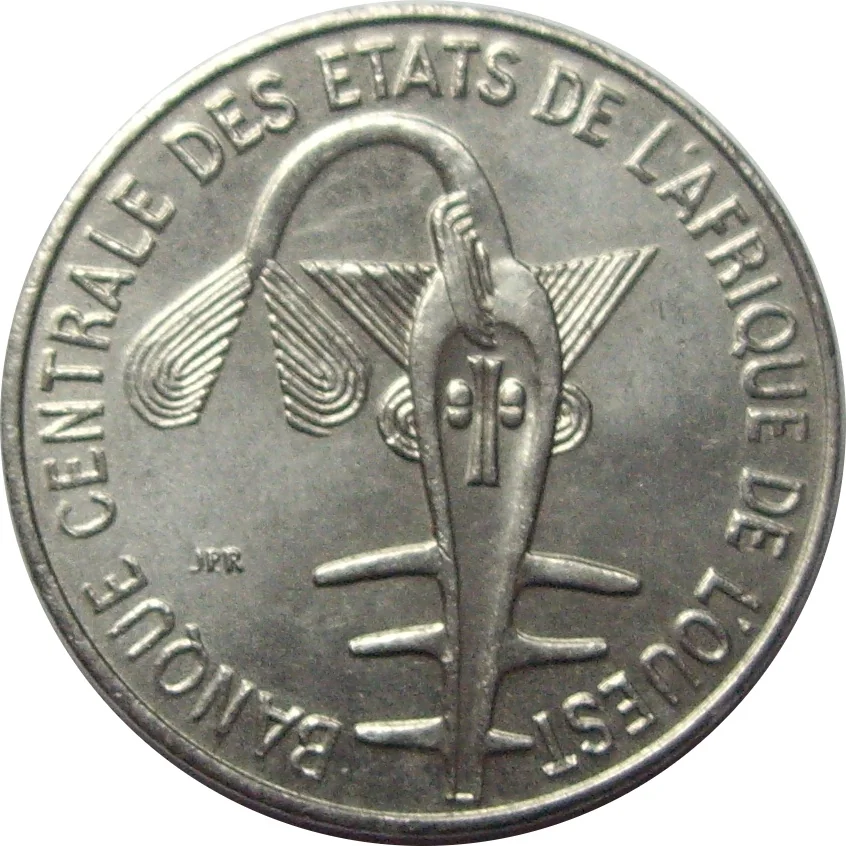
Obverse
Description:
Central Bank of West African States emblem
Inscription:
BANQUE CENTRALE DES ETATS DE L'AFRIQUE DE L'OUEST
JPR
JPR
Translation:
CENTRAL BANK OF THE WEST AFRICAN STATES
Script: Latin
Language: French
Engraver: Jean-Pierre Réthoré
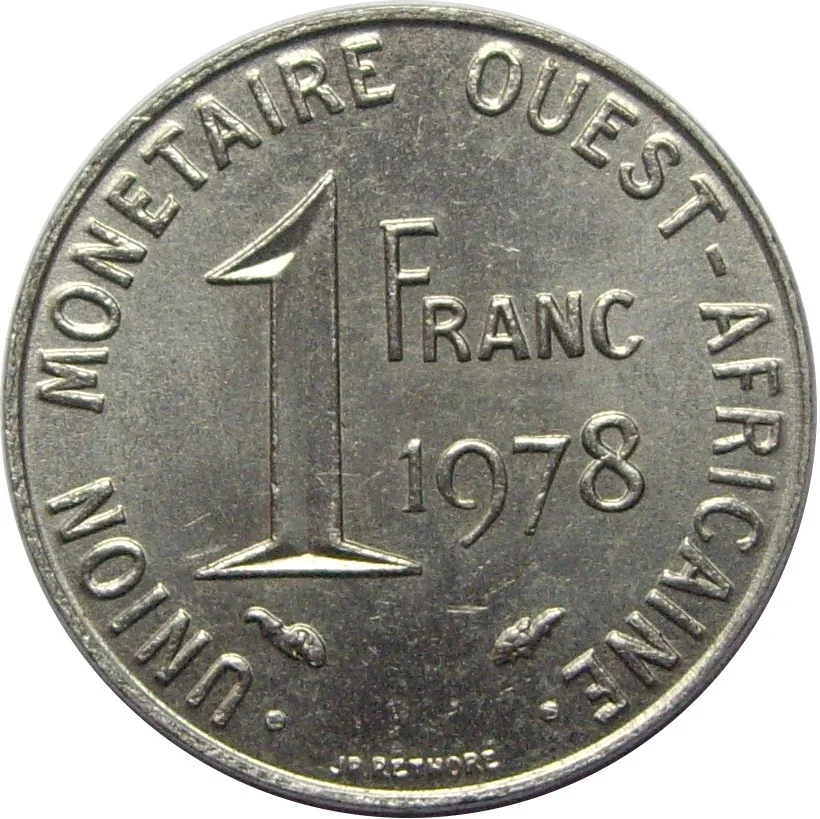
Reverse
Description:
Denomination and date.
Inscription:
1 FRANC
UNION MONETAIRE OUEST-AFRICAINE
1978
JP. RĒTHORĒ
UNION MONETAIRE OUEST-AFRICAINE
1978
JP. RĒTHORĒ
Translation:
1 FRANC
WEST AFRICAN MONETARY UNION
1978
JP. RĒTHORĒ
WEST AFRICAN MONETARY UNION
1978
JP. RĒTHORĒ
Script: Latin
Language: French
Engraver: Jean-Pierre Réthoré
Edge
Plain
Mints
| Name | Mark |
|---|---|
| Monnaie de Paris | — |
Mintings
| Year | Mint Mark | Mintage | Quality | Collection |
|---|---|---|---|---|
| 1976 | — | 8,000,000 | ||
| 1977 | — | 15,700,000 | ||
| 1978 | — | 21,840,000 | ||
| 1979 | — | 16,560,000 | ||
| 1980 | — | 13,000,000 | ||
| 1981 | — | 2,000,000 | ||
| 1982 | — | 6,000,000 | ||
| 1984 | — | 33,400,000 | ||
| 1990 | — | 10,000,000 | ||
| 1991 | — | 3,477,000 | ||
| 1992 | — | 6,000,000 | ||
| 1995 | — | 3,000,000 | ||
| 1996 | — | 3,000,000 | ||
| 1997 | — | 1,500,000 | ||
| 1999 | — | 4,000,000 | ||
| 2000 | — | 50,000 | ||
| 2001 | — | 2,350,000 | ||
| 2002 | — | 1,600,000 | ||
| 2011 | — | — |
Historical background
In 1976, the currency landscape of West Africa was defined by the continued dominance of the CFA franc, a colonial-era currency managed by France through two distinct monetary unions. The West African CFA franc (XOF), issued by the Banque Centrale des États de l'Afrique de l'Ouest (BCEAO), was the legal tender for seven member states: Ivory Coast, Dahomey (now Benin), Upper Volta (now Burkina Faso), Niger, Senegal, Togo, and Mali. Mali had rejoined the union in 1967 after a brief period of independence with its own Malian franc. A separate, but structurally identical, Central African CFA franc (XAF) circulated in Equatorial Africa. This system guaranteed convertibility at a fixed parity with the French franc and required members to deposit a significant portion of their foreign reserves with the French Treasury, ensuring stability but ceding substantial monetary sovereignty.
This arrangement existed alongside several independent national currencies in the region. Most notably, the naira had been introduced by Nigeria in 1973, replacing the pound. As Africa's most populous country and a growing oil power, Nigeria's decision to have its own currency was a statement of economic independence and a reflection of its different fiscal priorities, particularly increased public spending. Other non-CFA states included Liberia, which used the US dollar-linked Liberian dollar, and Ghana, which struggled with its heavily devalued cedi amidst political instability and economic turmoil, highlighting the contrasting monetary experiences within the region.
The year 1976 fell within a period of relative stability for the CFA zone, benefiting from the fixed exchange rate and low inflation compared to its non-CFA neighbors. However, this stability came with ongoing debates about the system's neo-colonial nature and its constraints on independent economic policy, especially the inability to devalue to boost competitiveness. Meanwhile, Nigeria's oil boom was beginning to reshape regional economic dynamics, creating a gravitational pull that would later challenge the CFA franc's dominance in cross-border trade. Thus, the currency situation presented a clear dichotomy: a French-anchored, externally guaranteed stability in the CFA franc zone versus the volatile but sovereign monetary policies of the larger independent states.
This arrangement existed alongside several independent national currencies in the region. Most notably, the naira had been introduced by Nigeria in 1973, replacing the pound. As Africa's most populous country and a growing oil power, Nigeria's decision to have its own currency was a statement of economic independence and a reflection of its different fiscal priorities, particularly increased public spending. Other non-CFA states included Liberia, which used the US dollar-linked Liberian dollar, and Ghana, which struggled with its heavily devalued cedi amidst political instability and economic turmoil, highlighting the contrasting monetary experiences within the region.
The year 1976 fell within a period of relative stability for the CFA zone, benefiting from the fixed exchange rate and low inflation compared to its non-CFA neighbors. However, this stability came with ongoing debates about the system's neo-colonial nature and its constraints on independent economic policy, especially the inability to devalue to boost competitiveness. Meanwhile, Nigeria's oil boom was beginning to reshape regional economic dynamics, creating a gravitational pull that would later challenge the CFA franc's dominance in cross-border trade. Thus, the currency situation presented a clear dichotomy: a French-anchored, externally guaranteed stability in the CFA franc zone versus the volatile but sovereign monetary policies of the larger independent states.
🌱 Very Common