

½ Rupia – Portuguese India
India
Context
Year: 1936
Country: India 
Issuer: Portuguese India
Period:
(1910—1961)
Currency:
(1880—1958)
Subdivision: ½ Rupia = 8 Tangas
Demonetization: 1948
Total mintage: 100,000
Material
References
KM: #Click to copy to clipboard23
Numista: #32126
Value
Bullion value: $15.56
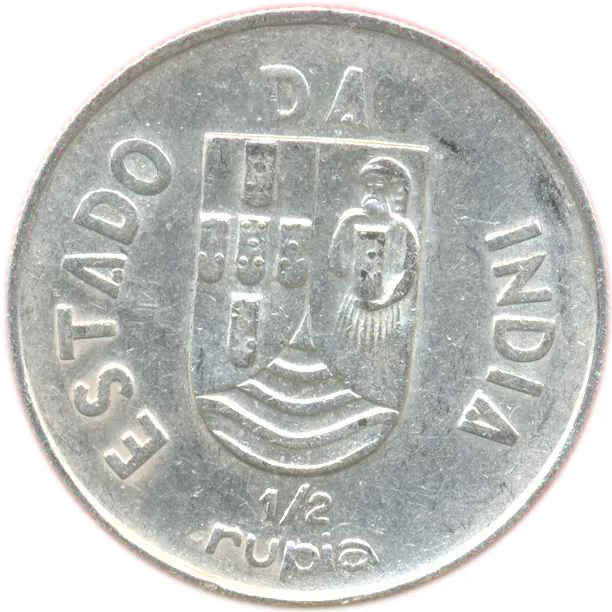
Obverse
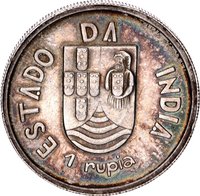
Description:
Split shield
Inscription:
ESTADO DA INDIA
½ Rupia
½ Rupia
Translation:
State of India
½ Rupee
½ Rupee
Script: Latin
Language: Portuguese
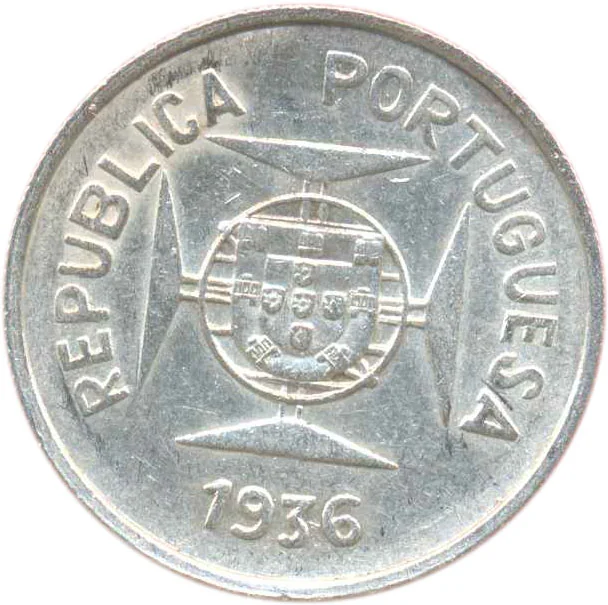
Reverse
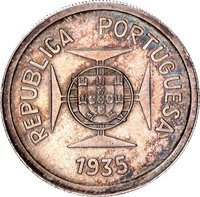
Description:
Shield centered on a Maltese Cross.
Inscription:
REPUBLICA PORTUGUESA
1936
1936
Translation:
Portuguese Republic
1936
1936
Script: Latin
Language: Portuguese
Edge
Reeded
Mints
| Name | Mark |
|---|---|
| Imprensa Nacional - Casa da Moeda | — |
Mintings
| Year | Mint Mark | Mintage | Quality | Collection |
|---|---|---|---|---|
| 1936 | — | 100,000 |
Historical background
In 1936, the currency situation in Portuguese India (Goa, Daman, and Diu) was a complex reflection of its dual identity as a Portuguese overseas province deeply integrated into the Indian economic sphere. The official currency was the Portuguese Indian rupia (INR), which was pegged at a fixed parity of 1 rupia to 1 British Indian rupee. This formal link was established by a 1881 monetary agreement and was crucial for facilitating the extensive trade and daily cross-border economic activity with British India, which surrounded the enclaves. The rupia was subdivided into 16 tangas or 960 reis, maintaining a distinct Portuguese colonial nomenclature.
However, the practical reality was one of significant monetary coexistence. While the Portuguese Indian rupia was legal tender, British Indian rupees circulated freely and were widely accepted, often interchangeably, throughout the territory. This de facto dual circulation was essential for commerce, as the vast majority of Portuguese India's trade was with the Indian subcontinent, not with metropolitan Portugal. The system functioned without major conflict, as the fixed parity eliminated exchange rate risk for merchants and the population.
This stable but hybrid system existed under the authority of the Banco Nacional Ultramarino (BNU), which held the exclusive right of note issue for Portuguese India from 1883. In 1936, the territory was thus insulated from the economic turbulence affecting Portugal's escudo, as its currency was effectively anchored to the British Indian rupee. The situation underscored a key administrative reality: while politically controlled by Lisbon, Portuguese India's economic lifeblood was inextricably tied to the monetary and commercial systems of British India.
However, the practical reality was one of significant monetary coexistence. While the Portuguese Indian rupia was legal tender, British Indian rupees circulated freely and were widely accepted, often interchangeably, throughout the territory. This de facto dual circulation was essential for commerce, as the vast majority of Portuguese India's trade was with the Indian subcontinent, not with metropolitan Portugal. The system functioned without major conflict, as the fixed parity eliminated exchange rate risk for merchants and the population.
This stable but hybrid system existed under the authority of the Banco Nacional Ultramarino (BNU), which held the exclusive right of note issue for Portuguese India from 1883. In 1936, the territory was thus insulated from the economic turbulence affecting Portugal's escudo, as its currency was effectively anchored to the British Indian rupee. The situation underscored a key administrative reality: while politically controlled by Lisbon, Portuguese India's economic lifeblood was inextricably tied to the monetary and commercial systems of British India.
🌱 Fairly Common