

10 sengis – Republic of the Congo
Add to wishlist
Context
Year: 1967
Issuer: Republic of the Congo
Issuing organization: National Bank of the Congo
Period:
(1964—1971)
Currency:
(1967—1993)
Demonetized: Yes
Total mintage: 25
Material
References
KM: #
Numista: #3536
Value
Exchange value: 0.001 ZRZ
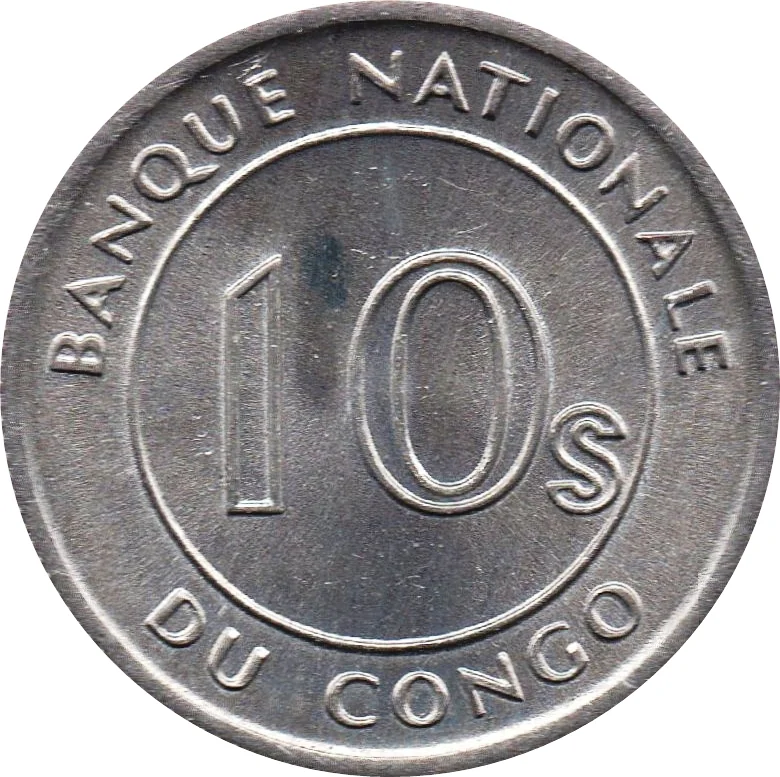
Obverse
Description:
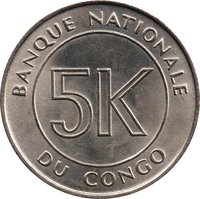
Denomination center, issuer name around.
Inscription:
BANQUE NATIONALE
10S
DU CONGO
10S
DU CONGO
Translation:
National Bank of the Congo
10 S
10 S
Script: Latin
Language: French
Engraver: Michael Rizzello
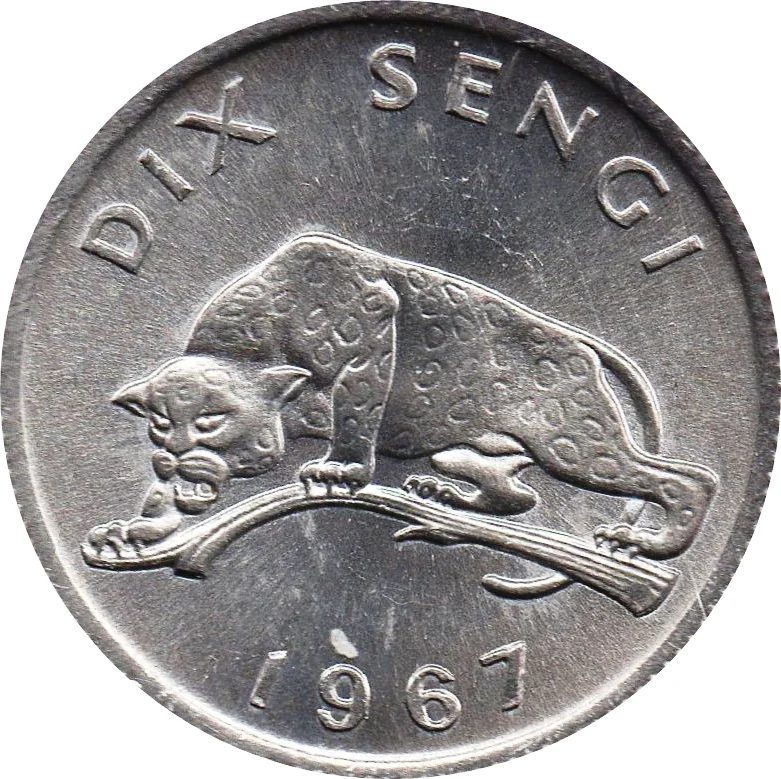
Reverse
Description:
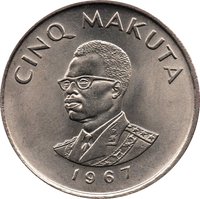
Leopard on branch, date beneath.
Inscription:
DIX SENGI
1967
1967
Translation:
Ten Sengi
Script: Latin
Engraver: Michael Rizzello
Edge
Reeded
Mints
| Name | Mark |
|---|---|
| Heaton and Sons / The Mint Birmingham | — |
Mintings
| Year | Mint Mark | Mintage | Quality | Collection |
|---|---|---|---|---|
| 1967 | — | 25 |
Historical background
In 1967, the Republic of the Congo (often called Congo-Brazzaville to distinguish it from its larger neighbor, the Democratic Republic of the Congo) was navigating its early post-independence economic landscape under the left-leaning, Marxist-Leninist government of President Alphonse Massamba-Débat. The country's currency situation was directly tied to its membership in the Franc Zone, a monetary union anchored by France. As such, the official currency remained the CFA franc (specifically the Franc de la Coopération Financière en Afrique Centrale), which was issued by the Bank of Central African States (BEAC), a multinational central bank established that very year.
The creation of the BEAC in 1967 was a pivotal event, formalizing a shared monetary system among five member states: Congo, Cameroon, Central African Republic, Chad, and Gabon. This new franc, guaranteed by the French Treasury and pegged to the French franc at a fixed rate (CFA 50 = 1 French franc), provided monetary stability and facilitated trade with France. For the Congolese government, this arrangement meant relinquishing direct control over national monetary policy but gained the benefits of low inflation, convertibility, and financial support, which were crucial for a developing economy reliant on timber and nascent oil exports.
However, this currency regime also reflected and reinforced continued economic dependence on the former colonial power. While it provided stability, it limited Congo's ability to use currency devaluation as a tool to boost competitiveness or to finance state-led development projects through monetary expansion—a potential point of tension for a government officially pursuing a socialist path. Thus, in 1967, the currency situation was one of institutionalized stability within a Francophone framework, representing both a pragmatic choice for economic order and a symbol of enduring post-colonial ties.
The creation of the BEAC in 1967 was a pivotal event, formalizing a shared monetary system among five member states: Congo, Cameroon, Central African Republic, Chad, and Gabon. This new franc, guaranteed by the French Treasury and pegged to the French franc at a fixed rate (CFA 50 = 1 French franc), provided monetary stability and facilitated trade with France. For the Congolese government, this arrangement meant relinquishing direct control over national monetary policy but gained the benefits of low inflation, convertibility, and financial support, which were crucial for a developing economy reliant on timber and nascent oil exports.
However, this currency regime also reflected and reinforced continued economic dependence on the former colonial power. While it provided stability, it limited Congo's ability to use currency devaluation as a tool to boost competitiveness or to finance state-led development projects through monetary expansion—a potential point of tension for a government officially pursuing a socialist path. Thus, in 1967, the currency situation was one of institutionalized stability within a Francophone framework, representing both a pragmatic choice for economic order and a symbol of enduring post-colonial ties.
🌱 Very Common