Logo Title
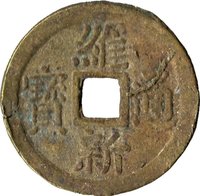
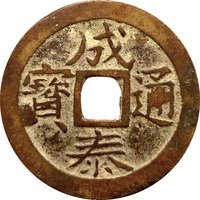
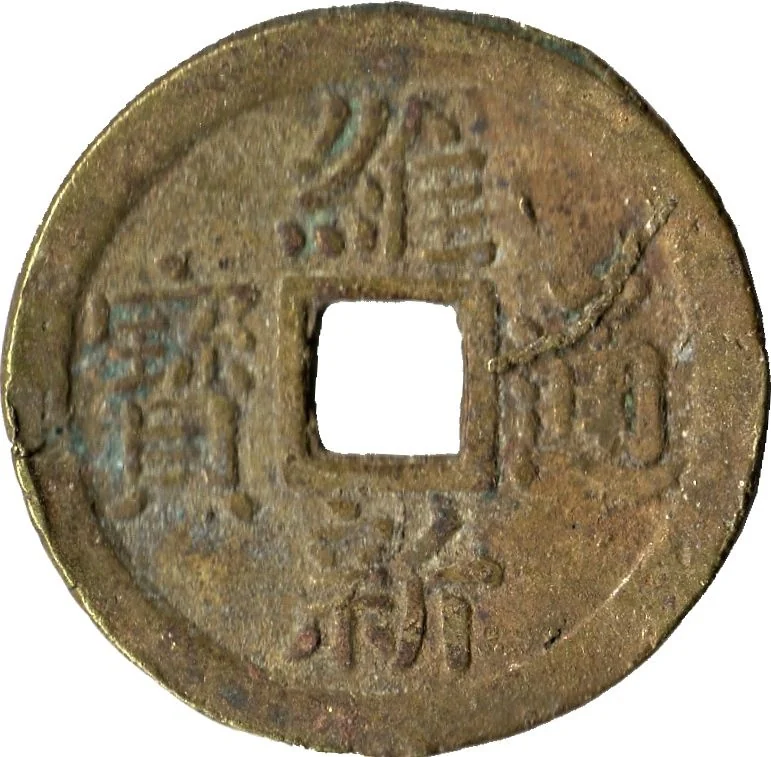
obverse
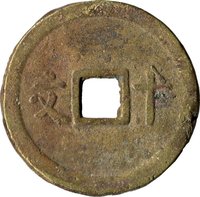
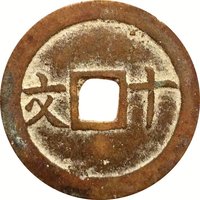
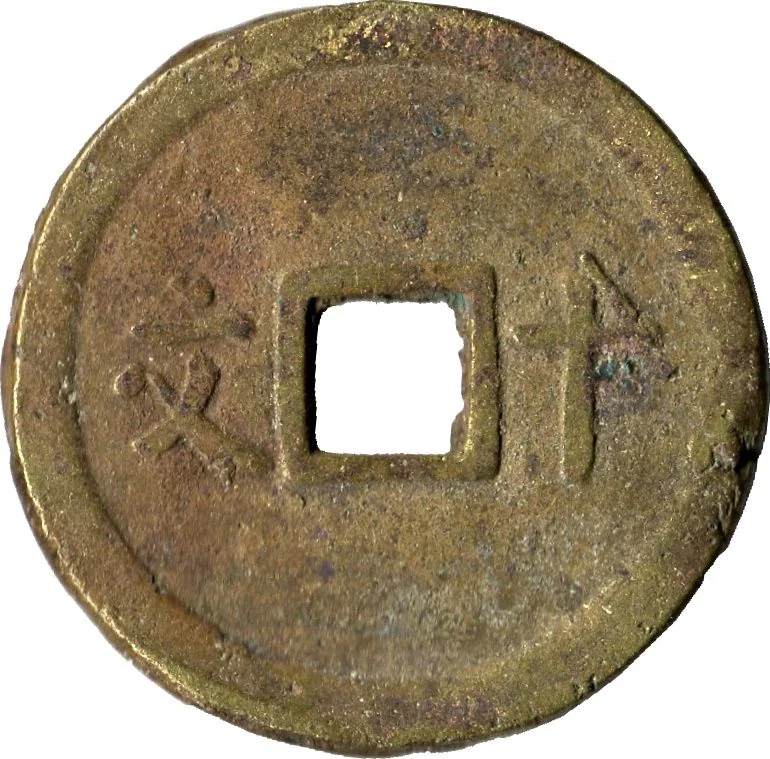
reverse
Numista CC BY

10 Cash – Empire of Vietnam

Vietnam
Context
Years: 1907–1916
Country: Vietnam Country flag
Ruler: Duy Tân
Demonetized: Yes
Material
Diameter: 26 mm
Weight: 3.89 g
Composition: Brass
Magnetic: No
Technique: Cast
Alignment: Medal alignment
Obverse
OBVERSE ↑
flip
Reverse
REVERSE ↑
References
KM: #Click to copy to clipboard652
Numista: #3185

Obverse

Description:
Four Chinese characters read vertically, right to left.
Inscription:


寶 通

 新
Translation:
Eternal Treasure
New Currency

Reverse

Description:
Left and right Chinese ideograms.
Inscription:
文十
Translation:
Wen Ten

Edge

Plain

Mintings

YearMint MarkMintageQualityCollection

Historical background

In 1907, the currency situation within the Empire of Vietnam was a complex reflection of its diminished sovereignty under French colonial rule. Officially, the Nguyễn Dynasty emperor still reigned in Huế, but real financial and monetary control lay with the government of French Indochina, established in 1887. The French had systematically moved to replace traditional Vietnamese coinage with a unified, colonial currency system. The primary unit was the French Indochinese piastre, a silver coin tied to the franc at a fixed rate, which facilitated trade and integration with the French imperial economy.

Despite the imposition of the piastre, the monetary landscape remained fragmented and transitional. In rural areas and daily local commerce, people continued to use older forms of currency, including zinc and copper-alloy cash coins (văn) produced by the Huế mint, as well as Chinese and Mexican silver dollars. This created a multi-tiered system where large transactions and government affairs were conducted in piastres, while smaller, everyday market purchases relied on the familiar, centuries-old cash coins. The French administration tolerated this duality but actively worked to phase out indigenous coinage to solidify economic control.

The year 1907 itself was one of particular political and economic tension. Following the anti-tax revolts of 1908, Emperor Thành Thái was forced by the French to abdicate in September, underscoring the complete subordination of the imperial court. Economically, the period was marked by efforts to standardize and modernize the currency, but also by inflation and hardship for peasants, who struggled with tax obligations fixed in piastres while their local income was often in depreciating copper cash. Thus, the currency situation was not merely a financial matter but a direct manifestation of colonial domination and the ongoing erosion of traditional Vietnamese economic structures.
🌟 Uncommon