

1 Cash – South Xinjiang
China
Context
Years: 1851–1853
Country: China 
Issuer: South Xinjiang
Ruler: Xianfeng
Currency:
(1759—1909)
Demonetized: Yes
Material
Diameter: 24 mm
Weight: 4.75 g
Shape: Round with a square hole
Composition: Copper
Magnetic: No
Technique: Cast
Alignment: Medal alignment

flip
References
Numista: #317885
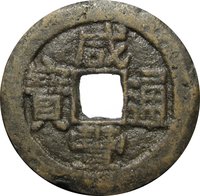
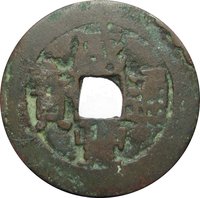
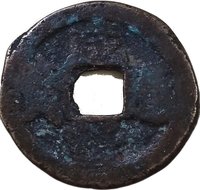
Obverse
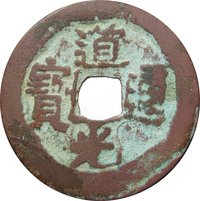
Description:
Four Chinese characters read vertically, right to left.
Inscription:
咸
寶 通
豐
寶 通
豐
Translation:
Xianfeng.
Tongbao.
Tongbao.
Scripts: Chinese (traditional, regular script)
Language: Chinese
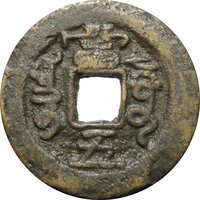
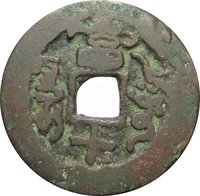
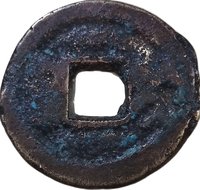
Reverse
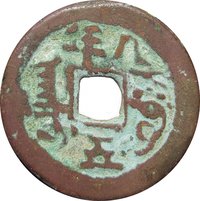
Description:
Two Manchu words flank the hole.
Inscription:
ᠪᠣᠣ ᡳ
Translation:
Boo i
Script: Mongolian / Manchu
Language: Manchu
Edge
Plain
Mintings
| Year | Mint Mark | Mintage | Quality | Collection |
|---|---|---|---|---|
| — | — | — |
Historical background
In 1851, the currency situation in South Xinjiang (the Tarim Basin region) was complex and fragmented, reflecting both its geographical position on the Silk Road and its political status within the Qing Empire. The primary circulating currency was the pūl (also called kahar or Yarkand pūl), a small, hand-stamped copper coin minted locally in Yarkand and Kashgar. This coinage was debased and of inconsistent weight and alloy, leading to chronic instability in everyday transactions. Alongside the pūl, silver played a crucial role, not as standardized coinage but in the form of silver ingots (yamboos) and foreign silver coins (like the Russian ruble or Indian rupee), which were used for larger trade and valued by weight and purity.
This monetary disorder was exacerbated by the region's isolated economy and the Qing's indirect rule through local begs. While the Qing state issued its own standardized copper cash (zhiqian) and silver sycee elsewhere, its administrative and monetary control in South Xinjiang was weak. The local currency system functioned largely autonomously, disconnected from the central monetary system, which created a vulnerable economy prone to inflation and counterfeiting. Furthermore, revenue collection for the Qing authorities was often conducted in kind (grain, cloth) or in silver, bypassing the problematic local coinage altogether.
The year 1851 itself was a point of relative calm before a storm, but the underlying currency chaos was a significant symptom of the region's integration challenges. It highlighted the logistical and administrative difficulties of governing a distant, ethnically diverse frontier. This fragile and fragmented monetary environment would soon be severely tested by the major upheavals of the Dungan Revolt (1862–1877), which would devastate the region and ultimately lead to the Qing reconquest and a more direct, but still challenging, effort to impose standardized currency after 1877.
This monetary disorder was exacerbated by the region's isolated economy and the Qing's indirect rule through local begs. While the Qing state issued its own standardized copper cash (zhiqian) and silver sycee elsewhere, its administrative and monetary control in South Xinjiang was weak. The local currency system functioned largely autonomously, disconnected from the central monetary system, which created a vulnerable economy prone to inflation and counterfeiting. Furthermore, revenue collection for the Qing authorities was often conducted in kind (grain, cloth) or in silver, bypassing the problematic local coinage altogether.
The year 1851 itself was a point of relative calm before a storm, but the underlying currency chaos was a significant symptom of the region's integration challenges. It highlighted the logistical and administrative difficulties of governing a distant, ethnically diverse frontier. This fragile and fragmented monetary environment would soon be severely tested by the major upheavals of the Dungan Revolt (1862–1877), which would devastate the region and ultimately lead to the Qing reconquest and a more direct, but still challenging, effort to impose standardized currency after 1877.

✨ Legendary