

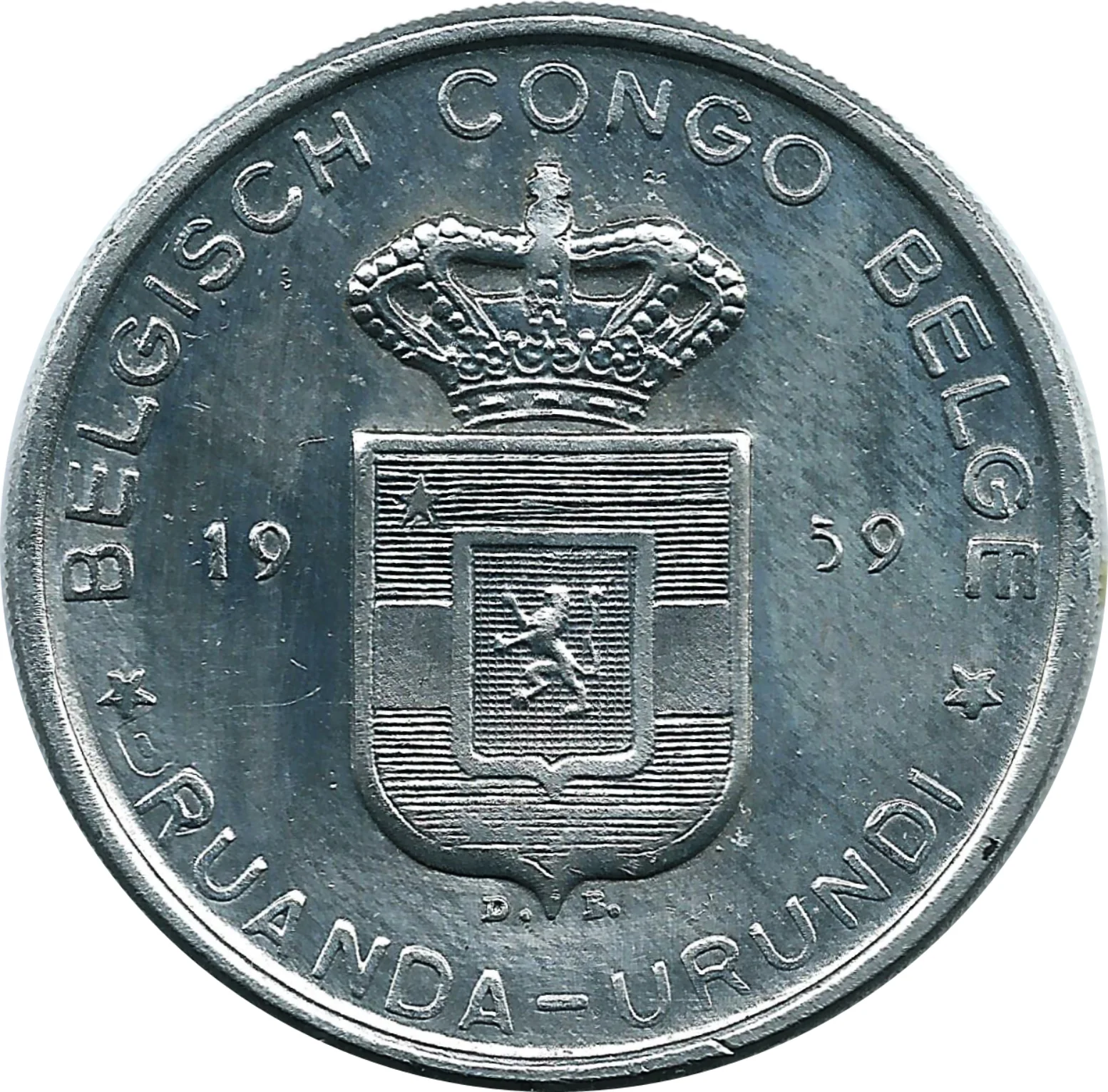
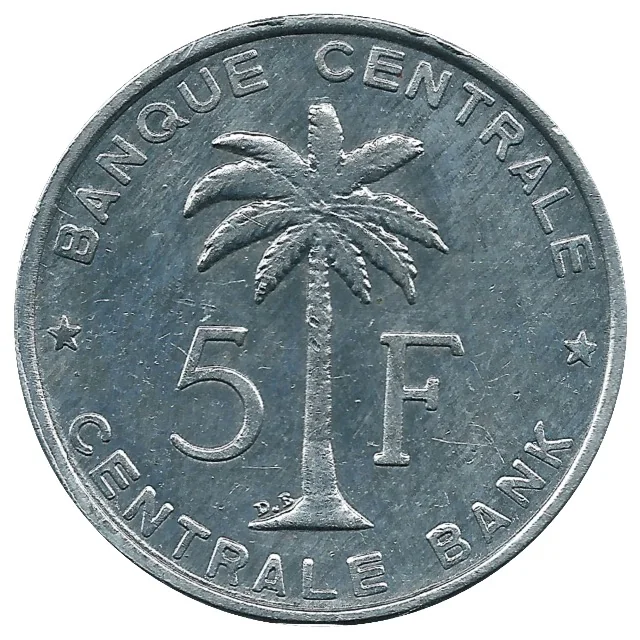
5 francs – Belgian Congo and Ruanda-Urundi
Add to wishlist
Context
Years: 1956–1959
Country: Rwanda and Urundi Belgian Congo
Issuer: Belgian Congo and Ruanda-Urundi
Issuing organization: Central Bank of Belgian Congo and Rwanda-Urundi
Currency:
(1908—1960)
Demonetized: Yes
Total mintage: 40,000,000
Material
References
KM: #
Numista: #3168
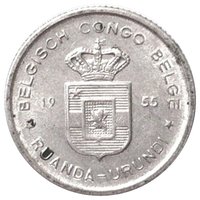
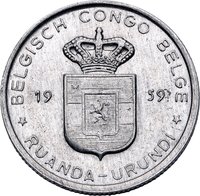
Obverse
Description:
Arms flank date.
Inscription:
BELGISCH CONGO BELGE
19 59
D. B.
RUANDA-URUNDI
19 59
D. B.
RUANDA-URUNDI
Translation:
Belgian Congo
19 59
D. B.
Ruanda-Urundi
19 59
D. B.
Ruanda-Urundi
Script: Latin
Engraver: Joseph De Bruyn
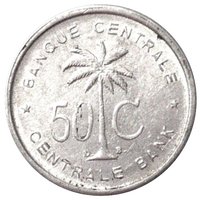
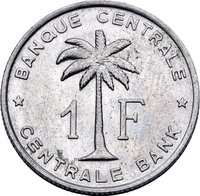
Reverse
Description:
Oil palm classification.
Inscription:
BANQUE CENTRALE
* 5 F *
D.B.
CENTRALE BANK
* 5 F *
D.B.
CENTRALE BANK
Translation:
Central Bank
* 5 F *
D.B.
Central Bank
* 5 F *
D.B.
Central Bank
Script: Latin
Engraver: Joseph De Bruyn
Edge
Reeded
Mints
| Name | Mark |
|---|---|
| Royal Mint of Belgium | — |
Mintings
| Year | Mint Mark | Mintage | Quality | Collection |
|---|---|---|---|---|
| 1956 | — | 10,000,000 | ||
| 1958 | — | 26,110,000 | ||
| 1959 | — | 3,890,000 |
Historical background
In 1956, the Belgian Congo and Ruanda-Urundi operated under a unified currency system anchored by the Congolese franc (CF), which was pegged to the Belgian franc at a 1:1 parity. This monetary union facilitated trade and administrative control for Belgium, with the Banque Centrale du Congo Belge et du Ruanda-Urundi in Léopoldville serving as the sole issuer of banknotes and coins for both territories. The system was inherently colonial, designed to integrate the economies tightly with that of Belgium, ensuring financial stability and the smooth repatriation of profits from the Congo's vast mineral and agricultural exports.
Economically, the mid-1950s was a period of prosperity, driven by a global boom in commodity prices, particularly for the Congo's copper, cobalt, and uranium. This resulted in significant budget surpluses for the colonial government and high levels of investment in infrastructure. However, this wealth was unevenly distributed, primarily benefiting European companies and settlers. In Ruanda-Urundi, a much poorer, densely populated, and agriculturally based mandate territory, the same currency facilitated administrative integration but did not generate comparable economic dynamism, highlighting the disparity within the monetary union.
Beneath this surface stability, the currency system faced underlying pressures. The economic boom fueled inflation and growing wage disparities, contributing to social tensions. Furthermore, the centralized monetary authority faced criticism from Belgian settlers and businesses who desired greater autonomy and credit flexibility. Most significantly, the entire financial structure was inextricably linked to continued Belgian political control. As nationalist movements began to gain momentum in the late 1950s, the future of this common currency area became uncertain, foreshadowing the monetary reorganisation that would follow the independence of the Congo in 1960 and Ruanda-Urundi in 1962.
Economically, the mid-1950s was a period of prosperity, driven by a global boom in commodity prices, particularly for the Congo's copper, cobalt, and uranium. This resulted in significant budget surpluses for the colonial government and high levels of investment in infrastructure. However, this wealth was unevenly distributed, primarily benefiting European companies and settlers. In Ruanda-Urundi, a much poorer, densely populated, and agriculturally based mandate territory, the same currency facilitated administrative integration but did not generate comparable economic dynamism, highlighting the disparity within the monetary union.
Beneath this surface stability, the currency system faced underlying pressures. The economic boom fueled inflation and growing wage disparities, contributing to social tensions. Furthermore, the centralized monetary authority faced criticism from Belgian settlers and businesses who desired greater autonomy and credit flexibility. Most significantly, the entire financial structure was inextricably linked to continued Belgian political control. As nationalist movements began to gain momentum in the late 1950s, the future of this common currency area became uncertain, foreshadowing the monetary reorganisation that would follow the independence of the Congo in 1960 and Ruanda-Urundi in 1962.
🌱 Very Common