

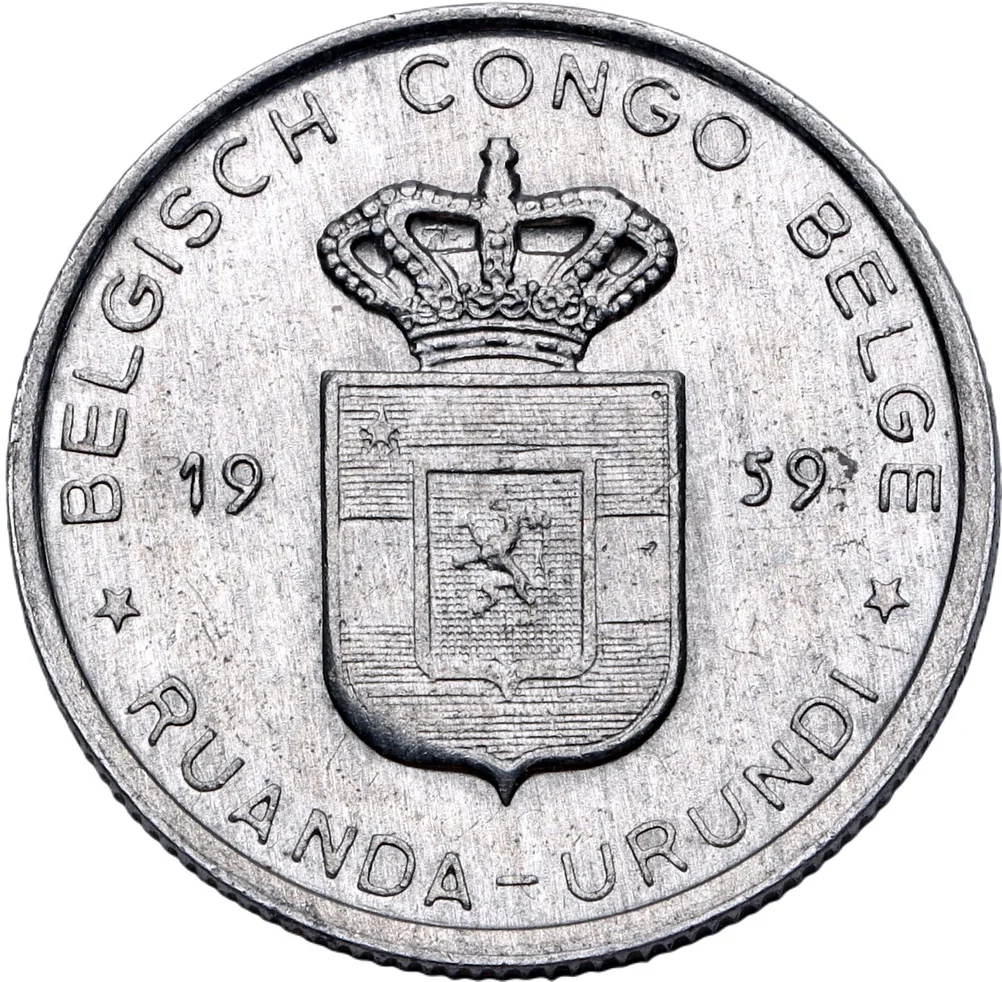
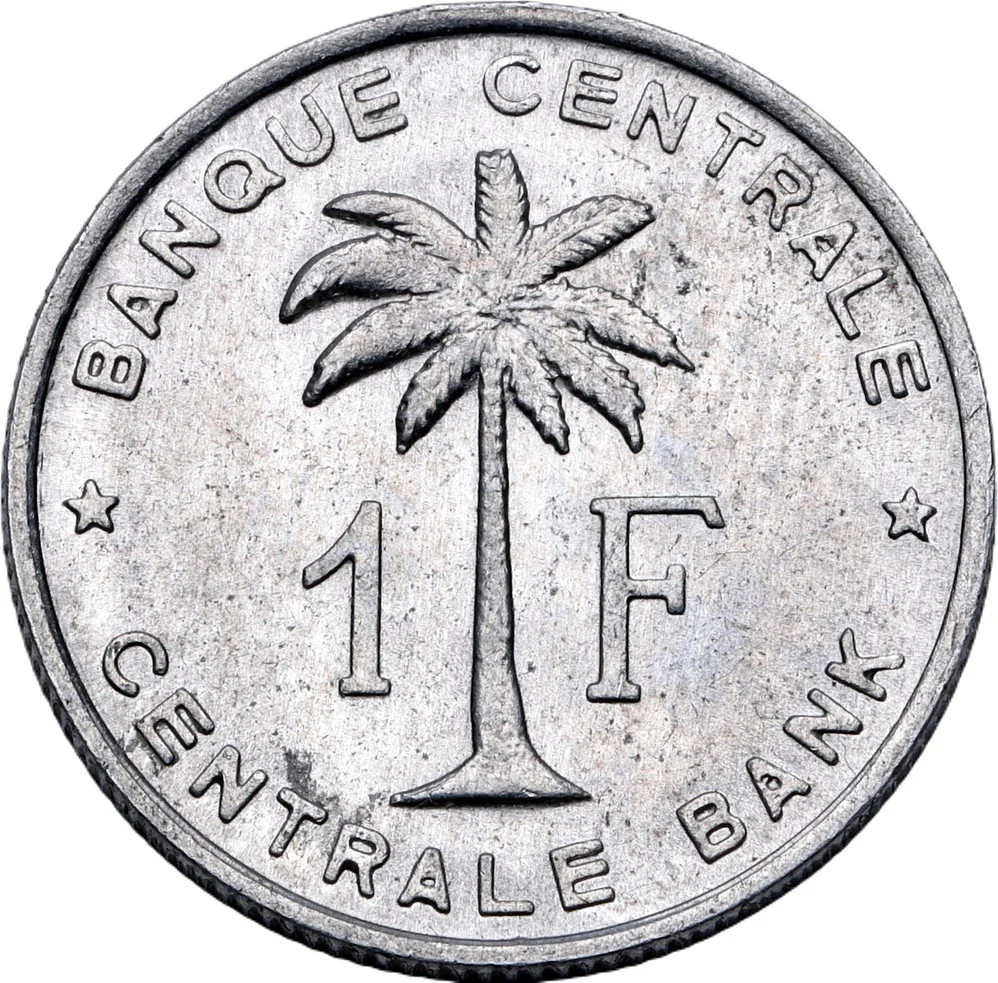
1 Franc – Belgian Congo and Ruanda-Urundi
Context
Years: 1957–1960
Country: Rwanda and Urundi Belgian Congo
Issuer: Belgian Congo and Ruanda-Urundi
Issuing organization: Central Bank of Belgian Congo and Rwanda-Urundi
Currency:
(1908—1960)
Demonetized: Yes
Total mintage: 70,002,000
Material
References
KM: #Click to copy to clipboard4
Numista: #6465
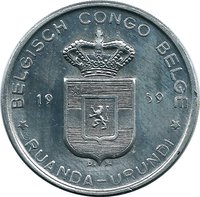
Obverse
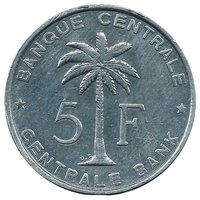
Reverse
Edge
Reeded
Mints
| Name | Mark |
|---|---|
| Royal Mint of Belgium | — |
Mintings
| Year | Mint Mark | Mintage | Quality | Collection |
|---|---|---|---|---|
| 1957 | — | 10,002,000 | ||
| 1958 | — | 20,000,000 | ||
| 1959 | — | 20,000,000 | ||
| 1960 | — | 20,000,000 |
Historical background
By 1957, the Belgian Congo and Ruanda-Urundi operated under a unified monetary system anchored by the Congolese franc (CF). This currency was managed by the Banque Centrale du Congo Belge et du Ruanda-Urundi, established in 1952, which succeeded a currency board. The system was designed to ensure stability and full convertibility with the Belgian franc at a fixed parity of 1.7 metropolitan francs to 1 Congolese franc. This link guaranteed the currency's value and facilitated the flow of capital and trade with Belgium, reflecting the territory's deep integration into the Belgian economic sphere.
The currency served the dual economies of the region: a thriving export sector driven by the Congo's vast mineral resources (copper, cobalt, uranium) and cash crops, and a much larger subsistence-based rural economy, particularly in Ruanda-Urundi. The stability of the franc was crucial for the profitable repatriation of earnings by Belgian corporations like the Union Minière du Haut-Katanga. However, this very stability and its management from Brussels meant monetary policy was tailored to the needs of the export sector and the metropole, with little regard for localized economic development or the needs of the indigenous population.
The situation in 1957, while outwardly stable, existed on the precipice of dramatic change. Political pressures for independence were mounting in the Congo, and the rigid currency system would soon face existential challenges. Within three years, the rush to independence would force a rapid reorganization of the monetary authority, leading to the creation of separate central banks and currencies for the soon-to-be-independent states, fundamentally ending the unified franc zone as it existed in 1957.
The currency served the dual economies of the region: a thriving export sector driven by the Congo's vast mineral resources (copper, cobalt, uranium) and cash crops, and a much larger subsistence-based rural economy, particularly in Ruanda-Urundi. The stability of the franc was crucial for the profitable repatriation of earnings by Belgian corporations like the Union Minière du Haut-Katanga. However, this very stability and its management from Brussels meant monetary policy was tailored to the needs of the export sector and the metropole, with little regard for localized economic development or the needs of the indigenous population.
The situation in 1957, while outwardly stable, existed on the precipice of dramatic change. Political pressures for independence were mounting in the Congo, and the rigid currency system would soon face existential challenges. Within three years, the rush to independence would force a rapid reorganization of the monetary authority, leading to the creation of separate central banks and currencies for the soon-to-be-independent states, fundamentally ending the unified franc zone as it existed in 1957.
🌱 Very Common