

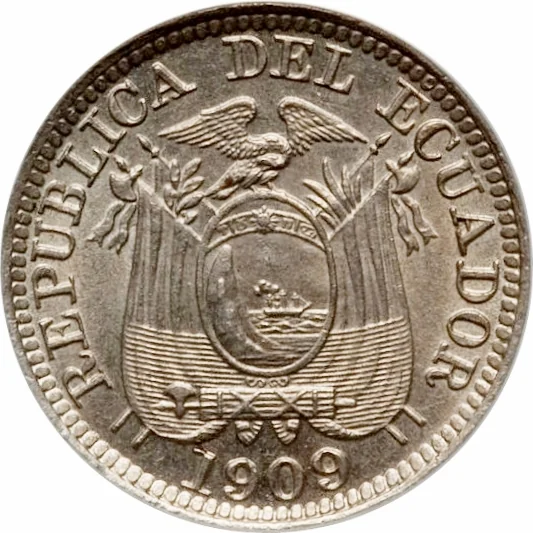
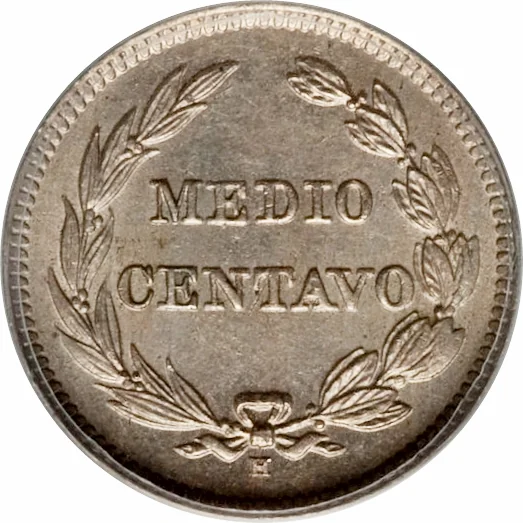
½ Centavo – Ecuador
Ecuador
Context
Material
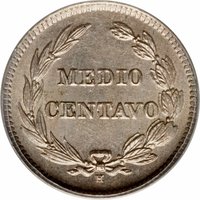
Diameter: 15 mm
Weight: 1.45 g
Thickness: 1.1 mm
Shape: Round
Composition: Copper-nickel
Technique: Milled
Alignment: Coin alignment
flip
References
KM: #Click to copy to clipboard57
Numista: #30970
Value
Exchange value: 0.005 ECS
Obverse
Reverse
Edge
Plain
Mints
| Name | Mark |
|---|---|
| Heaton and Sons / The Mint Birmingham | H |
Mintings
| Year | Mint Mark | Mintage | Quality | Collection |
|---|---|---|---|---|
| 1909 | H | 4,000,000 |
Historical background
In 1909, Ecuador’s currency situation was characterized by profound instability and fragmentation, a legacy of the late 19th century. The country had no unified national currency; instead, a chaotic mix of foreign and domestic coins circulated. The most common were the silver sucre (established as the monetary unit in 1884) and the gold condor, but their value fluctuated wildly. Crucially, the sucre was on a de facto silver standard, while much of international trade was conducted on a gold standard. This mismatch, combined with a global decline in the price of silver, caused the sucre's external value to depreciate significantly, creating chronic balance of payments problems and making foreign debt repayment extraordinarily expensive.
This monetary disorder was exacerbated by the government's fiscal weakness. To finance deficits, successive administrations had resorted to printing unbacked paper money, leading to inflation and a loss of public confidence. By 1909, banknotes issued by private banks (notably the Banco Comercial y Agrícola) and the government itself circulated at a steep discount to their face value. The result was a multi-tiered system where gold coins, silver sucres, and various paper issues all traded at different, fluctuating rates. This complexity hampered domestic commerce and discouraged foreign investment, as economic calculations were fraught with exchange risk.
The situation in 1909 was at a critical juncture, setting the stage for major reform. The Eloy Alfaro government, recognizing that monetary anarchy was a barrier to modernization and fiscal stability, was actively pursuing a fundamental overhaul. Just a few years later, in 1914, these efforts would culminate in the creation of the Central Bank of Ecuador, which was granted the sole right of note issue. The reforms of 1914 aimed to eliminate the chaotic multiplicity of currencies, establish a gold exchange standard, and provide much-needed stability, making 1909 a year marking the final chapter of Ecuador’s prolonged period of monetary chaos.
This monetary disorder was exacerbated by the government's fiscal weakness. To finance deficits, successive administrations had resorted to printing unbacked paper money, leading to inflation and a loss of public confidence. By 1909, banknotes issued by private banks (notably the Banco Comercial y Agrícola) and the government itself circulated at a steep discount to their face value. The result was a multi-tiered system where gold coins, silver sucres, and various paper issues all traded at different, fluctuating rates. This complexity hampered domestic commerce and discouraged foreign investment, as economic calculations were fraught with exchange risk.
The situation in 1909 was at a critical juncture, setting the stage for major reform. The Eloy Alfaro government, recognizing that monetary anarchy was a barrier to modernization and fiscal stability, was actively pursuing a fundamental overhaul. Just a few years later, in 1914, these efforts would culminate in the creation of the Central Bank of Ecuador, which was granted the sole right of note issue. The reforms of 1914 aimed to eliminate the chaotic multiplicity of currencies, establish a gold exchange standard, and provide much-needed stability, making 1909 a year marking the final chapter of Ecuador’s prolonged period of monetary chaos.
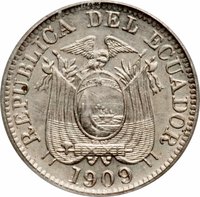
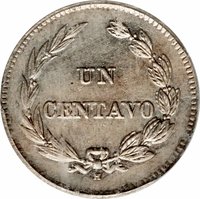
Series: 1909 Ecuador circulation coins
⭐ Somewhat Rare