

1 Real – Guatemala
Circulating commemorative coins
Commemoration: Proclamation of the Republic of Guatemala
Guatemala
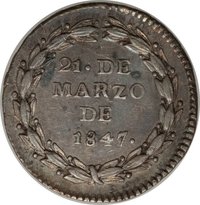
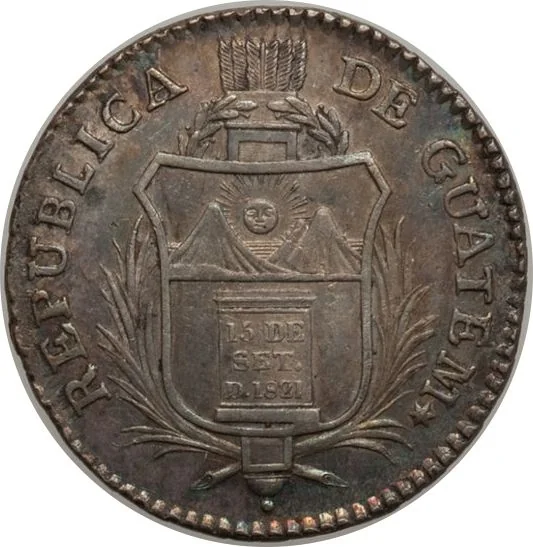
Obverse
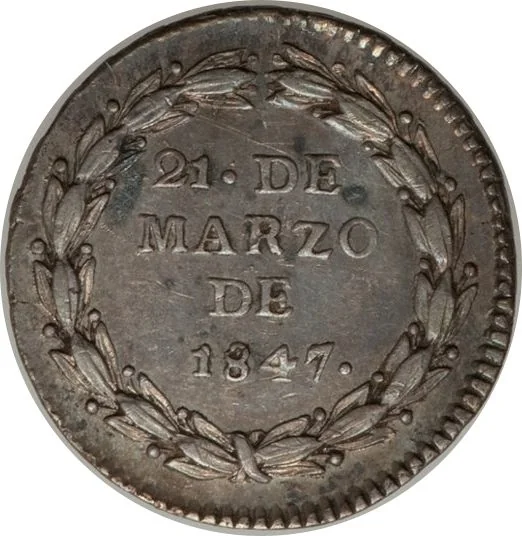
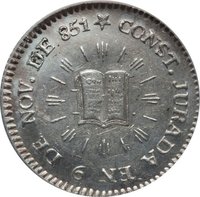
Reverse
Edge
Categories
| Symbols> Coat of Arms |
| Symbol> Wreath |
Mints
| Name | Mark |
|---|---|
| Casa de Moneda de Guatemala | — |
Mintings
| Year | Mint Mark | Mintage | Quality | Collection |
|---|---|---|---|---|
| 1847 | — | — |
Historical background
In 1847, Guatemala’s currency situation was a direct legacy of its recent independence and the collapse of the Central American Federation. Following independence from Spain in 1821, the region initially used the old Spanish colonial currency, primarily silver reales and gold escudos. However, the political fragmentation after the Federation dissolved in 1838-40 meant that Guatemala, now a sovereign republic under President Rafael Carrera, faced the challenge of establishing its own fiscal and monetary authority without a unified regional system. The economy was predominantly agricultural and relied heavily on the indigo and cochineal trades, with transactions often conducted in physical specie (coin), which was frequently in short supply.
The actual circulating medium was a chaotic mix of foreign and obsolete coins. Alongside clipped and worn Spanish colonial pieces, coins from other former Spanish colonies, particularly Peruvian and Mexican silver, circulated widely. Their value was not fixed by a central authority but was often determined by weight and purity in private transactions, leading to inconsistency and confusion. The government had not yet issued an official national currency, so this heterogeneous mix of silver and gold coins served as the de facto money supply, hindering commerce and state revenue collection.
Recognizing the need for monetary sovereignty and stability, the government of Rafael Carrera took a pivotal step in 1847. It authorized the establishment of the Casa de Moneda de Guatemala (the Guatemala Mint) and began planning for the issuance of a national coinage. This set the stage for the introduction, in later years, of Guatemala's first official currency, the peso, subdivided into 8 reales, which would finally provide a uniform standard. Thus, 1847 represents a transitional year, marked by the lingering disorder of a post-colonial currency system but also by the decisive political action that would soon lead to a modernized monetary regime.
The actual circulating medium was a chaotic mix of foreign and obsolete coins. Alongside clipped and worn Spanish colonial pieces, coins from other former Spanish colonies, particularly Peruvian and Mexican silver, circulated widely. Their value was not fixed by a central authority but was often determined by weight and purity in private transactions, leading to inconsistency and confusion. The government had not yet issued an official national currency, so this heterogeneous mix of silver and gold coins served as the de facto money supply, hindering commerce and state revenue collection.
Recognizing the need for monetary sovereignty and stability, the government of Rafael Carrera took a pivotal step in 1847. It authorized the establishment of the Casa de Moneda de Guatemala (the Guatemala Mint) and began planning for the issuance of a national coinage. This set the stage for the introduction, in later years, of Guatemala's first official currency, the peso, subdivided into 8 reales, which would finally provide a uniform standard. Thus, 1847 represents a transitional year, marked by the lingering disorder of a post-colonial currency system but also by the decisive political action that would soon lead to a modernized monetary regime.
✨ Legendary