

50 Cents – Canada
Canada
Context
Years: 1959–1964
Issuer: Canada 
Ruler: Elizabeth II
Currency:
(since 1858)
Total mintage: 33,103,426
Material
References
KM: #Click to copy to clipboard56
Numista: #308
Value
Exchange value: 0.50 CAD = $0.37
Bullion value: $27.03
Inflation-adjusted value: 5.34 CAD
Obverse
Description:
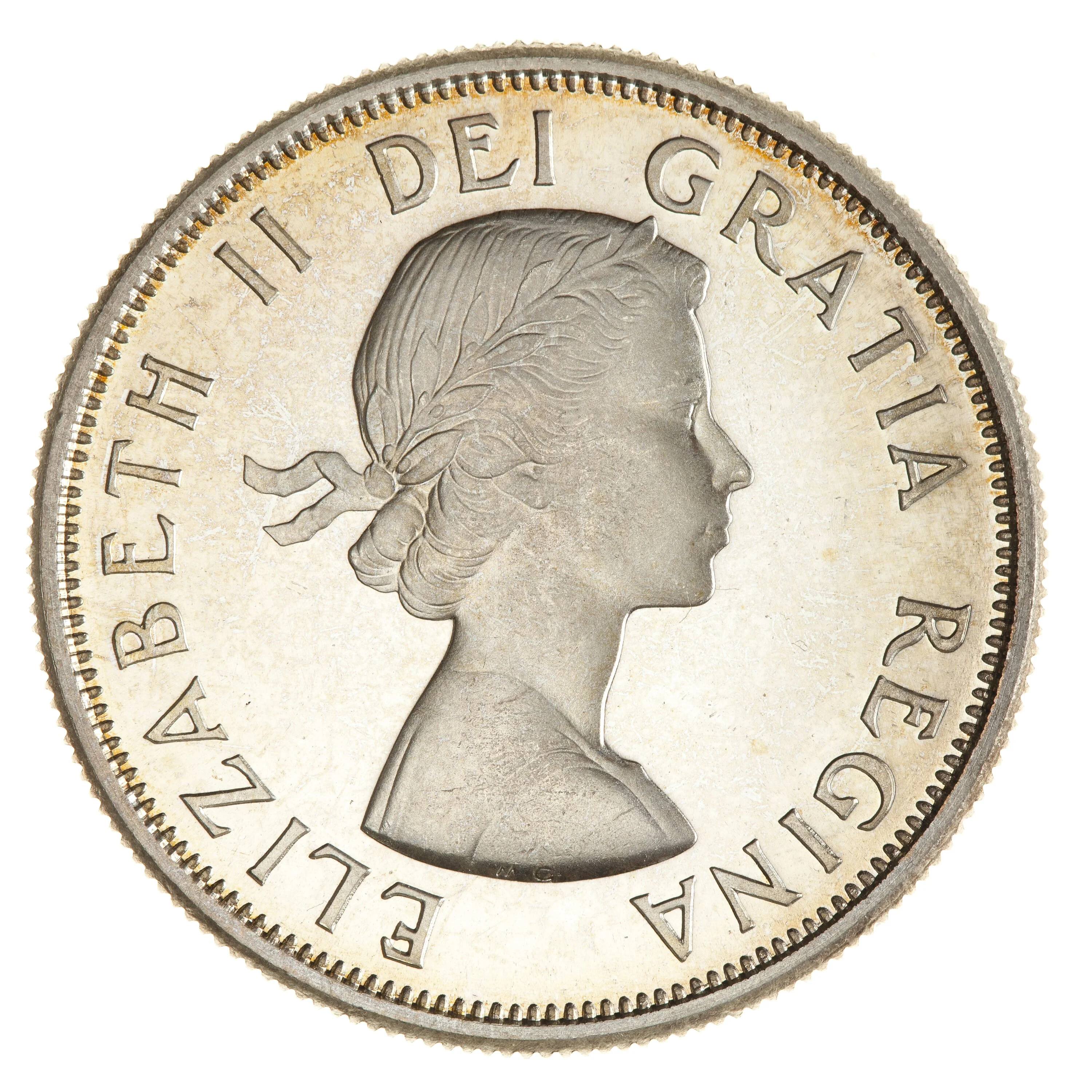
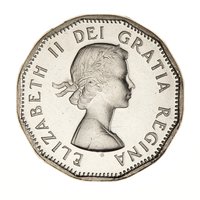
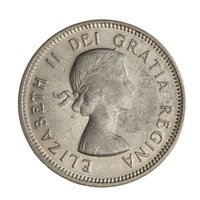
Bust of Queen Elizabeth II at age 27, wearing a wreath and facing right.
Inscription:
ELIZABETH II DEI GRATIA REGINA
Translation:
Elizabeth II by the Grace of God Queen
Script: Latin
Language: Latin
Designer: Mary Gillick
Reverse
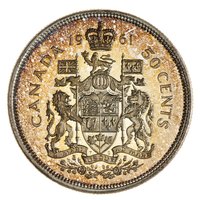
Description:
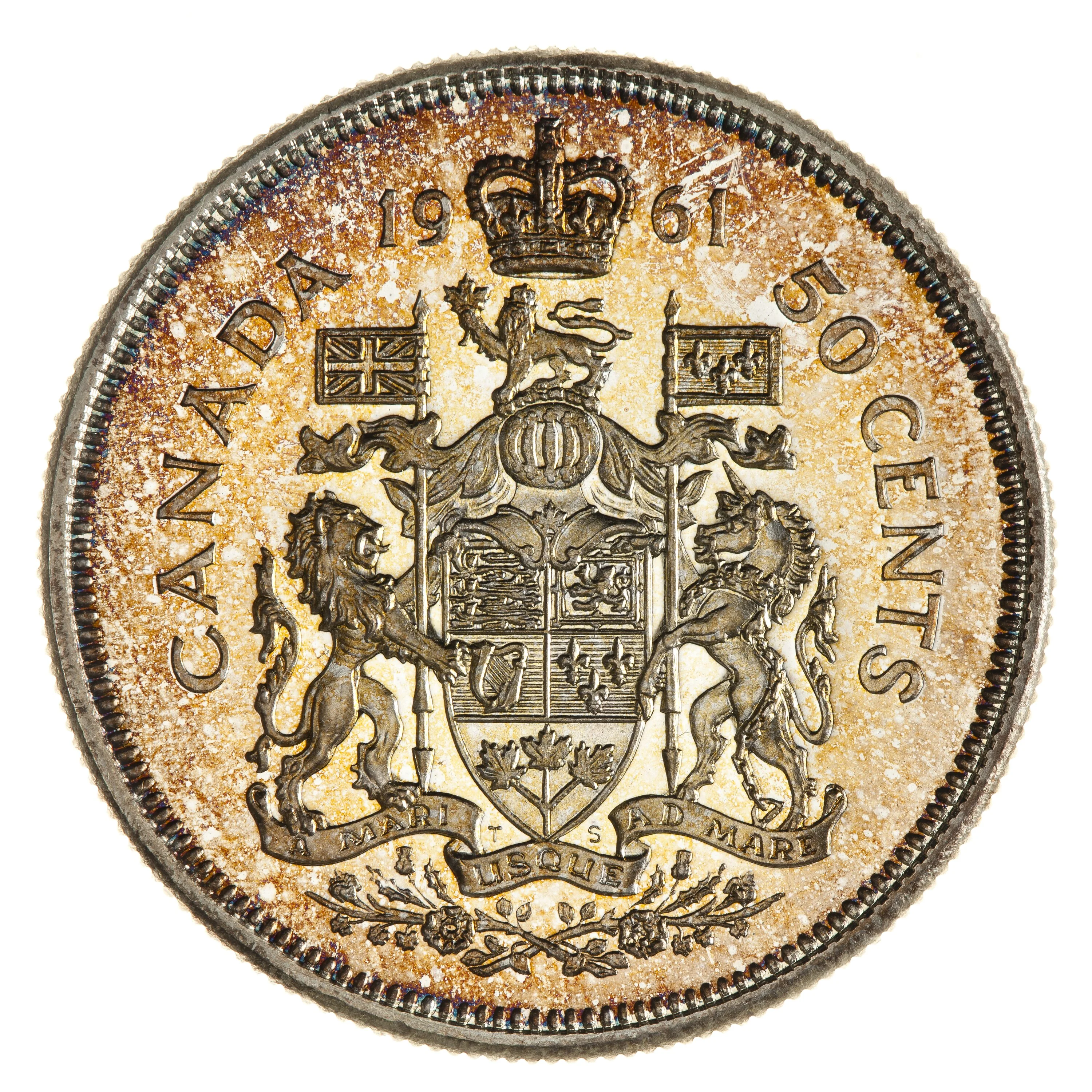
Crown divides the date above the Royal Arms of Canada, proclaimed in 1921 and updated in 1957, surrounded by the face value and "CANADA."
Inscription:
19 64
CANADA 50 CENTS
T S
CANADA 50 CENTS
T S
Script: Latin
Designer: Thomas Shingles
Edge
Reeded
Categories
| Symbols> Coat of Arms |
Mints
| Name | Mark |
|---|---|
| Royal Canadian Mint of Ottawa | — |
Mintings
| Year | Mint Mark | Mintage | Quality | Collection |
|---|---|---|---|---|
| 1959 | — | 3,095,535 | ||
| 1960 | — | 3,488,897 | ||
| 1961 | — | 3,584,417 | ||
| 1962 | — | 5,208,030 | ||
| 1963 | — | 8,348,871 | ||
| 1964 | — | 9,377,676 |
Historical background
In 1959, Canada's currency system was in a transitional phase, still anchored by the Bretton Woods system of fixed exchange rates. The Canadian dollar was pegged, but uniquely, it operated under a "floating peg" established in 1950. This meant its value was allowed to fluctuate within a range against the U.S. dollar, a significant deviation from the rigid parities of other major currencies. This flexibility was a deliberate policy choice, providing a buffer against volatile capital flows and giving the Bank of Canada greater control over domestic monetary policy to manage economic cycles.
Economically, the period was one of post-war prosperity, yet the currency faced persistent upward pressure. Strong foreign investment, particularly from the United States into Canada's resource and industrial sectors, drove demand for the Canadian dollar. This led to concerns about "Dutch disease"—where a high currency value could hurt manufacturing exports by making them more expensive abroad. The government and the Bank, under Governor James Coyne, were engaged in a delicate balancing act: maintaining confidence and low inflation without letting the dollar appreciate to a point that would damage export competitiveness.
This monetary environment was not without controversy. Governor Coyne pursued a notably tight monetary policy, emphasizing price stability and warning against consumer debt, which often put him at odds with the expansionary fiscal desires of the Diefenbaker government. The tensions of 1959 would culminate in the "Coyne Affair" of 1961, a major political crisis over central bank independence. Furthermore, the pressures on the fixed-but-floating system were mounting, foreshadowing its end. By 1962, Canada would abandon the floating peg and return to a fixed rate of US$0.925, a decision underscoring the challenges of managing sovereignty, trade, and capital flows in the mid-20th century.
Economically, the period was one of post-war prosperity, yet the currency faced persistent upward pressure. Strong foreign investment, particularly from the United States into Canada's resource and industrial sectors, drove demand for the Canadian dollar. This led to concerns about "Dutch disease"—where a high currency value could hurt manufacturing exports by making them more expensive abroad. The government and the Bank, under Governor James Coyne, were engaged in a delicate balancing act: maintaining confidence and low inflation without letting the dollar appreciate to a point that would damage export competitiveness.
This monetary environment was not without controversy. Governor Coyne pursued a notably tight monetary policy, emphasizing price stability and warning against consumer debt, which often put him at odds with the expansionary fiscal desires of the Diefenbaker government. The tensions of 1959 would culminate in the "Coyne Affair" of 1961, a major political crisis over central bank independence. Furthermore, the pressures on the fixed-but-floating system were mounting, foreshadowing its end. By 1962, Canada would abandon the floating peg and return to a fixed rate of US$0.925, a decision underscoring the challenges of managing sovereignty, trade, and capital flows in the mid-20th century.
🌱 Very Common