

5 Cents – Canada
Canada
Context
Years: 1955–1962
Issuer: Canada 
Ruler: Elizabeth II
Currency:
(since 1858)
Total mintage: 172,656,418
Material
Diameter: 21.23 mm
Weight: 4.54 g
Thickness: 1.7 mm
Shape: Dodecagonal
Composition: Nickel
Magnetic: Yes
Technique: Milled
Alignment: Medal alignment
flip
References
KM: #Click to copy to clipboard50a
Numista: #404
Value
Exchange value: 0.05 CAD = $0.04
Inflation-adjusted value: 0.57 CAD
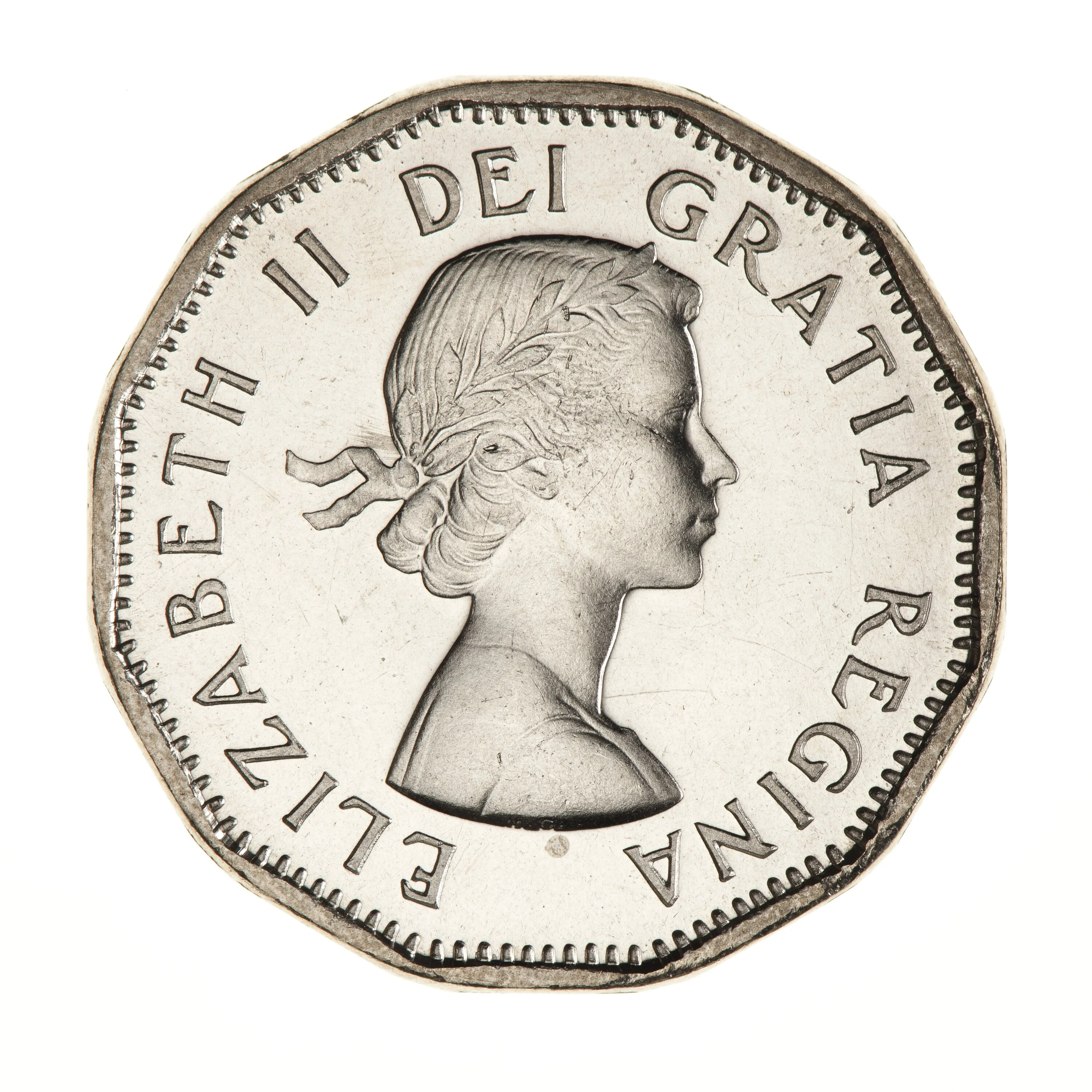
Obverse
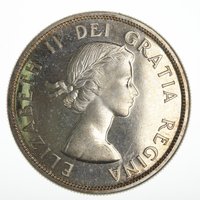
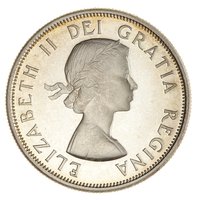
Description:
Bust of Queen Elizabeth II at age 27, wearing a wreath and facing right.
Inscription:
ELIZABETH II DEI GRATIA REGINA
M·G·
M·G·
Translation:
Elizabeth II by the Grace of God Queen
M·G·
M·G·
Script: Latin
Engraver: Thomas Shingles
Designer: Mary Gillick
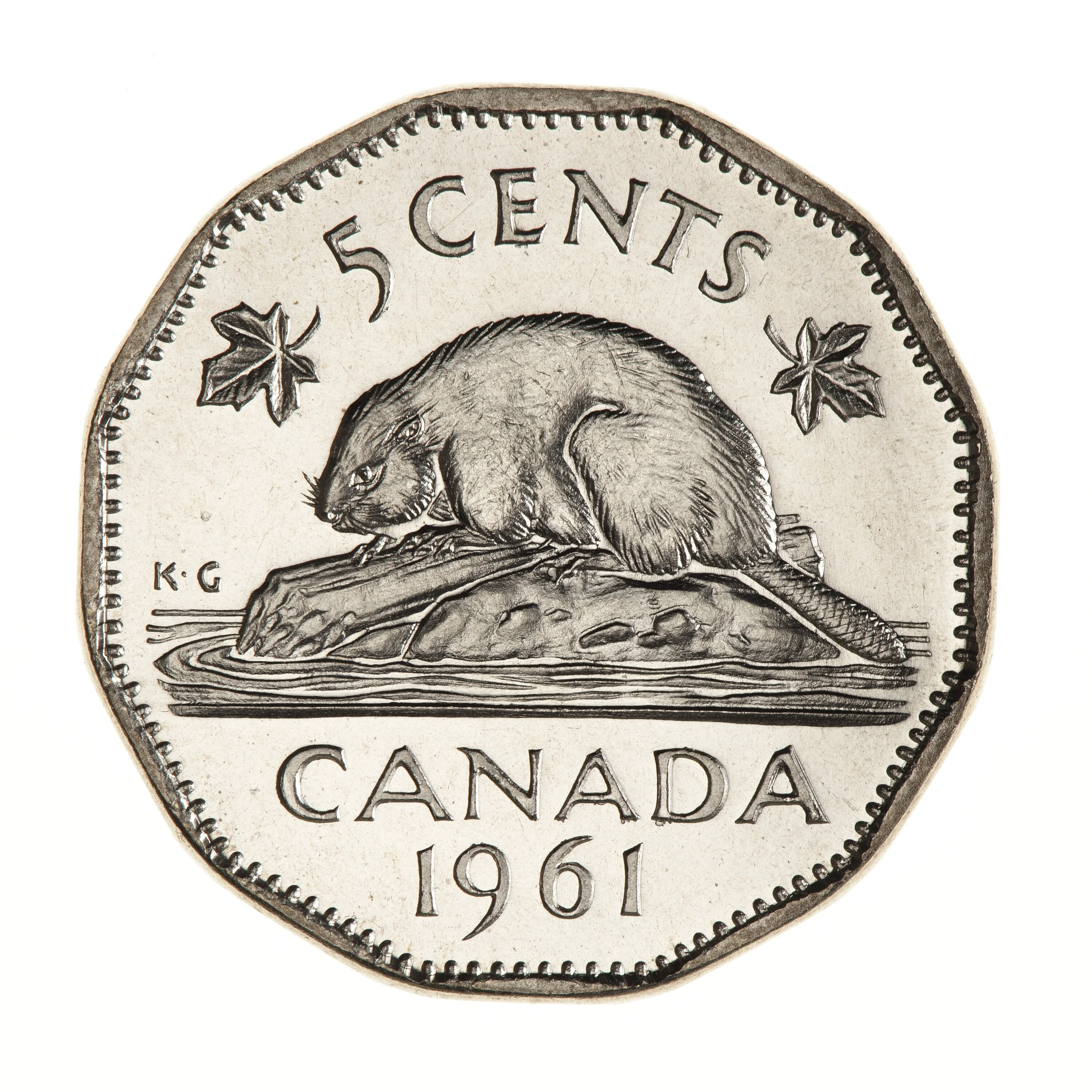
Reverse
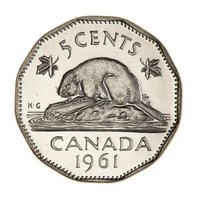
Description:
A beaver above "CANADA" is flanked by maple leaves and the face value.
Inscription:
5 CENTS
CANADA
1962
K·G
CANADA
1962
K·G
Script: Latin
Engraver: Thomas Shingles
Designer: George Kruger Gray
Edge
Plain
Mints
| Name | Mark |
|---|---|
| Royal Canadian Mint of Ottawa | — |
Mintings
| Year | Mint Mark | Mintage | Quality | Collection |
|---|---|---|---|---|
| 1955 | — | 5,355,028 | ||
| 1956 | — | 9,399,854 | ||
| 1957 | — | 7,387,703 | ||
| 1958 | — | 7,607,521 | ||
| 1959 | — | 11,552,523 | ||
| 1960 | — | 37,157,433 | ||
| 1961 | — | 47,889,051 | ||
| 1962 | — | 46,307,305 |
Historical background
In 1955, Canada's currency system was in a transitional period, operating under the Bretton Woods system of fixed exchange rates established after World War II. The Canadian dollar was pegged, but with a unique and significant twist: from 1950 to 1962, Canada allowed its dollar to float freely on international markets. This made it the only major Western currency not fixed to the U.S. dollar or gold within the Bretton Woods framework. The decision to float was taken to manage substantial capital inflows, particularly from American investment, which threatened to drive up the Canadian dollar's value excessively and hurt export competitiveness.
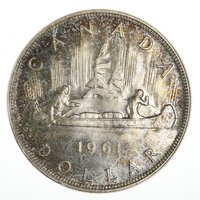
Domestically, currency was issued by the Bank of Canada, which had been nationalized in 1938. Banknotes in circulation were largely the first series of "Canadian Landscape" notes, introduced in 1954, which featured distinctive, modernist designs and bilingual text. Coins, minted by the Royal Canadian Mint, included the silver dollar (featuring a voyageur design), the half-dollar, quarter, dime, nickel, and penny. The currency was decimal-based, and the monetary system was fully independent from the United Kingdom, a status solidified with the Currency, Mint and Exchange Fund Act of 1952.
Economically, the mid-1950s were a time of prosperity and resource-led growth, which influenced currency demand and value. The floating dollar traded at a slight premium to the U.S. dollar for much of 1955, reflecting strong foreign investment and demand for Canadian commodities. This period of a managed float was largely successful in insulating the domestic economy from inflationary pressures abroad, providing the Bank of Canada with greater monetary policy flexibility. However, this experiment would eventually end in 1962 when concerns over currency volatility led the government to return to a fixed peg against the U.S. dollar.
Domestically, currency was issued by the Bank of Canada, which had been nationalized in 1938. Banknotes in circulation were largely the first series of "Canadian Landscape" notes, introduced in 1954, which featured distinctive, modernist designs and bilingual text. Coins, minted by the Royal Canadian Mint, included the silver dollar (featuring a voyageur design), the half-dollar, quarter, dime, nickel, and penny. The currency was decimal-based, and the monetary system was fully independent from the United Kingdom, a status solidified with the Currency, Mint and Exchange Fund Act of 1952.
Economically, the mid-1950s were a time of prosperity and resource-led growth, which influenced currency demand and value. The floating dollar traded at a slight premium to the U.S. dollar for much of 1955, reflecting strong foreign investment and demand for Canadian commodities. This period of a managed float was largely successful in insulating the domestic economy from inflationary pressures abroad, providing the Bank of Canada with greater monetary policy flexibility. However, this experiment would eventually end in 1962 when concerns over currency volatility led the government to return to a fixed peg against the U.S. dollar.
🌱 Very Common