

1 dime – United States
Add to wishlist
United States
Context
Years: 1828–1837
Issuer: United States
Period:
(since 1776)
Currency:
(since 1785)
Subdivision: 1 dime = 10 Cents
Total mintage: 5,248,350
Material
References
KM: #
Numista: #21828
Value
Exchange value: 0.1 USD = $0.10
Bullion value: $5.89
Obverse
Description:
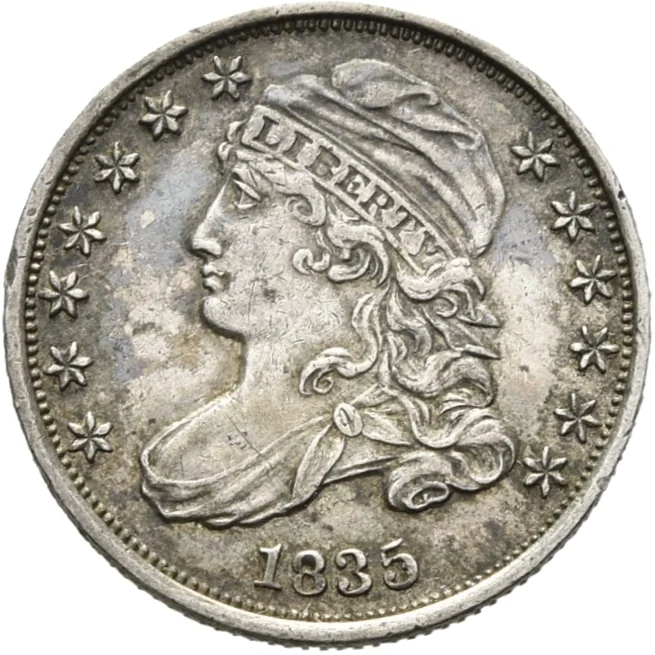
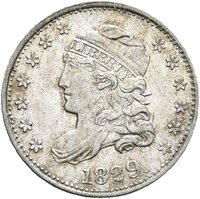
Liberty cap, left. Thirteen stars.
Inscription:
1833
Script: Latin
Designer: John Reich
Reverse
Description:
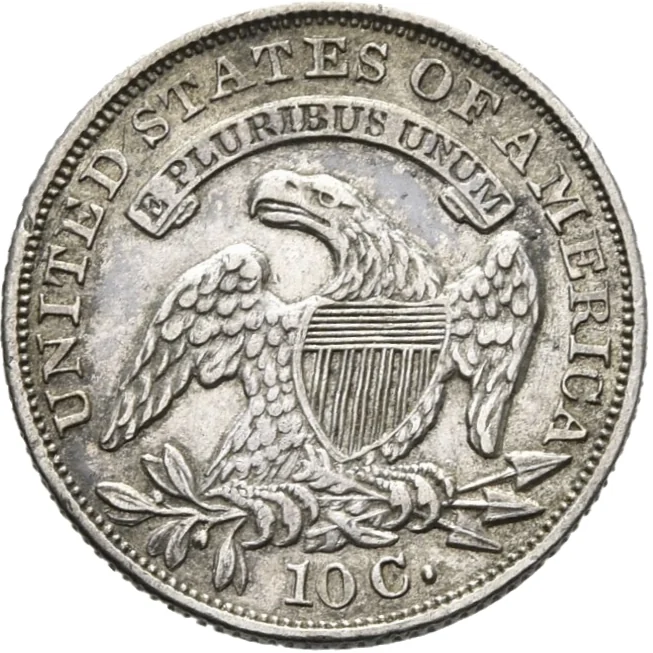
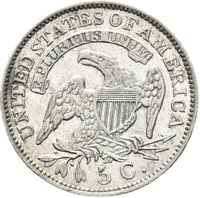
Eagle clutching arrows and olive branch, banner above.
Inscription:
UNITED STATES OF AMERICA
E. PLURIBUS UNUM
10 C.
E. PLURIBUS UNUM
10 C.
Script: Latin
Designer and engraver: John Reich
Edge
Reeded
Categories
| Animal> Bird> Eagle |
| Symbol> Allegory |
| Symbol> Phrygian cap |
| Object> Cold weapons |
Mints
| Name | Mark |
|---|---|
| United States Mint of Philadelphia | — |
Mintings
| Year | Mint Mark | Mintage | Quality | Collection |
|---|---|---|---|---|
| 1828 | — | — | ||
| 1829 | — | — | ||
| 1830 | — | 510,000 | ||
| 1831 | — | 771,350 | ||
| 1832 | — | 522,500 | ||
| 1833 | — | 485,000 | ||
| 1834 | — | — | ||
| 1835 | — | 1,410,000 | ||
| 1836 | — | 1,190,000 | ||
| 1837 | — | 359,500 |
Historical background
In 1828, the United States operated under a bimetallic monetary system, as established by the Coinage Act of 1792. The official currency was specie—gold and silver coins—with the dollar defined as a specific weight of either metal. However, the system was unstable in practice due to the government's fixed exchange ratio between gold and silver (15:1), which often failed to match global market prices. This frequently caused one metal to be undervalued and subsequently exported, leaving the nation with a scarce and irregular supply of official coinage. Consequently, a wide variety of unofficial currencies circulated daily, including foreign coins (especially Spanish dollars), and a vast array of paper banknotes issued by hundreds of state-chartered private banks.
The proliferation of state bank notes was a defining and chaotic feature of the era. Following the dissolution of the Second Bank of the United States' federal charter in 1836, there was no central regulatory authority to standardize currency or control credit. Each state bank issued its own notes, ostensibly redeemable in specie on demand, but their actual value fluctuated wildly based on the perceived solvency of the issuing bank. This created a confusing and risky financial environment where "banknote detectors" were essential publications for merchants to assess the discount rate of notes from distant or questionable institutions. Counterfeiting was also rampant, further eroding public trust in paper money.
Politically, the currency question was deeply entangled in the era's bitter sectional and class divisions, foreshadowing the "Bank Wars" of the 1830s. President Andrew Jackson, elected in 1828, harbored a profound distrust of paper money and centralized banking power, which he viewed as tools for a wealthy elite to exploit ordinary farmers and workers. His opposition to the Second Bank of the United States, which he saw as an unconstitutional and corrupting monopoly, set the stage for a major political confrontation. Thus, in 1828, the nation stood at a monetary crossroads, grappling with the tensions between hard money (specie) advocates and the practical need for paper credit, and between state-controlled finance and the desire for a uniform national currency.
The proliferation of state bank notes was a defining and chaotic feature of the era. Following the dissolution of the Second Bank of the United States' federal charter in 1836, there was no central regulatory authority to standardize currency or control credit. Each state bank issued its own notes, ostensibly redeemable in specie on demand, but their actual value fluctuated wildly based on the perceived solvency of the issuing bank. This created a confusing and risky financial environment where "banknote detectors" were essential publications for merchants to assess the discount rate of notes from distant or questionable institutions. Counterfeiting was also rampant, further eroding public trust in paper money.
Politically, the currency question was deeply entangled in the era's bitter sectional and class divisions, foreshadowing the "Bank Wars" of the 1830s. President Andrew Jackson, elected in 1828, harbored a profound distrust of paper money and centralized banking power, which he viewed as tools for a wealthy elite to exploit ordinary farmers and workers. His opposition to the Second Bank of the United States, which he saw as an unconstitutional and corrupting monopoly, set the stage for a major political confrontation. Thus, in 1828, the nation stood at a monetary crossroads, grappling with the tensions between hard money (specie) advocates and the practical need for paper credit, and between state-controlled finance and the desire for a uniform national currency.
🌱 Common