

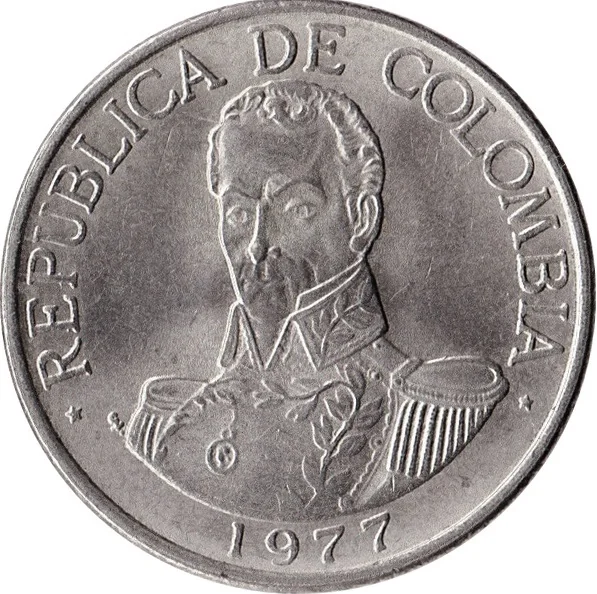
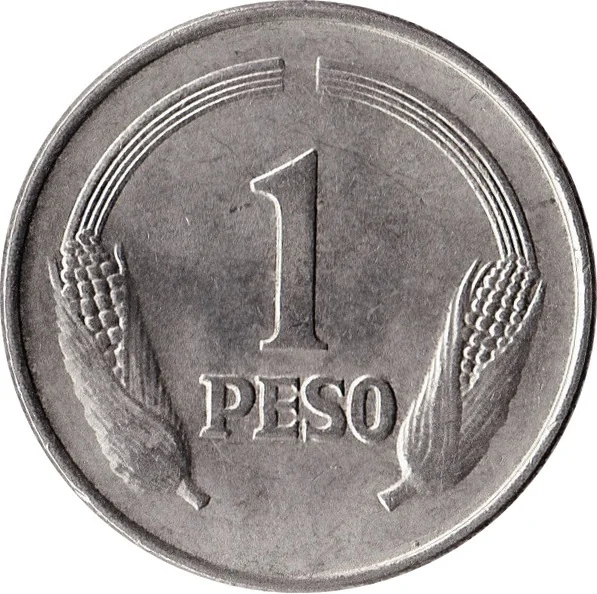
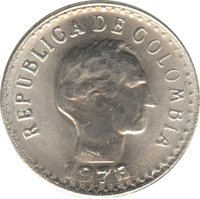
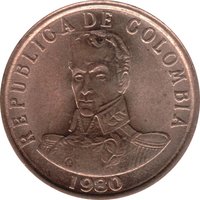
Obverse
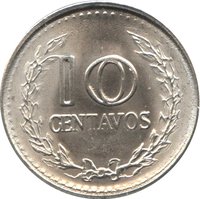
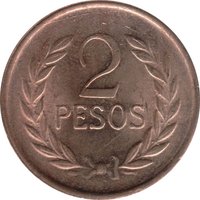
Reverse
Edge
Reeded
Categories
| Person> Military leader |
| Person> Politician |
Mints
| Name | Mark |
|---|---|
| Bogota Mint | — |
| Staatliche Münze Baden-Württemberg | — |
Mintings
| Year | Mint Mark | Mintage | Quality | Collection |
|---|---|---|---|---|
| 1974 | — | 56,020,000 | ||
| 1975 | — | 117,714,000 | ||
| 1976 | — | 98,728,000 | ||
| 1977 | — | 62,083,000 | ||
| 1978 | — | 48,624,000 | ||
| 1979 | — | 83,908,000 | ||
| 1980 | — | 158,625,000 |
Historical background
In 1974, Colombia's currency situation was characterized by a managed exchange rate system under the framework of the Bretton Woods agreement, which had recently collapsed internationally. The Colombian peso was pegged to the U.S. dollar, but this peg was maintained through active intervention and capital controls by the Banco de la República (Central Bank). This period followed the significant economic stability of the "National Front" era, yet the country faced mounting external pressures. A coffee boom in the mid-1970s generated a large influx of foreign exchange, which complicated monetary policy by creating inflationary pressures and threatening to overvalue the peso, thereby hurting non-coffee exports.
The administration of President Alfonso López Michelsen, who took office in August 1974, inherited these challenges and responded with a major policy shift known as the "crawling peg" (minidevaluaciones). Implemented in 1967 but still defining the regime, this system allowed for frequent, small, pre-announced devaluations of the peso against the dollar. The goal was to maintain export competitiveness by preventing a real exchange rate appreciation due to inflation differentials and coffee revenues, while also avoiding the speculative shocks associated with large, sudden devaluations. This policy was a cornerstone of Colombia's relatively stable macroeconomic performance during a turbulent decade for Latin America.
Despite these institutional controls, 1974 marked a point of growing strain. The global oil crisis and rising international inflation began to import cost pressures into the Colombian economy. While the crawling peg managed the nominal exchange rate, controlling domestic inflation became increasingly difficult, leading to concerns about the real effective exchange rate. Thus, the currency situation in 1974 was one of a carefully managed but increasingly tested system, balancing the windfalls of a commodity boom against the imperative of long-term industrial and export diversification within a volatile new global financial order.
The administration of President Alfonso López Michelsen, who took office in August 1974, inherited these challenges and responded with a major policy shift known as the "crawling peg" (minidevaluaciones). Implemented in 1967 but still defining the regime, this system allowed for frequent, small, pre-announced devaluations of the peso against the dollar. The goal was to maintain export competitiveness by preventing a real exchange rate appreciation due to inflation differentials and coffee revenues, while also avoiding the speculative shocks associated with large, sudden devaluations. This policy was a cornerstone of Colombia's relatively stable macroeconomic performance during a turbulent decade for Latin America.
Despite these institutional controls, 1974 marked a point of growing strain. The global oil crisis and rising international inflation began to import cost pressures into the Colombian economy. While the crawling peg managed the nominal exchange rate, controlling domestic inflation became increasingly difficult, leading to concerns about the real effective exchange rate. Thus, the currency situation in 1974 was one of a carefully managed but increasingly tested system, balancing the windfalls of a commodity boom against the imperative of long-term industrial and export diversification within a volatile new global financial order.
🌱 Very Common