

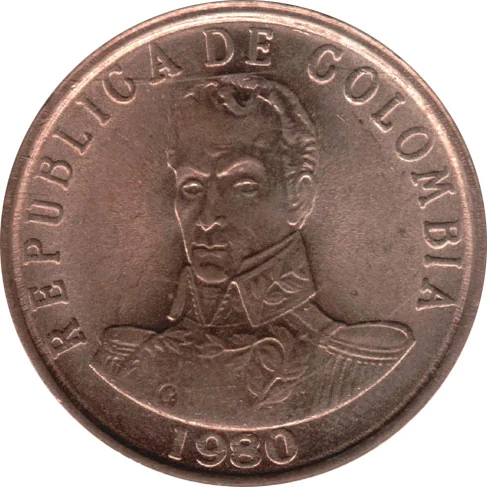
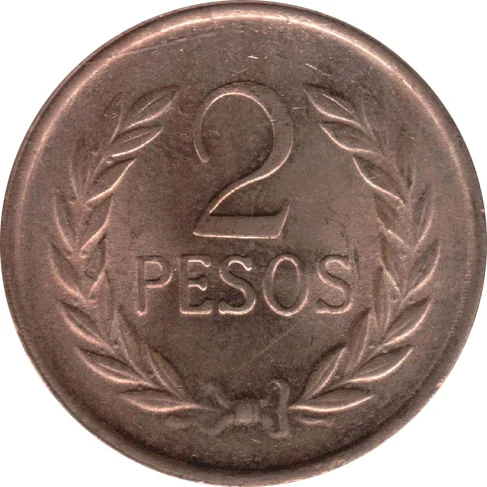
2 pesos – Colombia
Add to wishlist
Colombia
Context
Years: 1977–1987
Issuer: Colombia
Period:
(since 1886)
Currency:
(since 1847)
Total mintage: 390,070,725
Material
Diameter: 24.5 mm
Weight: 7.7 g
Thickness: 1.95 mm
Shape: Round
Standard: Silver quarter ounce
Technique: Milled
Alignment: Coin alignment
flip
References
KM: #
Numista: #1351
Value
Exchange value: 2 COP
Inflation-adjusted value: 891.47 COP
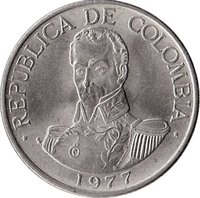
Obverse
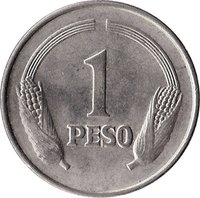
Reverse
Edge
Smooth with inscription.
Legend:
CASA DE MONEDA ** LIBERTAD Y ORDEN **
Categories
| Person> Military leader |
| Person> Politician |
| Symbol> Wreath |
Mints
| Name | Mark |
|---|---|
| Bogota Mint | — |
Mintings
| Year | Mint Mark | Mintage | Quality | Collection |
|---|---|---|---|---|
| 1977 | — | 76,661,000 | ||
| 1978 | — | 69,575,000 | ||
| 1979 | — | 56,537,000 | ||
| 1980 | — | 108,521,000 | ||
| 1981 | — | 48,726,000 | ||
| 1987 | — | 30,050,725 |
Historical background
In 1977, Colombia's currency situation was characterized by a managed exchange rate regime under the "crawling peg" system, a policy adopted in 1967 to promote export competitiveness and control inflation. The Colombian peso was devalued gradually and predictably against the U.S. dollar at a rate slightly higher than the inflation differential with its main trading partners. This system, administered by the Banco de la República, provided relative stability compared to the shocks experienced by other Latin American nations, shielding the economy from sudden speculative attacks and fostering a steady growth in non-traditional exports like cut flowers and textiles.
However, the period was not without significant pressure. Colombia faced persistent, though moderate, inflation (around 20-30% annually), driven in part by expansionary fiscal policies, increases in public sector wages, and high global commodity prices. A major coffee boom (1975-1977), triggered by a frost in Brazil, flooded the country with foreign exchange reserves, which complicated monetary management. To prevent excessive monetary expansion and further inflation from these coffee revenues, the government implemented a "sterilization" policy, borrowing pesos from the domestic market to absorb the liquidity, a move that also pushed up domestic interest rates.
Overall, 1977 represents a year of cautious management within a long-standing framework. The crawling peg successfully avoided the severe balance-of-payments crises seen elsewhere in the region, and the coffee windfall was managed to prevent runaway inflation. Nevertheless, the underlying structural challenges of inflation, fiscal deficits, and reliance on primary commodities like coffee highlighted the limits of the monetary regime and foreshadowed the more severe economic difficulties Colombia would encounter in the early 1980s.
However, the period was not without significant pressure. Colombia faced persistent, though moderate, inflation (around 20-30% annually), driven in part by expansionary fiscal policies, increases in public sector wages, and high global commodity prices. A major coffee boom (1975-1977), triggered by a frost in Brazil, flooded the country with foreign exchange reserves, which complicated monetary management. To prevent excessive monetary expansion and further inflation from these coffee revenues, the government implemented a "sterilization" policy, borrowing pesos from the domestic market to absorb the liquidity, a move that also pushed up domestic interest rates.
Overall, 1977 represents a year of cautious management within a long-standing framework. The crawling peg successfully avoided the severe balance-of-payments crises seen elsewhere in the region, and the coffee windfall was managed to prevent runaway inflation. Nevertheless, the underlying structural challenges of inflation, fiscal deficits, and reliance on primary commodities like coffee highlighted the limits of the monetary regime and foreshadowed the more severe economic difficulties Colombia would encounter in the early 1980s.
🌱 Very Common