


Obverse
Description:
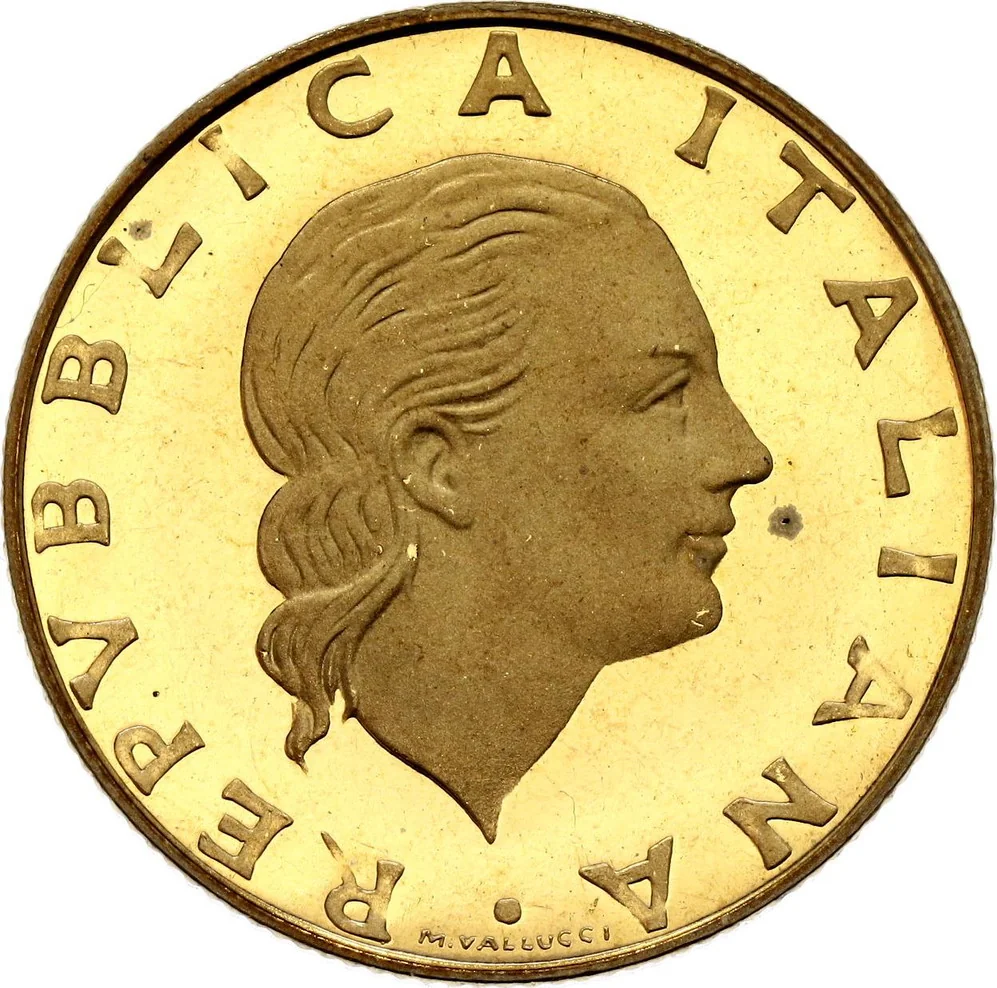
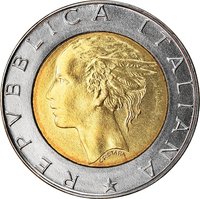
Female head with long curls facing right. Below neck, a large dot and engraver's name.
Inscription:
REPVBBLICA ITALIANA
M. VALLUCCI
M. VALLUCCI
Translation:
Italian Republic
M. Vallucci
M. Vallucci
Script: Latin
Engraver: Mario Vallucci
Reverse
Description:
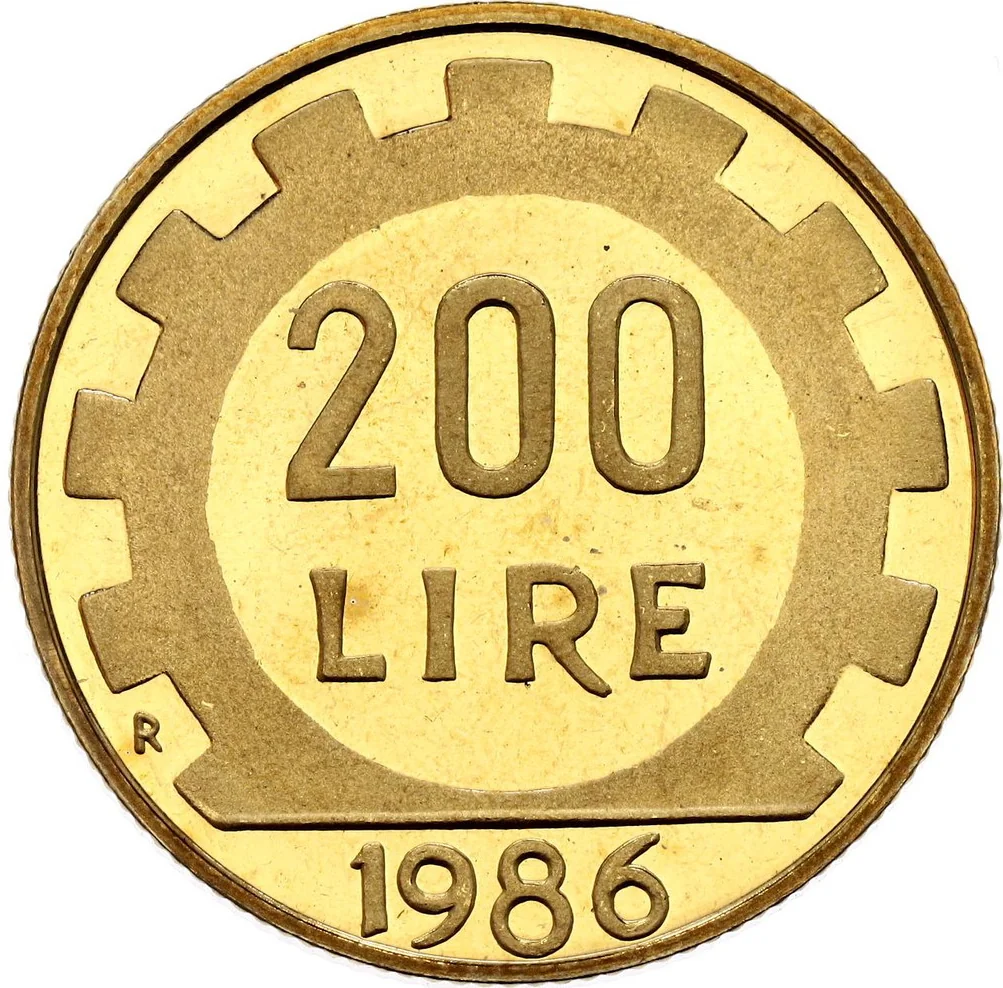
Square gear with value on two lines, date in exergue, mint mark (R) at 8 o'clock.
Inscription:
200 LIRE
R
1977
R
1977
Script: Latin
Engraver: Mario Vallucci
Edge
Reeded
Mints
| Name | Mark |
|---|---|
| Rome | R |
Mintings
| Year | Mint Mark | Mintage | Quality | Collection |
|---|---|---|---|---|
| 1977 | R | 15,900,000 | ||
| 1978 | R | 461,034,000 | ||
| 1979 | R | 487,325,000 | ||
| 1980 | R | 105,690,000 | ||
| 1981 | R | 72,500,000 | ||
| 1982 | R | 9,500,000 | ||
| 1983 | R | 20,000,000 | ||
| 1984 | R | 10,000,000 | ||
| 1985 | R | 15,000,000 | ||
| 1985 | R | 20,345 | Proof | |
| 1986 | R | 17,500 | Proof | |
| 1986 | R | — | ||
| 1987 | R | — | ||
| 1987 | R | 10,000 | Proof | |
| 1988 | R | 9,000 | Proof | |
| 1988 | R | 37,000,000 | ||
| 1989 | R | 11,000 | Proof | |
| 1991 | R | 11,000 | Proof | |
| 1991 | R | 70,000,000 | ||
| 1995 | R | 170,000,000 | ||
| 1995 | R | 7,960 | Proof | |
| 1998 | R | 9,000 | Proof | |
| 1998 | R | 120,000,000 | ||
| 2000 | R | 61,400 | BU | |
| 2000 | R | 8,960 | Proof | |
| 2001 | R | 100,000 | BU | |
| 2001 | R | 10,000 | Proof |
Historical background
In 1977, Italy was in the throes of a severe economic and political crisis known as the "Years of Lead." The national currency, the lira, was under immense pressure, caught between rampant domestic inflation and the constraints of the European "currency snake" – a forerunner to the Exchange Rate Mechanism (ERM) designed to limit fluctuations between European currencies. Italy’s inflation rate soared to approximately 18% that year, driven by high wage indexation (scala mobile), soaring oil prices, and massive public deficit spending. This made Italian goods less competitive internationally and led to frequent lira devaluations to prop up exports, a cycle that further fueled imported inflation.
Politically, the situation was chaotic, with a fragile government of "national solidarity" and the powerful Italian Communist Party (PCI) at its peak electoral strength. This political instability, combined with social unrest and terrorist violence from both far-left and far-right groups, eroded international confidence in Italy's ability to manage its economy. The Bank of Italy, led by Governor Paolo Baffi, struggled to defend the lira within the European monetary system. Foreign exchange reserves dwindled as the bank intervened to support the currency, while capital flight saw wealthy Italians and businesses moving funds into stronger currencies like the German Deutsche Mark and Swiss Franc.
Ultimately, the strain proved unsustainable. In early 1977, Italy was forced to make a humiliating exit from the European currency snake, allowing the lira to float freely and depreciate significantly. This move, while easing immediate pressure on reserves and exports, underscored Italy's economic divergence from its Northern European partners. The crisis of 1977 set the stage for the harsh austerity measures and the landmark entry into the European Monetary System (EMS) in 1979, a move intended to impose external discipline on the chronically unstable lira and the Italian economy.
Politically, the situation was chaotic, with a fragile government of "national solidarity" and the powerful Italian Communist Party (PCI) at its peak electoral strength. This political instability, combined with social unrest and terrorist violence from both far-left and far-right groups, eroded international confidence in Italy's ability to manage its economy. The Bank of Italy, led by Governor Paolo Baffi, struggled to defend the lira within the European monetary system. Foreign exchange reserves dwindled as the bank intervened to support the currency, while capital flight saw wealthy Italians and businesses moving funds into stronger currencies like the German Deutsche Mark and Swiss Franc.
Ultimately, the strain proved unsustainable. In early 1977, Italy was forced to make a humiliating exit from the European currency snake, allowing the lira to float freely and depreciate significantly. This move, while easing immediate pressure on reserves and exports, underscored Italy's economic divergence from its Northern European partners. The crisis of 1977 set the stage for the harsh austerity measures and the landmark entry into the European Monetary System (EMS) in 1979, a move intended to impose external discipline on the chronically unstable lira and the Italian economy.
🌱 Very Common