

Obverse
Description:
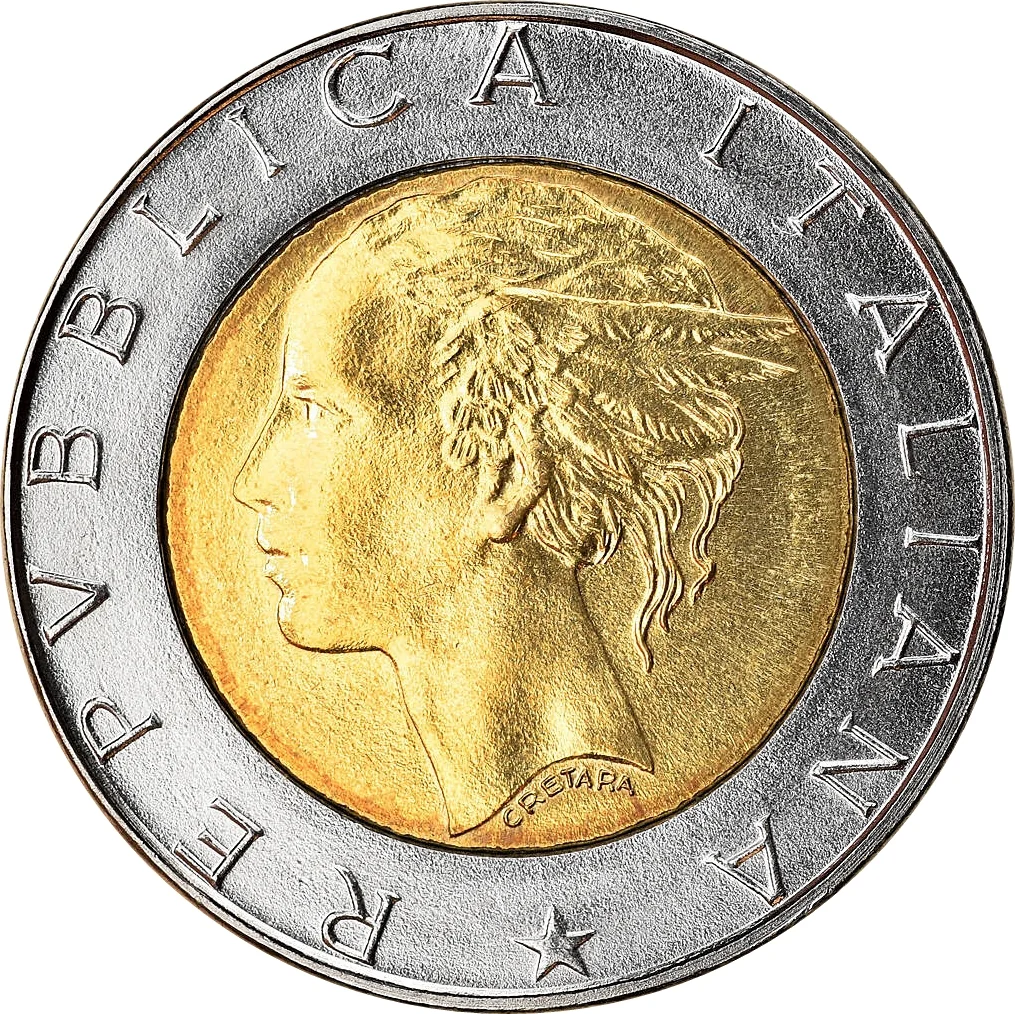
Woman facing left, symbolizing the Italian Republic with feathered wings at her temples (intelligence and freedom). Engraver's name below.
Inscription:
REPVBBLICA ITALIANA
CRETARA
CRETARA
Translation:
Italian Republic
Cretara
Cretara
Script: Latin
Engraver: Laura Cretara
Reverse
Description:
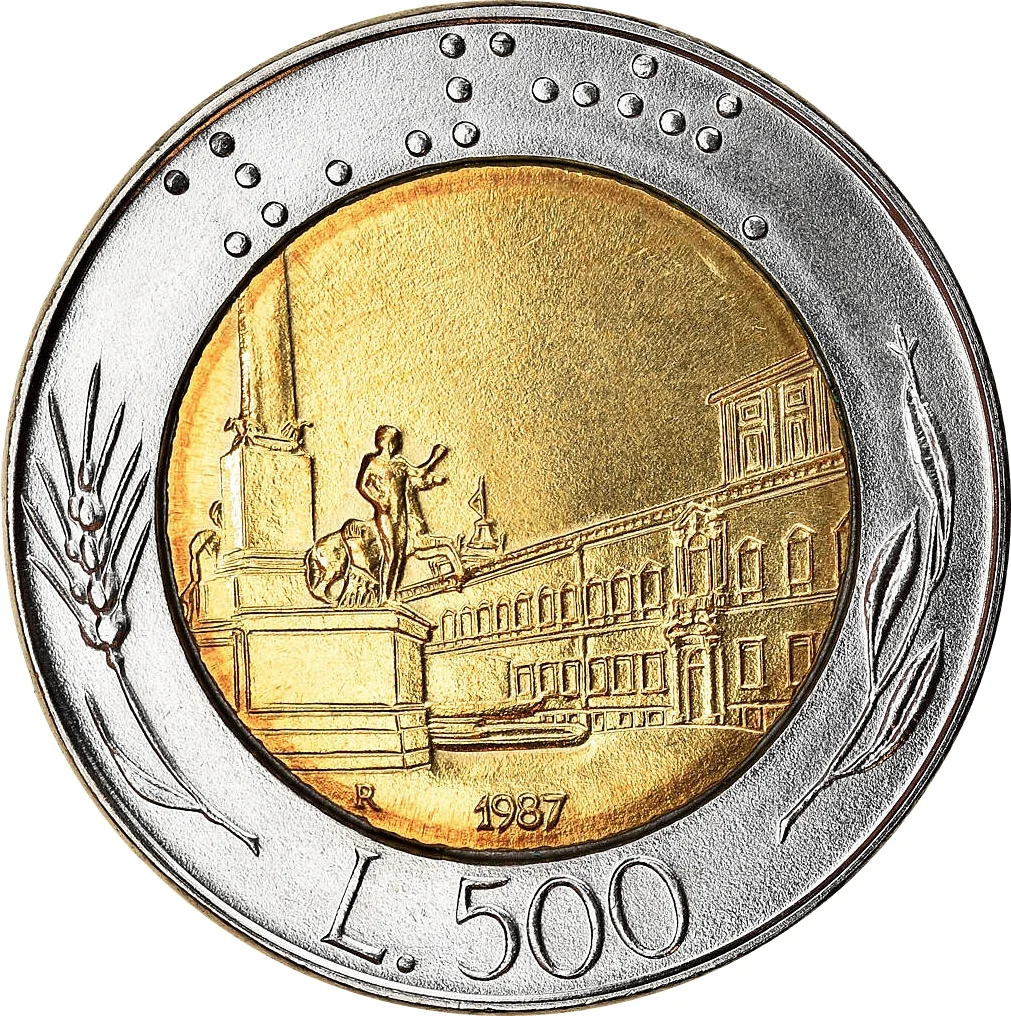
Piazza del Quirinale, Rome, centered with a small date below. "L.500" appears in Braille at the top and in text at the bottom, flanked by plants.
Inscription:
⠨⠇⠄⠼⠑⠚⠚⠄
R 1987
L.500
R 1987
L.500
Engraver: Laura Cretara
Edge
Alternating smooth and reeded segments.
Mints
| Name | Mark |
|---|---|
| Rome | R |
Mintings
| Year | Mint Mark | Mintage | Quality | Collection |
|---|---|---|---|---|
| 1982 | R | 162,026,000 | ||
| 1983 | R | 138,000,000 | ||
| 1984 | R | 162,000,000 | ||
| 1985 | R | 20,345 | Proof | |
| 1985 | R | 162,000,000 | ||
| 1986 | R | 17,500 | Proof | |
| 1986 | R | 165,000,000 | ||
| 1987 | R | 200,000,000 | ||
| 1987 | R | 10,000 | Proof | |
| 1988 | R | 142,000,000 | ||
| 1988 | R | 9,000 | Proof | |
| 1989 | R | 9,250 | Proof | |
| 1989 | R | 155,000,000 | ||
| 1990 | R | 9,400 | Proof | |
| 1990 | R | 130,000,000 | ||
| 1991 | R | 11,400 | Proof | |
| 1991 | R | — | ||
| 1992 | R | — | ||
| 1992 | R | 9,500 | Proof | |
| 1995 | R | 7,960 | Proof | |
| 1995 | R | 110,000,000 | ||
| 2000 | R | 61,400 | BU | |
| 2000 | R | 10,000 | Proof | |
| 2001 | R | 10,000 | Proof | |
| 2001 | R | 100,000 | BU |
Historical background
In 1982, Italy's currency situation was defined by its participation in the European Monetary System (EMS), established in 1979 to reduce exchange rate volatility. The Italian lira was a member, but it operated under unique pressures. It was allowed a wider fluctuation band of ±6% (compared to the standard ±2.25%), a concession acknowledging its historically higher inflation and economic instability. This period was characterized by frequent but managed devaluations, known as "realignments," where the lira's central rate within the EMS was officially lowered to restore competitiveness without abandoning the system entirely.
Domestically, the lira was under severe strain from Italy's entrenched economic problems: persistently high inflation (running around 16% in 1982), large public deficits, and a powerful wage-indexation system (scala mobile) that created an inflationary spiral. The Bank of Italy, led by Governor Carlo Azeglio Ciampi, was engaged in a difficult balancing act. It had to defend the lira's parity within the EMS, which required high interest rates and foreign reserve interventions, while simultaneously grappling with the government's expansive fiscal policy and the political costs of economic restraint.
The situation culminated in a significant crisis in the summer of 1982. Speculative attacks intensified, draining Italy's foreign currency reserves as the Bank of Italy fought to uphold the lira's EMS band. By June, the pressure became unsustainable, forcing a major 7% devaluation of the lira within the EMS—one of the system's largest realignments. This move provided temporary relief for exporters but underscored the fundamental tension between Italy's domestic economic policies and the discipline required for European monetary stability, a theme that would recur for decades.
Domestically, the lira was under severe strain from Italy's entrenched economic problems: persistently high inflation (running around 16% in 1982), large public deficits, and a powerful wage-indexation system (scala mobile) that created an inflationary spiral. The Bank of Italy, led by Governor Carlo Azeglio Ciampi, was engaged in a difficult balancing act. It had to defend the lira's parity within the EMS, which required high interest rates and foreign reserve interventions, while simultaneously grappling with the government's expansive fiscal policy and the political costs of economic restraint.
The situation culminated in a significant crisis in the summer of 1982. Speculative attacks intensified, draining Italy's foreign currency reserves as the Bank of Italy fought to uphold the lira's EMS band. By June, the pressure became unsustainable, forcing a major 7% devaluation of the lira within the EMS—one of the system's largest realignments. This move provided temporary relief for exporters but underscored the fundamental tension between Italy's domestic economic policies and the discipline required for European monetary stability, a theme that would recur for decades.
🌱 Very Common