

5 kroner (Kongsberg Mint) – Norway
Add to wishlist
Circulating commemorative coins
Commemoration: 300th Anniversary of the Kongsberg Mint
Norway
Context
Material
Diameter: 29.5 mm
Weight: 11.5 g
Thickness: 2.23 mm
Shape: Round
Composition: Copper-nickel
Technique: Milled
Alignment: Medal alignment
flip
References
KM: #
Numista: #13549
Value
Exchange value: 5 NOK
Inflation-adjusted value: 15.37 NOK
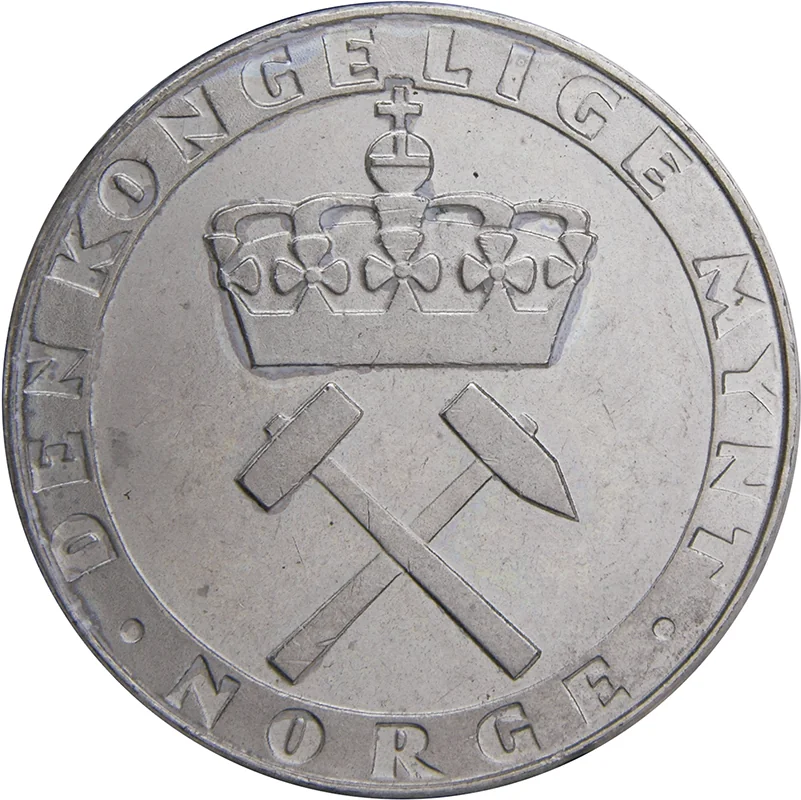
Obverse
Description:
Crown above crossed hammers within a ring, surrounded by an inscription. Solid rim.
Inscription:
DEN KONGELIGE MYNT
· NORGE ·
· NORGE ·
Translation:
The Royal Mint
· Norway ·
· Norway ·
Script: Latin
Engraver: Øivind Hansen
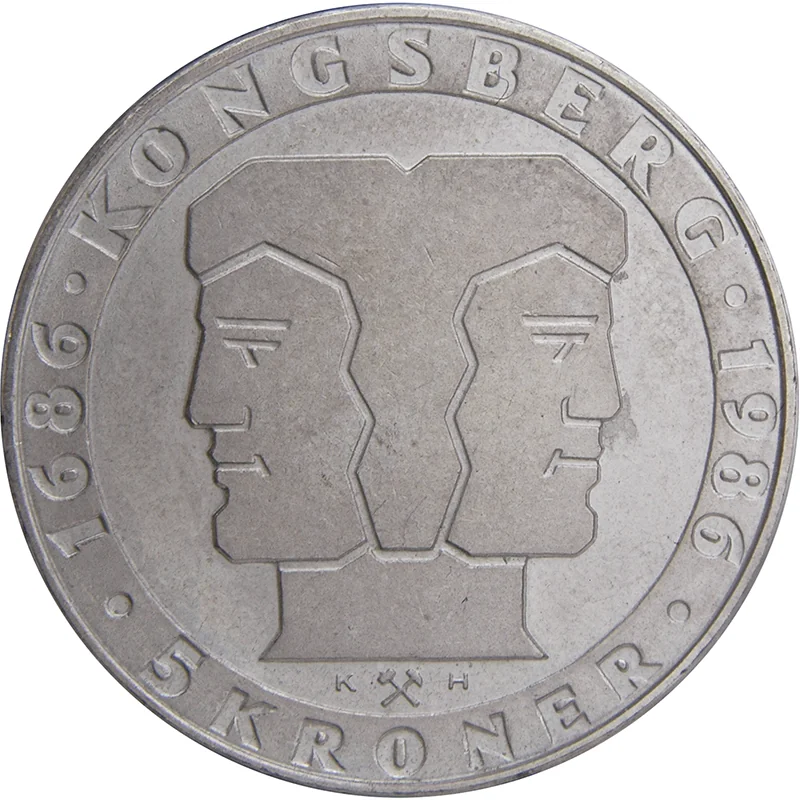
Reverse
Description:
Janus head. Mint details below within ring, inscription around, value at bottom. Solid rim.
Inscription:
1686 · KONGSBERG · 1986
K ⚒ H
· 5 KRONER ·
K ⚒ H
· 5 KRONER ·
Script: Latin
Engraver: Øivind Hansen
Edge
Plain
Mints
| Name | Mark |
|---|---|
| Norwegian Mint | — |
Mintings
| Year | Mint Mark | Mintage | Quality | Collection |
|---|---|---|---|---|
| 1986 | — | 2,245,500 | ||
| 1986 | — | 5,000 | Proof | |
| 1986 | — | 5,000 | Prooflike |
Historical background
In 1986, Norway's currency situation was defined by the aftermath of a profound economic crisis and a pivotal shift in monetary policy. The early 1980s had been marked by a deregulated credit market, soaring inflation, and a deeply overvalued krone, which was pegged to a trade-weighted currency basket. This unsustainable regime culminated in a severe banking crisis and a forced devaluation in May 1986, when the krone was devalued by 10% as a last-ditch effort to restore competitiveness. The economy was in recession, and the government was grappling with the dual pressures of a collapsing oil price—which halved in 1986—and rising unemployment, which strained the fixed exchange rate system.
The devaluation represented a strategic retreat and a move towards a more flexible exchange rate management. While the krone remained formally pegged, the 1986 adjustment signaled a loosening of the rigid commitment, acknowledging that maintaining a strong currency parity was untenable. Monetary policy was in a transitional phase, with the central bank, Norges Bank, increasingly focused on stabilizing the krone's value while also beginning to consider other targets, such as interest rates, to manage the domestic economic turmoil. The period was characterized by high interest rates aimed at defending the new parity and curbing inflation, which nonetheless remained a persistent concern.
Overall, the currency situation in 1986 was one of managed instability and reorientation. The devaluation provided temporary relief for Norway's export industries, but the fundamental vulnerability exposed by the oil price shock underscored the challenges of a small, open economy dependent on a volatile commodity. This experience paved the way for further evolution in Norway's monetary framework, ultimately leading to the formal adoption of a floating exchange rate regime in 1992 and the establishment of an explicit inflation-targeting policy in 2001.
The devaluation represented a strategic retreat and a move towards a more flexible exchange rate management. While the krone remained formally pegged, the 1986 adjustment signaled a loosening of the rigid commitment, acknowledging that maintaining a strong currency parity was untenable. Monetary policy was in a transitional phase, with the central bank, Norges Bank, increasingly focused on stabilizing the krone's value while also beginning to consider other targets, such as interest rates, to manage the domestic economic turmoil. The period was characterized by high interest rates aimed at defending the new parity and curbing inflation, which nonetheless remained a persistent concern.
Overall, the currency situation in 1986 was one of managed instability and reorientation. The devaluation provided temporary relief for Norway's export industries, but the fundamental vulnerability exposed by the oil price shock underscored the challenges of a small, open economy dependent on a volatile commodity. This experience paved the way for further evolution in Norway's monetary framework, ultimately leading to the formal adoption of a floating exchange rate regime in 1992 and the establishment of an explicit inflation-targeting policy in 2001.
🌱 Common