

5 kroner (Norwegian Army) – Norway
Add to wishlist
Circulating commemorative coins
Commemoration: 350th Anniversary of Norwegian Army
Norway
Context
Material
Diameter: 29.5 mm
Weight: 11.5 g
Thickness: 2.23 mm
Shape: Round
Composition: Copper-nickel
Technique: Milled
Alignment: Medal alignment
flip
References
KM: #
Numista: #21087
Value
Exchange value: 5 NOK
Inflation-adjusted value: 29.69 NOK
Obverse
Description:
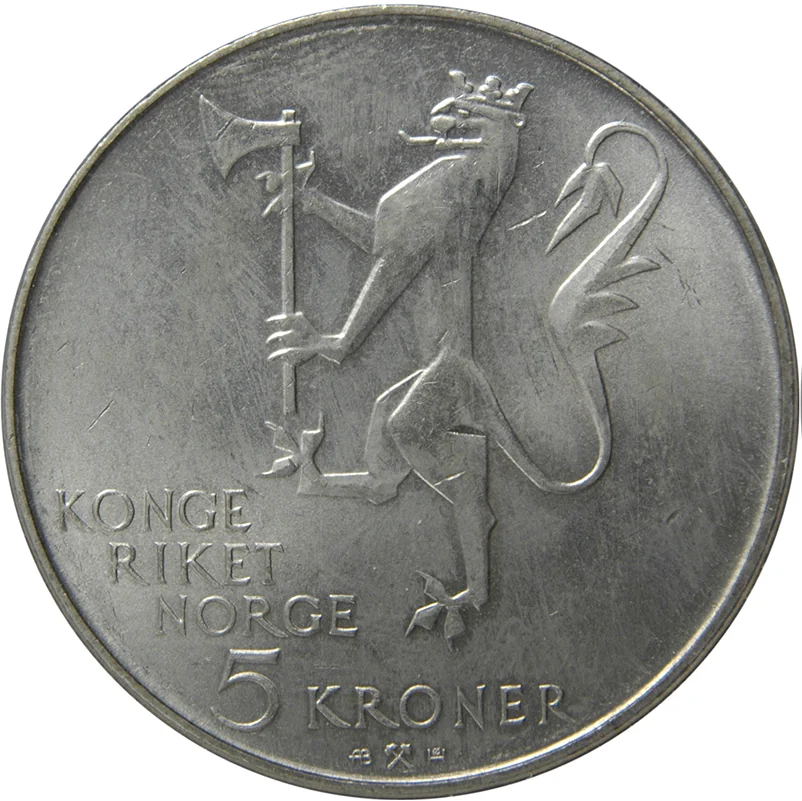
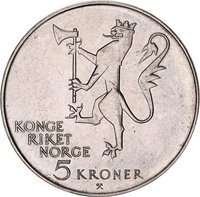
Crowned Norwegian lion facing left, holding a halberd. Inscription on three lines between its legs. Value, initials, mintmark, and engraver below. Solid rim ring.
Inscription:
KONGE
RIKET
NORGE
5 KRONER
AB ⚒ ØH
RIKET
NORGE
5 KRONER
AB ⚒ ØH
Translation:
KINGDOM OF NORWAY
5 CROWNS
AB ⚒ ØH
5 CROWNS
AB ⚒ ØH
Script: Latin
Language: Norwegian
Engraver: Øivind Hansen
Reverse
Description:
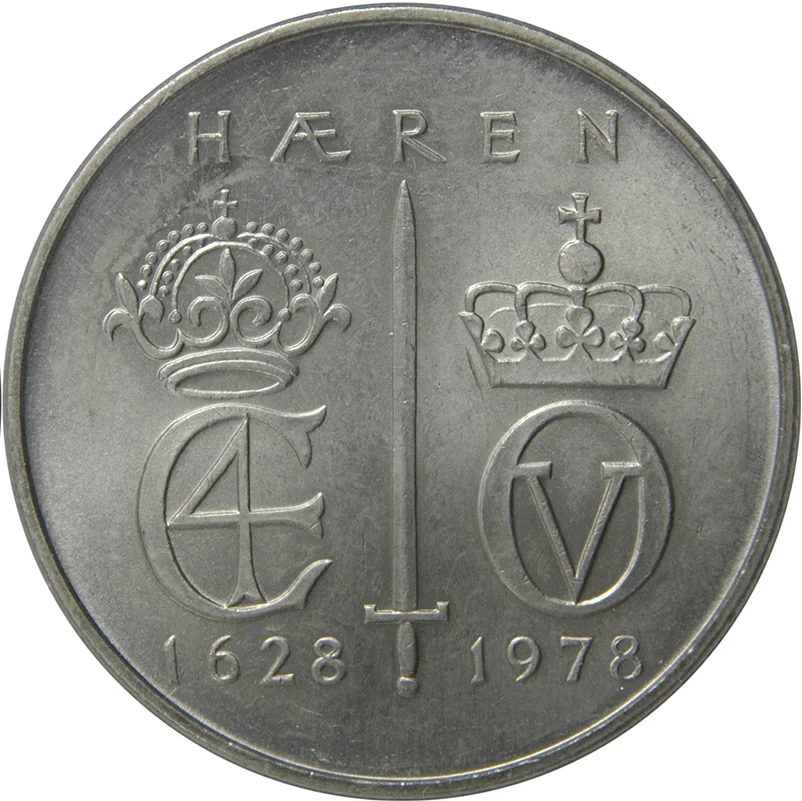
Sword center. Left: Christian IV crowned monogram with date. Right: Olav V crowned monogram with date. Inscription above. Solid rim ring.
Inscription:
HÆREN
C4 | OV
1628 | 1978
C4 | OV
1628 | 1978
Translation:
Army
C4 | OV
1628 | 1978
C4 | OV
1628 | 1978
Script: Latin
Engraver: Øivind Hansen
Edge
Plain
Mints
| Name | Mark |
|---|---|
| Norwegian Mint | — |
Mintings
| Year | Mint Mark | Mintage | Quality | Collection |
|---|---|---|---|---|
| 1978 | — | 2,989,768 |
Historical background
In 1978, Norway's currency situation was defined by its membership in the European "snake" arrangement, a multilateral agreement to limit exchange rate fluctuations between participating European currencies. Norway had joined the snake in 1972, pegging the Norwegian krone (NOK) to a basket of currencies, but this period was marked by significant instability. The country faced strong economic headwinds, including a large current account deficit and rising inflation, which put persistent downward pressure on the krone. This necessitated several devaluations within the snake throughout the mid-1970s and required substantial interventions by Norges Bank, Norway's central bank, to defend the peg.
The core challenge stemmed from a divergence between Norway's domestic economic policy and the requirements of a fixed exchange rate. While many other European countries were prioritizing anti-inflationary measures, Norway was pursuing an expansive fiscal policy, fueled by the nascent oil revenues from the North Sea. This "oil-fueled Keynesianism" led to high wage growth and strong domestic demand, which made Norwegian exports less competitive and worsened the trade balance. The krone was consequently perceived as overvalued, leading to repeated speculative attacks as markets anticipated further devaluations.
By December 1978, the pressures became unsustainable. Norway made the decisive move to withdraw from the European snake, opting instead to peg the krone to a trade-weighted currency basket of its own design. This unilateral basket peg allowed for greater flexibility and was better suited to Norway's specific economic structure, particularly its growing dependence on oil and gas exports. The exit from the snake marked the end of a turbulent chapter of fixed exchange rate commitments and set the stage for a more managed currency policy in the lead-up to the oil boom of the 1980s.
The core challenge stemmed from a divergence between Norway's domestic economic policy and the requirements of a fixed exchange rate. While many other European countries were prioritizing anti-inflationary measures, Norway was pursuing an expansive fiscal policy, fueled by the nascent oil revenues from the North Sea. This "oil-fueled Keynesianism" led to high wage growth and strong domestic demand, which made Norwegian exports less competitive and worsened the trade balance. The krone was consequently perceived as overvalued, leading to repeated speculative attacks as markets anticipated further devaluations.
By December 1978, the pressures became unsustainable. Norway made the decisive move to withdraw from the European snake, opting instead to peg the krone to a trade-weighted currency basket of its own design. This unilateral basket peg allowed for greater flexibility and was better suited to Norway's specific economic structure, particularly its growing dependence on oil and gas exports. The exit from the snake marked the end of a turbulent chapter of fixed exchange rate commitments and set the stage for a more managed currency policy in the lead-up to the oil boom of the 1980s.
🌱 Common