

5 kroner (National Bank) – Norway
Add to wishlist
Circulating commemorative coins
Commemoration: 175th anniversary - National Bank
Norway
Context
Material
Diameter: 29.5 mm
Weight: 11.5 g
Thickness: 2.23 mm
Shape: Round
Composition: Copper-nickel
Technique: Milled
Alignment: Medal alignment
flip
References
KM: #
Numista: #14685
Value
Exchange value: 5 NOK
Inflation-adjusted value: 11.36 NOK
Obverse
Description:
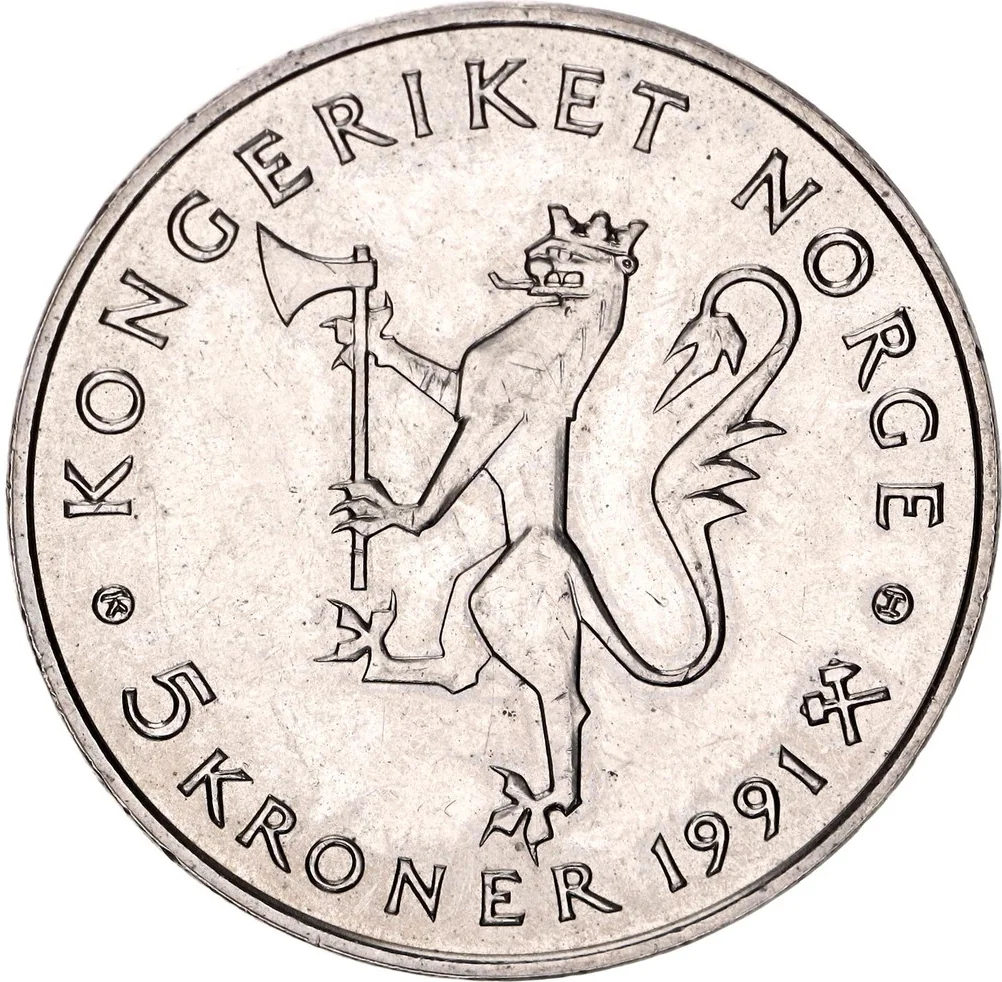
Norwegian lion with halberd left, crowned and encircled by inscription. Mintmaster initial left, engraver initial right (each in a dot). Value, date, and mintmark below. Solid rim ring.
Inscription:
KONGERIKET NORGE
K | H
• 5 KRONER 1991 ⚒ •
K | H
• 5 KRONER 1991 ⚒ •
Translation:
Kingdom of Norway
K | H
• 5 Kroner 1991 ⚒ •
K | H
• 5 Kroner 1991 ⚒ •
Script: Latin
Language: Norwegian
Engraver: Øivind Hansen
Reverse
Description:
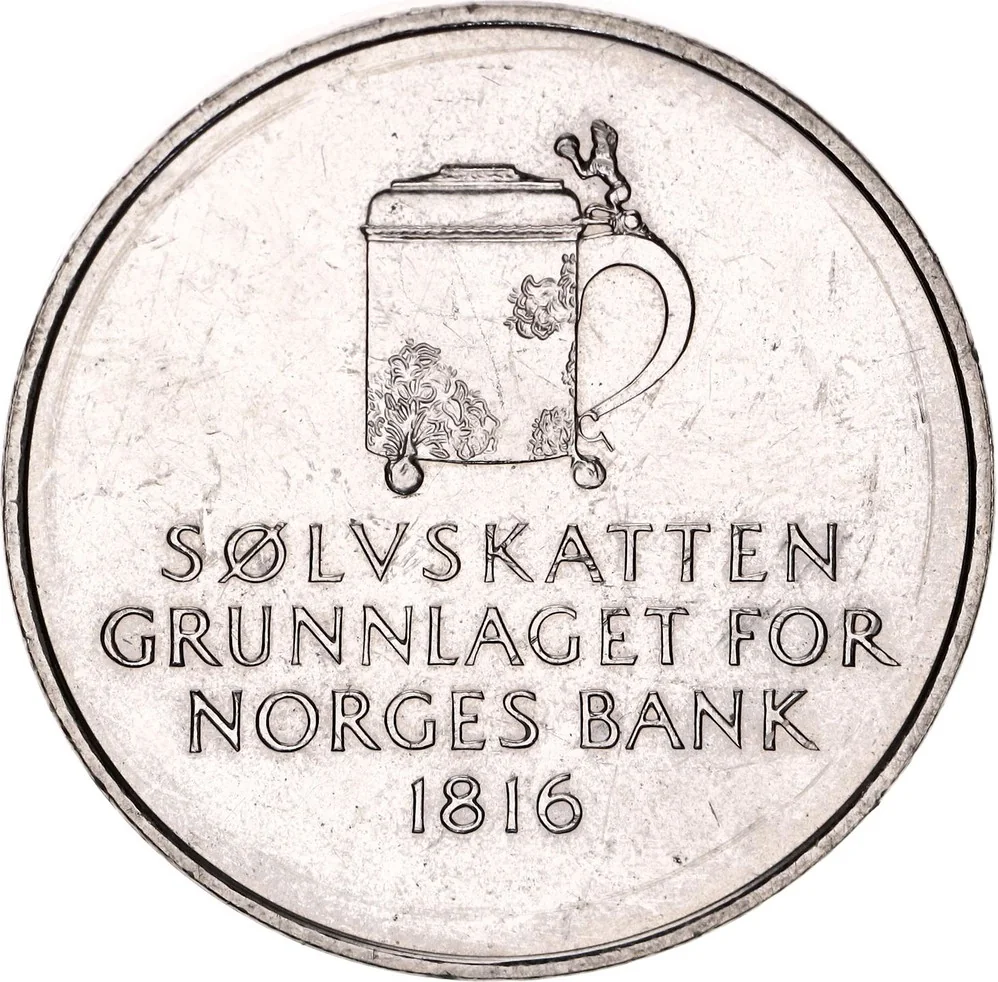
Old silver tankard with a solid rim ring and a four-line inscription below.
Inscription:
SØLVSKATTEN
GRUNNLAGET FOR
NORGES BANK
1816
GRUNNLAGET FOR
NORGES BANK
1816
Translation:
The Silver Treasure
The Foundation of
Norway's Bank
1816
The Foundation of
Norway's Bank
1816
Script: Latin
Language: Norwegian
Engraver: Øivind Hansen
Edge
Plain
Mints
| Name | Mark |
|---|---|
| Norwegian Mint | — |
Mintings
| Year | Mint Mark | Mintage | Quality | Collection |
|---|---|---|---|---|
| 1991 | — | 20,000 | Proof | |
| 1991 | — | 432,000 | ||
| 1991 | — | 12,000 | BU |
Historical background
In 1991, Norway's currency situation was defined by its managed exchange rate regime, where the Norwegian krone (NOK) was pegged to a trade-weighted basket of currencies, primarily the European Currency Unit (ECU). This system, established in the 1970s, aimed to provide stability for the small, open economy by tethering the krone to its major trading partners, thus reducing uncertainty for exporters and importers. However, maintaining this peg required continuous intervention by Norges Bank, the central bank, which used interest rate adjustments and foreign currency reserves to defend the krone's value against market pressures.
The period was marked by significant economic strain following a domestic banking crisis and a sharp recession, which put the fixed exchange rate under severe stress. High interest rates, necessary to support the krone and curb inflation, exacerbated the downturn by increasing debt-servicing costs for businesses and households. Furthermore, the international context was volatile, with European currencies facing turbulence in the lead-up to the Maastricht Treaty, creating additional speculative pressures on the krone peg.
This precarious situation ultimately proved unsustainable. In December 1992, in the wake of the European Exchange Rate Mechanism (ERM) crisis, Norway was forced to abandon its fixed exchange rate, allowing the krone to float. While this decisive shift occurred just after 1991, the entire year was a critical prelude, characterized by mounting market skepticism, dwindling foreign reserves, and the growing realization that the defensive high-interest rate policy was causing unacceptable damage to the real economy.
The period was marked by significant economic strain following a domestic banking crisis and a sharp recession, which put the fixed exchange rate under severe stress. High interest rates, necessary to support the krone and curb inflation, exacerbated the downturn by increasing debt-servicing costs for businesses and households. Furthermore, the international context was volatile, with European currencies facing turbulence in the lead-up to the Maastricht Treaty, creating additional speculative pressures on the krone peg.
This precarious situation ultimately proved unsustainable. In December 1992, in the wake of the European Exchange Rate Mechanism (ERM) crisis, Norway was forced to abandon its fixed exchange rate, allowing the krone to float. While this decisive shift occurred just after 1991, the entire year was a critical prelude, characterized by mounting market skepticism, dwindling foreign reserves, and the growing realization that the defensive high-interest rate policy was causing unacceptable damage to the real economy.
🌱 Fairly Common