

½ dollar – United States
Add to wishlist
United States
Context
Years: 1801–1807
Issuer: United States
Period:
(since 1776)
Currency:
(since 1785)
Subdivision: ½ dollar = 50 Cents
Total mintage: 761,211
Material
References
KM: #
Numista: #30053
Value
Exchange value: ½ USD = $0.50
Bullion value: $30.20
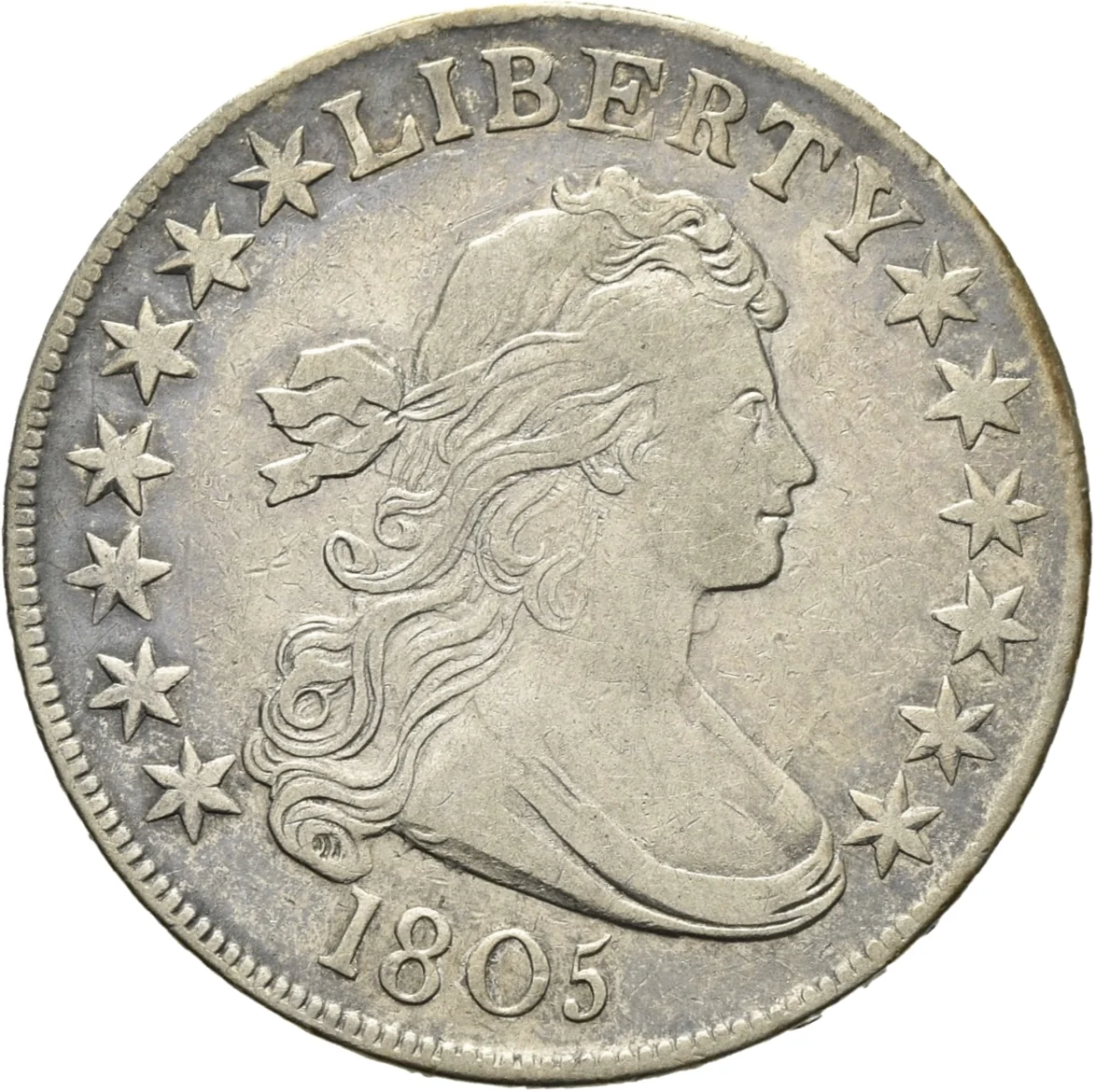
Obverse
Description:
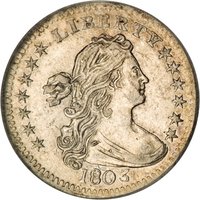
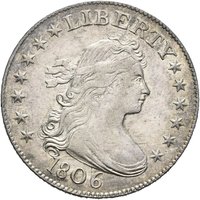
Draped bust right, 13 stars.
Inscription:
LIBERTY
1807
1807
Script: Latin
Engraver: Robert Scot
Designer: Gilbert Stuart
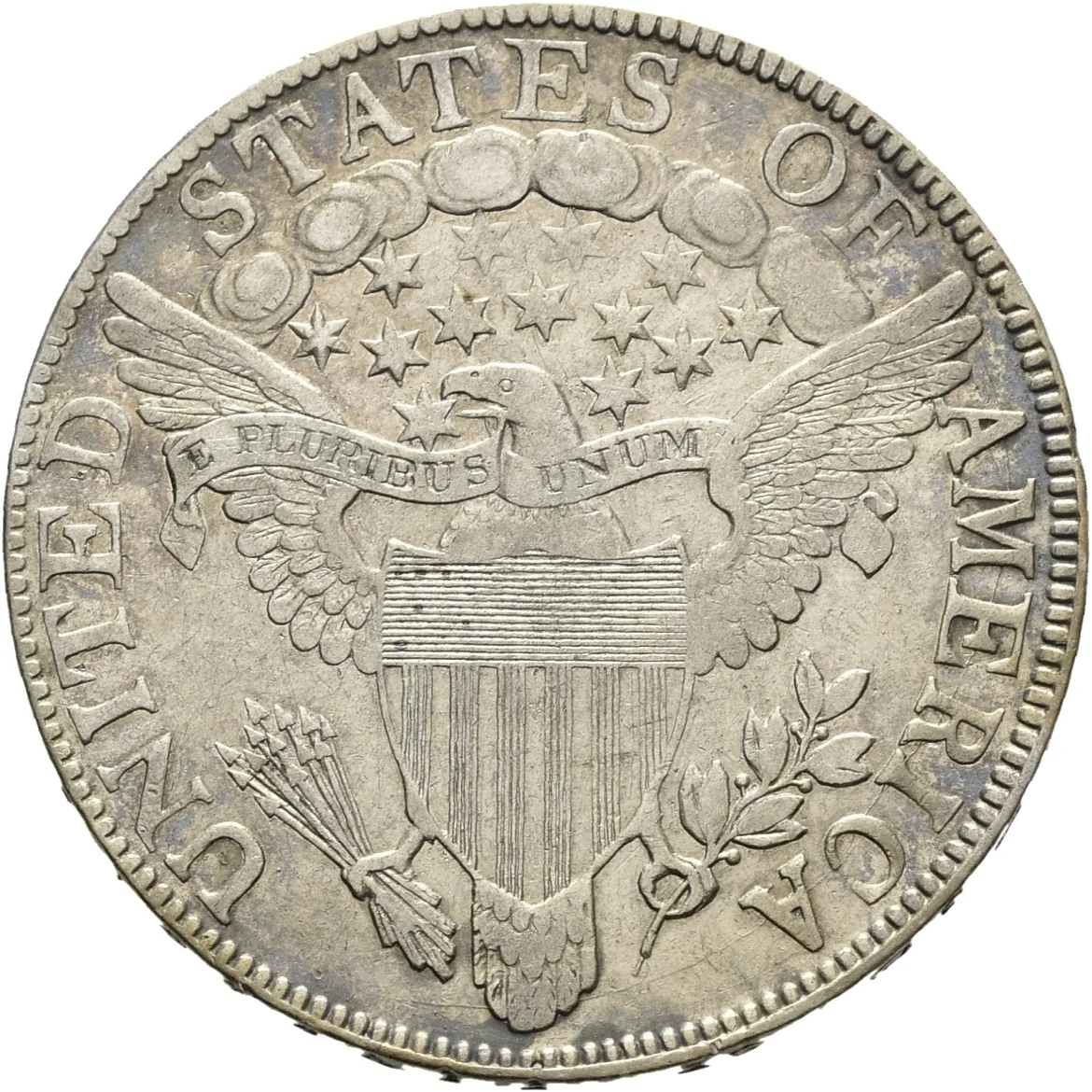
Reverse
Description:
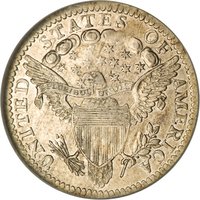
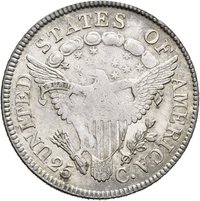
Heraldic eagle beneath 13 stars, country name encircling rim.
Inscription:
UNITED STATES OF AMERICA
E PLURIBUS UNUM
E PLURIBUS UNUM
Script: Latin
Engraver: Robert Scot
Edge
Lettered with decorations between words
Legend:
FIFTY CENTS OR HALF A DOLLAR
Mints
| Name | Mark |
|---|---|
| United States Mint of Philadelphia | — |
Mintings
| Year | Mint Mark | Mintage | Quality | Collection |
|---|---|---|---|---|
| 1801 | — | 30,289 | ||
| 1802 | — | 29,890 | ||
| 1803 | — | 188,234 | ||
| 1805 | — | 211,722 | ||
| 1806 | — | — | ||
| 1807 | — | 301,076 |
Historical background
In 1801, the United States operated under a bimetallic monetary system established by the Coinage Act of 1792. The dollar was defined in terms of both gold and silver, with 24.75 grains of gold or 371.25 grains of silver each equaling one dollar. This created a fixed legal ratio of 15:1 (silver to gold). However, this official ratio often differed from the market value in Europe, leading to the practical disappearance of one metal from circulation as it was exported for profit—a consequence of Gresham’s Law, where "bad money drives out good." In practice, silver coins, especially Spanish milled dollars (pieces of eight), remained the most common circulating specie, while gold was scarce.
The young nation also faced a severe shortage of official federal coinage. The First Bank of the United States (chartered in 1791) issued paper banknotes, but these were not universally trusted and often traded at a discount outside major commercial centers. Most everyday transactions relied on a chaotic mix of foreign coins (primarily Spanish, but also French and English), private banknotes, and even barter. This patchwork system created confusion and facilitated fraud, as the value and authenticity of hundreds of different note issues and worn foreign coins were difficult to ascertain.
Politically, the currency situation was a point of contention. The Jefferson administration, which took office in 1801, was deeply skeptical of centralized banking and paper money, favoring hard currency and agrarian principles. This put them at odds with the Federalist-supported First Bank, whose charter was due to expire in 1811. The debate was not merely financial but philosophical, centering on federal power versus states' rights, and the very nature of credit and economic growth. Thus, in 1801, America's money was an unstable and fragmented medium, reflecting the broader struggles of the new republic to define its economic identity.
The young nation also faced a severe shortage of official federal coinage. The First Bank of the United States (chartered in 1791) issued paper banknotes, but these were not universally trusted and often traded at a discount outside major commercial centers. Most everyday transactions relied on a chaotic mix of foreign coins (primarily Spanish, but also French and English), private banknotes, and even barter. This patchwork system created confusion and facilitated fraud, as the value and authenticity of hundreds of different note issues and worn foreign coins were difficult to ascertain.
Politically, the currency situation was a point of contention. The Jefferson administration, which took office in 1801, was deeply skeptical of centralized banking and paper money, favoring hard currency and agrarian principles. This put them at odds with the Federalist-supported First Bank, whose charter was due to expire in 1811. The debate was not merely financial but philosophical, centering on federal power versus states' rights, and the very nature of credit and economic growth. Thus, in 1801, America's money was an unstable and fragmented medium, reflecting the broader struggles of the new republic to define its economic identity.
⭐ Somewhat Rare