

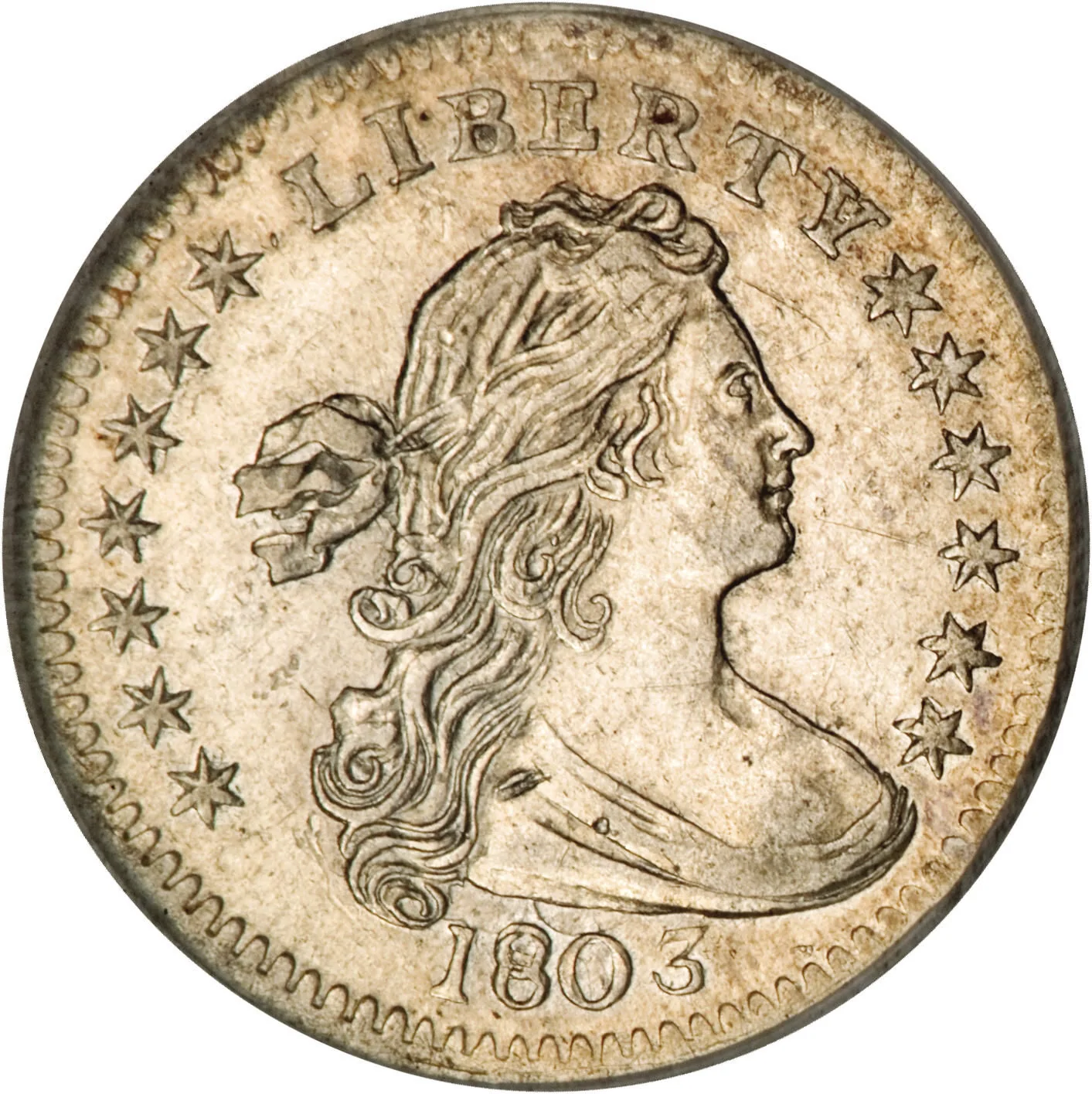
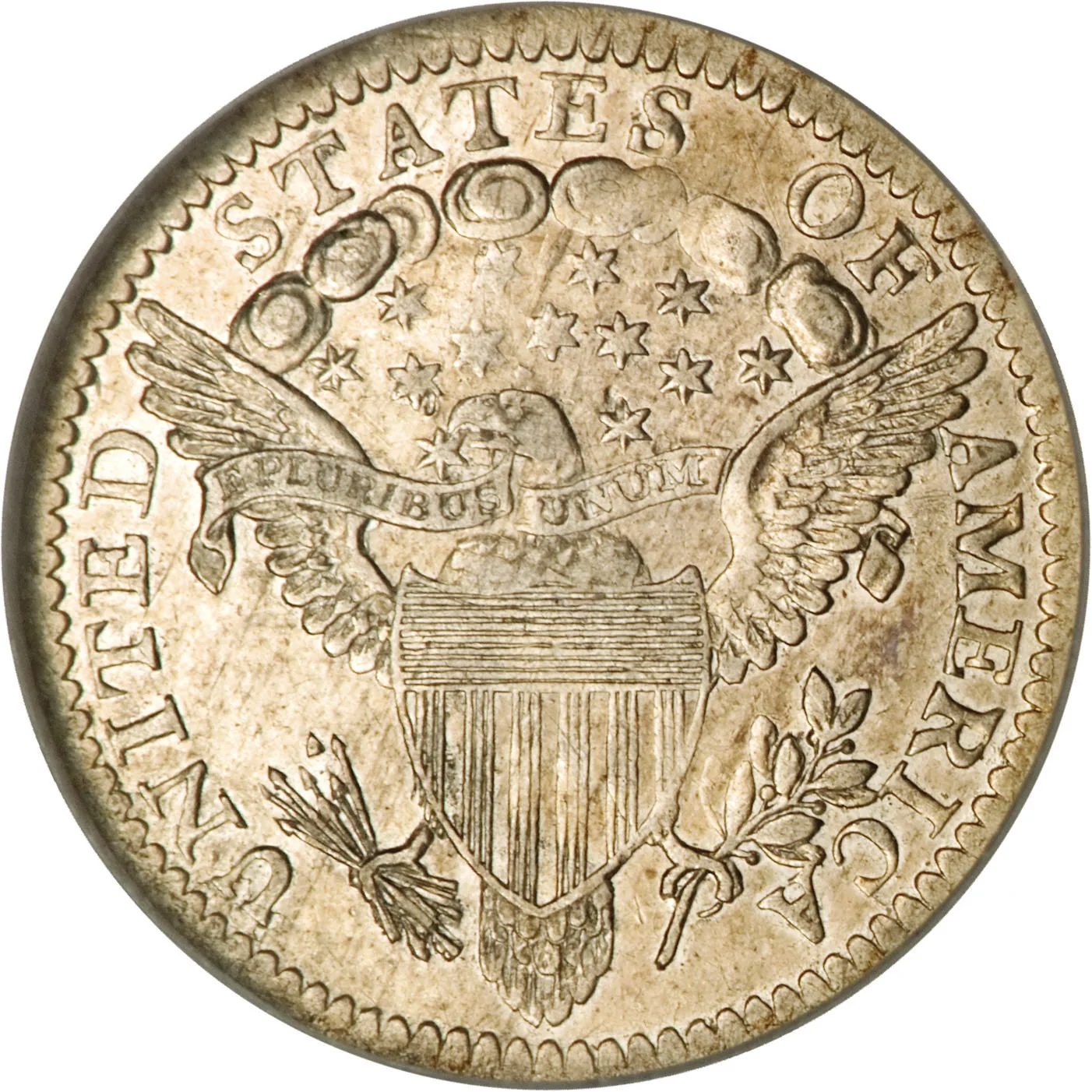
5 cents – United States
Add to wishlist
United States
Context
Years: 1800–1805
Issuer: United States
Period:
(since 1776)
Currency:
(since 1785)
Total mintage: 70,420
Material
References
KM: #
Numista: #30341
Value
Exchange value: 0.05 USD = $0.05
Bullion value: $3.08
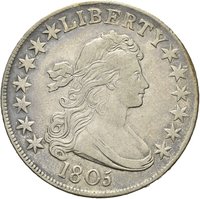
Obverse
Description:
Draped bust right between stars.
Inscription:
LIBERTY
1803
1803
Script: Latin
Engraver: Robert Scot
Designer: Gilbert Stuart
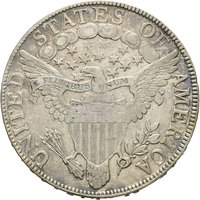
Reverse
Description:
Majestic heraldic eagle
Inscription:
UNITED STATES OF AMERICA
Script: Latin
Engraver: Robert Scot
Designer: Gilbert Stuart
Edge
Reeded
Mints
| Name | Mark |
|---|---|
| United States Mint of Philadelphia | — |
Mintings
| Year | Mint Mark | Mintage | Quality | Collection |
|---|---|---|---|---|
| 1800 | — | 24,000 | ||
| 1801 | — | 27,760 | ||
| 1802 | — | 3,060 | ||
| 1803 | — | — | ||
| 1805 | — | 15,600 |
Historical background
In the early years of the United States, the nation’s currency system was fragmented and unstable. Following the Revolutionary War, the federal government operated under the Articles of Confederation, which granted it no power to issue paper money or regulate currency. Consequently, a confusing mix of foreign coins (primarily Spanish dollars), state-chartered banknotes, and limited federal coinage circulated. These banknotes, issued by hundreds of different banks, traded at varying discounts depending on the perceived solvency of the issuing institution, leading to widespread confusion and facilitating counterfeiting.
The situation began to change with the ratification of the Constitution in 1789, which empowered Congress to "coin Money [and] regulate the Value thereof." Secretary of the Treasury Alexander Hamilton championed the establishment of a national mint and a stable monetary system. His 1790 Report on a National Bank led to the creation of the First Bank of the United States in 1791. While not issuing paper currency directly, this federally chartered bank helped discipline state banks by demanding they redeem their notes in specie (gold or silver), and its own notes served as a reliable national currency. The Coinage Act of 1792 established the U.S. Mint and defined the dollar based on a bimetallic standard of gold and silver.
Despite these federal efforts, the core tension between centralized control and decentralized banking persisted into the 1800s. The First Bank's charter was allowed to expire in 1811, reflecting deep political distrust of concentrated financial power. Thus, as the 19th century dawned, the United States still lacked a uniform national paper currency. The economy relied on a patchwork of state banknotes and specie, a system prone to wild fluctuations, local panics, and inflationary spirals whenever oversight was weak. This unstable foundation would lead to significant financial crises, most notably during the War of 1812, and set the stage for decades of political struggle over the nation's monetary soul.
The situation began to change with the ratification of the Constitution in 1789, which empowered Congress to "coin Money [and] regulate the Value thereof." Secretary of the Treasury Alexander Hamilton championed the establishment of a national mint and a stable monetary system. His 1790 Report on a National Bank led to the creation of the First Bank of the United States in 1791. While not issuing paper currency directly, this federally chartered bank helped discipline state banks by demanding they redeem their notes in specie (gold or silver), and its own notes served as a reliable national currency. The Coinage Act of 1792 established the U.S. Mint and defined the dollar based on a bimetallic standard of gold and silver.
Despite these federal efforts, the core tension between centralized control and decentralized banking persisted into the 1800s. The First Bank's charter was allowed to expire in 1811, reflecting deep political distrust of concentrated financial power. Thus, as the 19th century dawned, the United States still lacked a uniform national paper currency. The economy relied on a patchwork of state banknotes and specie, a system prone to wild fluctuations, local panics, and inflationary spirals whenever oversight was weak. This unstable foundation would lead to significant financial crises, most notably during the War of 1812, and set the stage for decades of political struggle over the nation's monetary soul.
💎 Very Rare