

20 Cash – Szechuan-Shensi Soviet
China
Context
Years: 1931–1934
Country: China 
Issuer: Szechuan-Shensi Soviet
Issuing organization: Szechuan-Shensi Soviet Worker's and Farmer's Bank
Currency:
(1930—1936)
Demonetized: Yes
Material
References
Numista: #298091
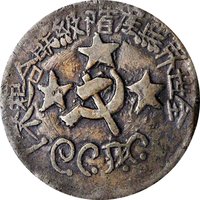
Obverse
Description:
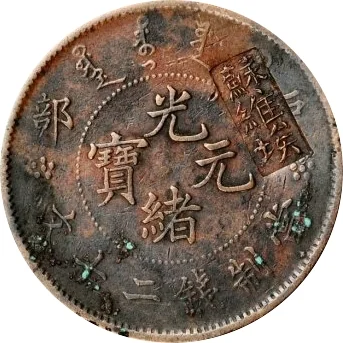
Four Chinese ideograms read vertically, right to left, with Manchu text above and surrounding characters, all with a countermark.
Inscription:
蘇
維
埃
ᠪᠠᡩᠠᡵᠠᠩᡤᠠ ᡩᠣᡵᠣ ᡳ ᠶᡠᠸᠠᠨ ᠪᠣᠣ
部戶
光
寶 元
緒
文十二錢制當
維
埃
ᠪᠠᡩᠠᡵᠠᠩᡤᠠ ᡩᠣᡵᠣ ᡳ ᠶᡠᠸᠠᠨ ᠪᠣᠣ
部戶
光
寶 元
緒
文十二錢制當
Translation:
SOVIET
BADARANGGADOROI YUWANBOO
MINISTRY OF HOUSEHOLD
GUANGXU
YUAN BAO
MADE IN THE 12TH YEAR OF THE GUANGXU REIGN, EQUIVALENT TO ONE COIN
BADARANGGADOROI YUWANBOO
MINISTRY OF HOUSEHOLD
GUANGXU
YUAN BAO
MADE IN THE 12TH YEAR OF THE GUANGXU REIGN, EQUIVALENT TO ONE COIN
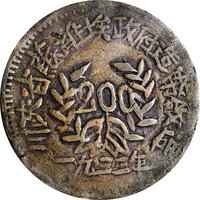
Reverse
Description:
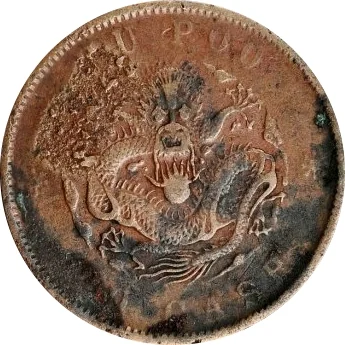
Dragon encircling a pearl, English legend above and below.
Inscription:
HU POO
20 CASH
20 CASH
Translation:
HU POO
20 CASH
20 CASH
Language: English
Edge
Plain
Mintings
| Year | Mint Mark | Mintage | Quality | Collection |
|---|---|---|---|---|
| — | — | — |
Historical background
The Szechuan-Shensi Soviet (also known as the Sichuan-Shaanxi Soviet), established in late 1932 and led by Zhang Guotao, faced immense economic challenges from its inception, including acute currency instability. Operating in a remote, blockaded, and impoverished region, the soviet's economy was primarily agrarian and lacked industrial capacity. To finance its military and administrative functions, the initial government resorted to issuing paper currency without sufficient reserves, leading to rapid depreciation and a loss of public trust. This was exacerbated by the circulation of various currencies from the ruling Kuomintang government, warlord regimes, and even foreign coins, creating a chaotic monetary environment that hampered trade and procurement.
In response, the soviet government undertook a deliberate currency reform to establish financial sovereignty and stabilize the local economy. In 1933, it founded the Szechuan-Shensi Soviet Worker-Peasant Bank, which issued new silver-backed banknotes. Crucially, the bank accumulated a hard currency reserve, reportedly including captured silver and sycee, to guarantee redemption and build credibility. The design of the notes featured revolutionary symbolism like hammers, sickles, and stars, serving both as economic instruments and propaganda tools. This move was a key part of a broader economic program that included establishing cooperatives and regulating markets to combat speculation and inflation.
The currency's stability and acceptance remained tenuous, directly tied to the soviet's military fortunes. While the reform initially boosted economic activity within the soviet zone by providing a unified medium of exchange, the constant warfare and tightening Nationalist blockades placed severe strain on resources. The bank's ability to maintain silver convertibility was periodically challenged. Ultimately, the currency's existence was coterminous with the soviet itself; when the Red Fourth Front Army was forced to abandon the base area in 1935 during the Long March, the Szechuan-Shensi Soviet currency ceased to function, leaving behind a brief but instructive episode of revolutionary financial experimentation under duress.
In response, the soviet government undertook a deliberate currency reform to establish financial sovereignty and stabilize the local economy. In 1933, it founded the Szechuan-Shensi Soviet Worker-Peasant Bank, which issued new silver-backed banknotes. Crucially, the bank accumulated a hard currency reserve, reportedly including captured silver and sycee, to guarantee redemption and build credibility. The design of the notes featured revolutionary symbolism like hammers, sickles, and stars, serving both as economic instruments and propaganda tools. This move was a key part of a broader economic program that included establishing cooperatives and regulating markets to combat speculation and inflation.
The currency's stability and acceptance remained tenuous, directly tied to the soviet's military fortunes. While the reform initially boosted economic activity within the soviet zone by providing a unified medium of exchange, the constant warfare and tightening Nationalist blockades placed severe strain on resources. The bank's ability to maintain silver convertibility was periodically challenged. Ultimately, the currency's existence was coterminous with the soviet itself; when the Red Fourth Front Army was forced to abandon the base area in 1935 during the Long March, the Szechuan-Shensi Soviet currency ceased to function, leaving behind a brief but instructive episode of revolutionary financial experimentation under duress.
✨ Legendary