

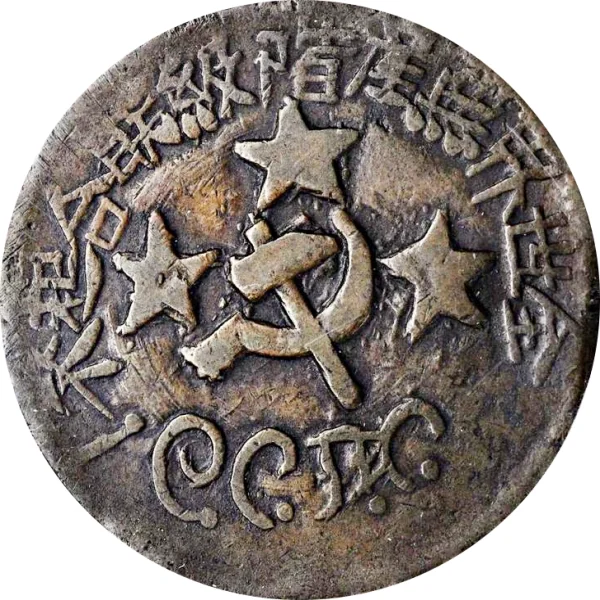
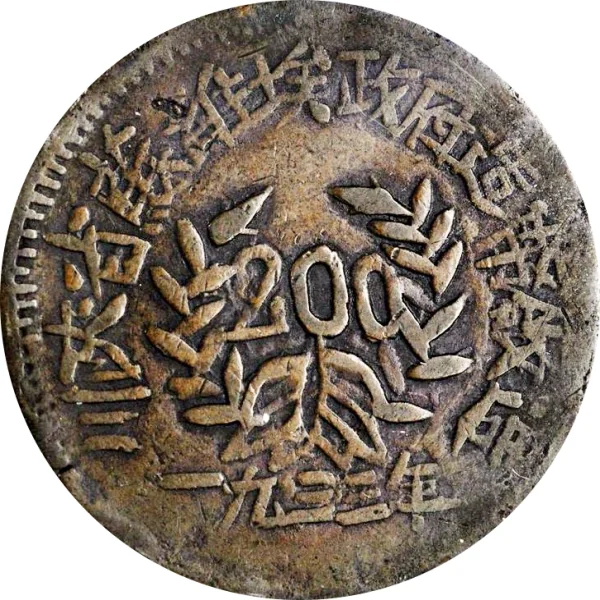
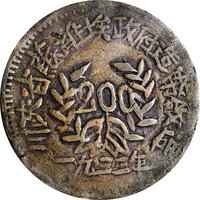
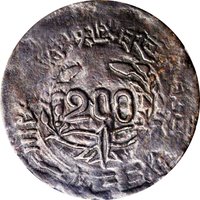
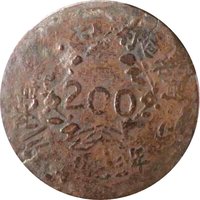
200 Cash – Szechuan-Shensi Soviet
China
Context
Years: 1933–1934
Country: China 
Issuer: Szechuan-Shensi Soviet
Issuing organization: Szechuan-Shensi Soviet Worker's and Farmer's Bank
Period:
(1927—1949)
Currency:
(1930—1936)
Demonetized: Yes
Material
References
Y: #Click to copy to clipboard510.1-3
Numista: #298075
Obverse
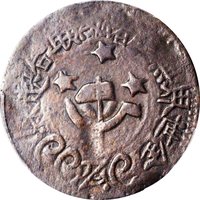
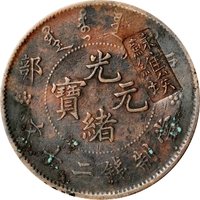
Reverse
Edge
Plain.
Categories
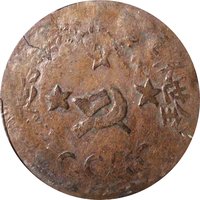
| Symbol> Hammer and sickle |
| Symbol> Wreath |
Mintings
| Year | Mint Mark | Mintage | Quality | Collection |
|---|---|---|---|---|
| 1933 | — | — | ||
| 1934 | — | — |
Historical background
The Szechuan-Shensi Soviet, established in late 1932 under the leadership of Zhang Guotao, faced severe economic challenges by 1933, with currency being a critical issue. The soviet's territory in the remote, impoverished border region of northeastern Sichuan and southern Shaanxi was under constant military pressure from both the Nationalist (KMT) government and local warlords, leading to economic blockade and instability. To finance its operations and administration, the soviet government initially relied on confiscation of wealth and issuance of bonds, but the need for a stable medium of exchange for daily transactions and to build economic legitimacy necessitated the creation of its own currency.
In 1933, the Szechuan-Shensi Soviet Bank was established and began issuing paper notes, known as "Soviet Currency" (Su bi). These notes were backed by a reserve of silver, copper, and strategic goods like salt and opium, which were critical resources in the region. The currency's design often featured revolutionary slogans and symbols like the hammer and sickle, serving a dual purpose as economic instrument and propaganda tool. However, its circulation was limited primarily to the core soviet areas, as its value and acceptance were heavily dependent on the military and political fortunes of the Red Fourth Front Army, which controlled the territory.
The currency situation remained precarious throughout 1933. Hyperinflation became a persistent threat due to over-issuance to meet military expenditures, undermining public confidence. Furthermore, the older, more trusted silver dollars (yuan) and copper coins continued to circulate in parallel, especially in border markets and among a skeptical peasantry. Consequently, the soviet's monetary system was a fragile and experimental component of its state-building project, constantly challenged by warfare, economic isolation, and the difficulty of establishing a sovereign financial system in a contested war zone.
In 1933, the Szechuan-Shensi Soviet Bank was established and began issuing paper notes, known as "Soviet Currency" (Su bi). These notes were backed by a reserve of silver, copper, and strategic goods like salt and opium, which were critical resources in the region. The currency's design often featured revolutionary slogans and symbols like the hammer and sickle, serving a dual purpose as economic instrument and propaganda tool. However, its circulation was limited primarily to the core soviet areas, as its value and acceptance were heavily dependent on the military and political fortunes of the Red Fourth Front Army, which controlled the territory.
The currency situation remained precarious throughout 1933. Hyperinflation became a persistent threat due to over-issuance to meet military expenditures, undermining public confidence. Furthermore, the older, more trusted silver dollars (yuan) and copper coins continued to circulate in parallel, especially in border markets and among a skeptical peasantry. Consequently, the soviet's monetary system was a fragile and experimental component of its state-building project, constantly challenged by warfare, economic isolation, and the difficulty of establishing a sovereign financial system in a contested war zone.
✨ Legendary