

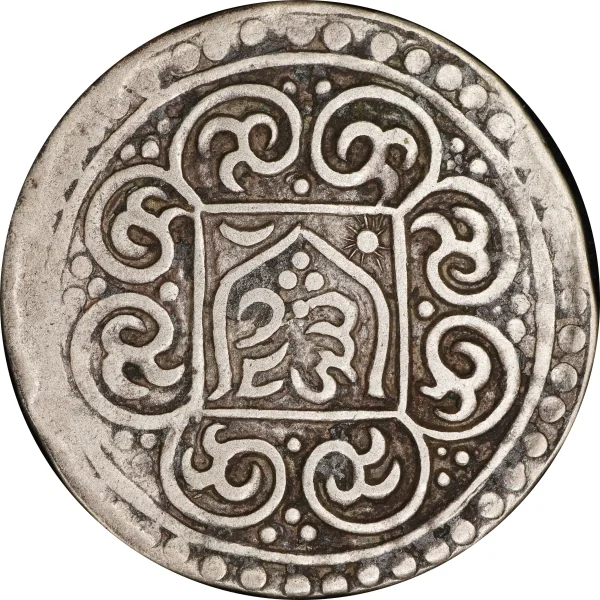

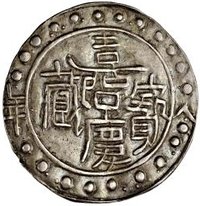
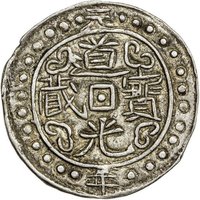
Obverse
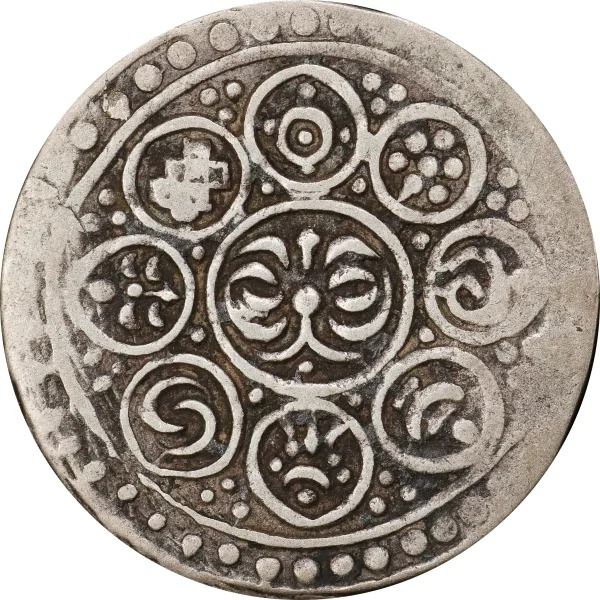
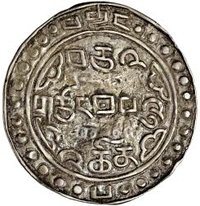
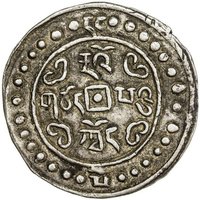
Reverse
Description:
A lotus encircled by the Eight Auspicious Symbols, all within an eight-petaled lotus.
Edge
Plain
Mints
| Name | Mark |
|---|---|
| Dopdal Mint | — |
Mintings
| Year | Mint Mark | Mintage | Quality | Collection |
|---|---|---|---|---|
| — | — | — |
Historical background
In 1820, Tibet operated under a distinct monetary system that was both isolated and intricately linked to its neighbors, primarily China and Nepal. The primary circulating currency was the Tibetan silver tangka (or tam), a coin minted locally in Lhasa and other centers. However, the system was not uniform or sovereign. A significant portion of the currency in circulation consisted of Nepalese mohars, a legacy of a 1792 treaty that required Nepal to mint coins for Tibet. While this arrangement provided a stable silver coin, it was a symbol of foreign influence and a point of political contention.
The monetary landscape was fundamentally shaped by Tibet's status within the Qing Empire. While internally autonomous, Tibet's foreign relations and major policies were overseen by Qing Ambans (imperial residents) and backed by Qing military garrisons. Chinese silver sycee, in the form of ingots, served as the high-value reserve currency for state finance, large transactions, and tax payments to the Qing administration. This created a dual-tier system: Chinese silver for official and wholesale trade, and a mix of Tibetan and Nepalese coinage for everyday local commerce.
This situation presented chronic challenges. The coexistence of multiple coinages led to complexities in exchange rates and valuation. Furthermore, concerns about the purity and weight of the Nepalese coins periodically caused friction. The year 1820 falls within a period of relative monetary stability under the Qing protectorate, but the underlying dependencies and lack of a fully independent minting policy left Tibet's economy vulnerable to the political and economic shifts of its more powerful neighbors. The system functioned for regional trade but reflected Tibet's constrained position in the early 19th-century geopolitical order.
The monetary landscape was fundamentally shaped by Tibet's status within the Qing Empire. While internally autonomous, Tibet's foreign relations and major policies were overseen by Qing Ambans (imperial residents) and backed by Qing military garrisons. Chinese silver sycee, in the form of ingots, served as the high-value reserve currency for state finance, large transactions, and tax payments to the Qing administration. This created a dual-tier system: Chinese silver for official and wholesale trade, and a mix of Tibetan and Nepalese coinage for everyday local commerce.
This situation presented chronic challenges. The coexistence of multiple coinages led to complexities in exchange rates and valuation. Furthermore, concerns about the purity and weight of the Nepalese coins periodically caused friction. The year 1820 falls within a period of relative monetary stability under the Qing protectorate, but the underlying dependencies and lack of a fully independent minting policy left Tibet's economy vulnerable to the political and economic shifts of its more powerful neighbors. The system functioned for regional trade but reflected Tibet's constrained position in the early 19th-century geopolitical order.
✨ Legendary