

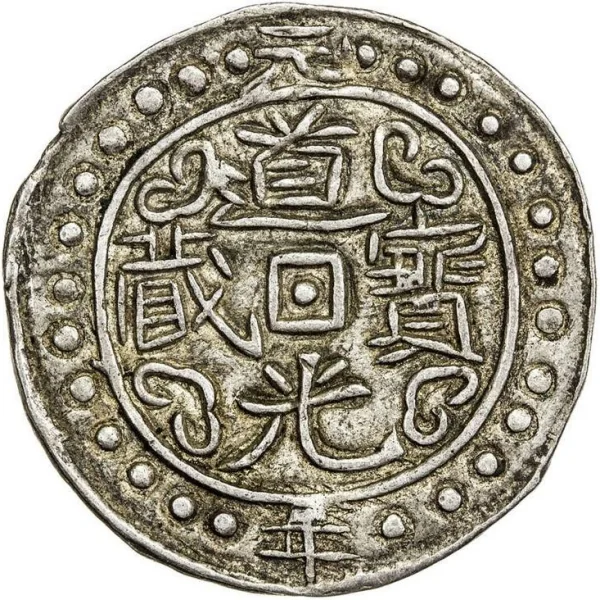
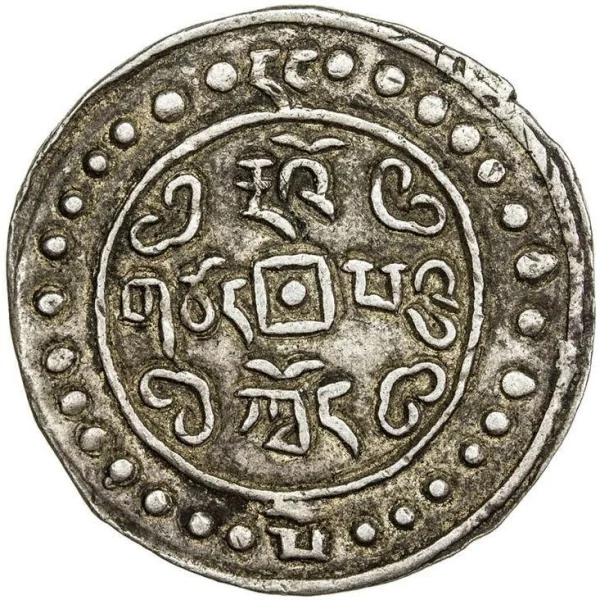

Obverse
Description:
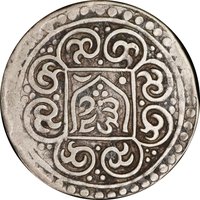
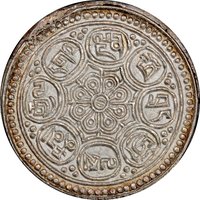
Four Chinese characters read vertically, right to left, with corner clouds and surrounding text indicating the year.
Inscription:
元
道
藏 通
光
年
道
藏 通
光
年
Translation:
Yuan
Dao
Cang Tong
Guang
Nian
Dao
Cang Tong
Guang
Nian
Scripts: Chinese (traditional, regular script)
Language: Chinese
Reverse
Edge
Plain
Mintings
| Year | Mint Mark | Mintage | Quality | Collection |
|---|---|---|---|---|
| 1821 | — | — | ||
| 1822 | — | — | ||
| 1823 | — | — | ||
| 1824 | — | — | ||
| 1835 | — | — | ||
| 1836 | — | — |
Historical background
In 1821, Tibet operated under a distinct monetary system that reflected its unique political and economic position within the Qing Empire. The primary currency in circulation was the Tibetan silver coin, known as the tangka or srang, which was minted locally in Lhasa under the authority of the Ganden Phodrang government. These coins, often struck from silver bullion imported from Nepal and China, were the standard for larger transactions and official purposes. However, the monetary landscape was not unified; alongside the tangka, Chinese silver sycee ingots (measured in taels) circulated for high-value trade, while smaller daily transactions were conducted using Chinese copper cash coins (zhiqian), which were imported in large quantities.
This multi-currency system created persistent challenges. The exchange rates between silver (tangka and sycee) and copper cash were volatile and a constant source of economic friction, especially for the peasantry who earned in copper but often paid taxes assessed in silver. Furthermore, the quality and weight of the Lhasa-minted tangka could vary, leading to disputes in trade. Crucially, Tibet's monetary autonomy was constrained by its subordination to Beijing. While the Qing Amban (imperial resident) in Lhasa oversaw broader policy, the 7th Panchen Lama, Palden Tenpai Nyima, and the 10th Dalai Lama, Tsultrim Gyatso (then a child), held religious authority, but the day-to-day fiscal and minting operations were managed by the Tibetan lay administration.
The year 1821 itself fell within a period of relative monetary stability under the Qing, following earlier turmoil in the late 18th century when Nepali-minted coins had dominated. The Qianlong Emperor's interventions had reasserted Tibetan minting rights, and by 1821, the system functioned under this settled, if complex, framework. The economy remained largely monastic, agrarian, and trade-based, with currency needs heavily influenced by taxation, religious offerings, and the bustling trans-Himalayan trade routes linking China, Nepal, and British India. Thus, Tibet's currency situation was a fragile equilibrium of local production, foreign bullion, and imperial oversight.
This multi-currency system created persistent challenges. The exchange rates between silver (tangka and sycee) and copper cash were volatile and a constant source of economic friction, especially for the peasantry who earned in copper but often paid taxes assessed in silver. Furthermore, the quality and weight of the Lhasa-minted tangka could vary, leading to disputes in trade. Crucially, Tibet's monetary autonomy was constrained by its subordination to Beijing. While the Qing Amban (imperial resident) in Lhasa oversaw broader policy, the 7th Panchen Lama, Palden Tenpai Nyima, and the 10th Dalai Lama, Tsultrim Gyatso (then a child), held religious authority, but the day-to-day fiscal and minting operations were managed by the Tibetan lay administration.
The year 1821 itself fell within a period of relative monetary stability under the Qing, following earlier turmoil in the late 18th century when Nepali-minted coins had dominated. The Qianlong Emperor's interventions had reasserted Tibetan minting rights, and by 1821, the system functioned under this settled, if complex, framework. The economy remained largely monastic, agrarian, and trade-based, with currency needs heavily influenced by taxation, religious offerings, and the bustling trans-Himalayan trade routes linking China, Nepal, and British India. Thus, Tibet's currency situation was a fragile equilibrium of local production, foreign bullion, and imperial oversight.
✨ Legendary