

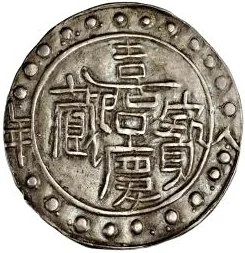
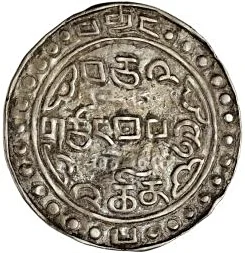

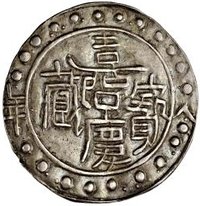
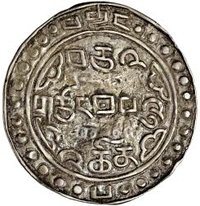
Obverse
Description:
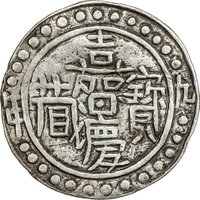
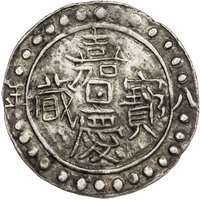
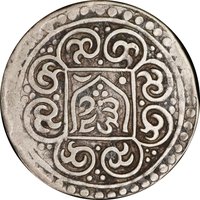
Four Chinese characters read vertically, right to left, surrounded by others indicating the year.
Inscription:
嘉
年藏 通八
慶
年藏 通八
慶
Translation:
Jiaqing Era, Circulating Treasure.
Scripts: Chinese (traditional, regular script)
Language: Classical Chinese
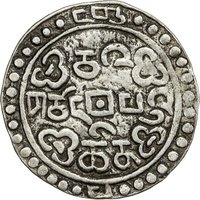
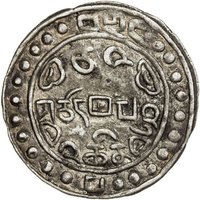
Reverse
Edge
Plain
Mintings
| Year | Mint Mark | Mintage | Quality | Collection |
|---|---|---|---|---|
| 1803 | — | — |
Historical background
In 1803, Tibet operated under a distinct monetary system that was deeply intertwined with both its regional autonomy within the Qing Empire and its long-standing economic ties to Nepal. The primary circulating currency was the Nepalese silver mohar, a coin minted in Kathmandu. This reliance on foreign coinage stemmed from a 1792 treaty, imposed by a victorious Qing China after a Nepalese invasion, which required Nepal to send an annual tribute of coins to Lhasa. While this secured a flow of currency, it left Tibet's economy vulnerable to the quality and quantity of coins supplied by a sometimes-reluctant Nepal.
The Qing authorities, through their Ambans (imperial residents) in Lhasa, were acutely aware of the problems this dependency caused. The Nepalese mohars were often debased with copper, leading to fluctuations in value and hindering trade. Furthermore, the system was a symbolic affront to Qing sovereignty. Consequently, the Qianlong Emperor had previously ordered the minting of a local Tibetan silver coin, the "Tangka of the Ganden Phodrang," first produced in 1793. By 1803, these new coins, bearing Tibetan legends and the imperial "Precious Realm" (Baozhang) mark, were in circulation alongside the older Nepalese coins, representing a direct assertion of Chinese monetary authority.
Thus, the currency situation in 1803 was one of transition and duality. The economy functioned on a bimetallic system of silver and alloyed coins, with the older, familiar Nepalese mohars coexisting with the newer, officially sanctioned Qing-sponsored tangkas. This period was characterized by efforts to stabilize the medium of exchange and assert political control, setting the stage for the eventual phasing out of Nepalese coinage and the fuller integration of Tibet's monetary system into the Qing administrative framework in the following decades.
The Qing authorities, through their Ambans (imperial residents) in Lhasa, were acutely aware of the problems this dependency caused. The Nepalese mohars were often debased with copper, leading to fluctuations in value and hindering trade. Furthermore, the system was a symbolic affront to Qing sovereignty. Consequently, the Qianlong Emperor had previously ordered the minting of a local Tibetan silver coin, the "Tangka of the Ganden Phodrang," first produced in 1793. By 1803, these new coins, bearing Tibetan legends and the imperial "Precious Realm" (Baozhang) mark, were in circulation alongside the older Nepalese coins, representing a direct assertion of Chinese monetary authority.
Thus, the currency situation in 1803 was one of transition and duality. The economy functioned on a bimetallic system of silver and alloyed coins, with the older, familiar Nepalese mohars coexisting with the newer, officially sanctioned Qing-sponsored tangkas. This period was characterized by efforts to stabilize the medium of exchange and assert political control, setting the stage for the eventual phasing out of Nepalese coinage and the fuller integration of Tibet's monetary system into the Qing administrative framework in the following decades.
✨ Legendary