

1 franc – French Polynesia
Add to wishlist
France
Context
Years: 1975–2020
Country: France
Issuer: French Polynesia
Issuing organization: Overseas Institution of Issue
Period:
(1957—2003)
Currency:
(since 1945)
Demonetization: 30 November 2022
Total mintage: 71,789,200
Material
References
KM: #
Numista: #1352
Value
Exchange value: 1 XPF
Inflation-adjusted value: 6.18 XPF
Obverse
Description:
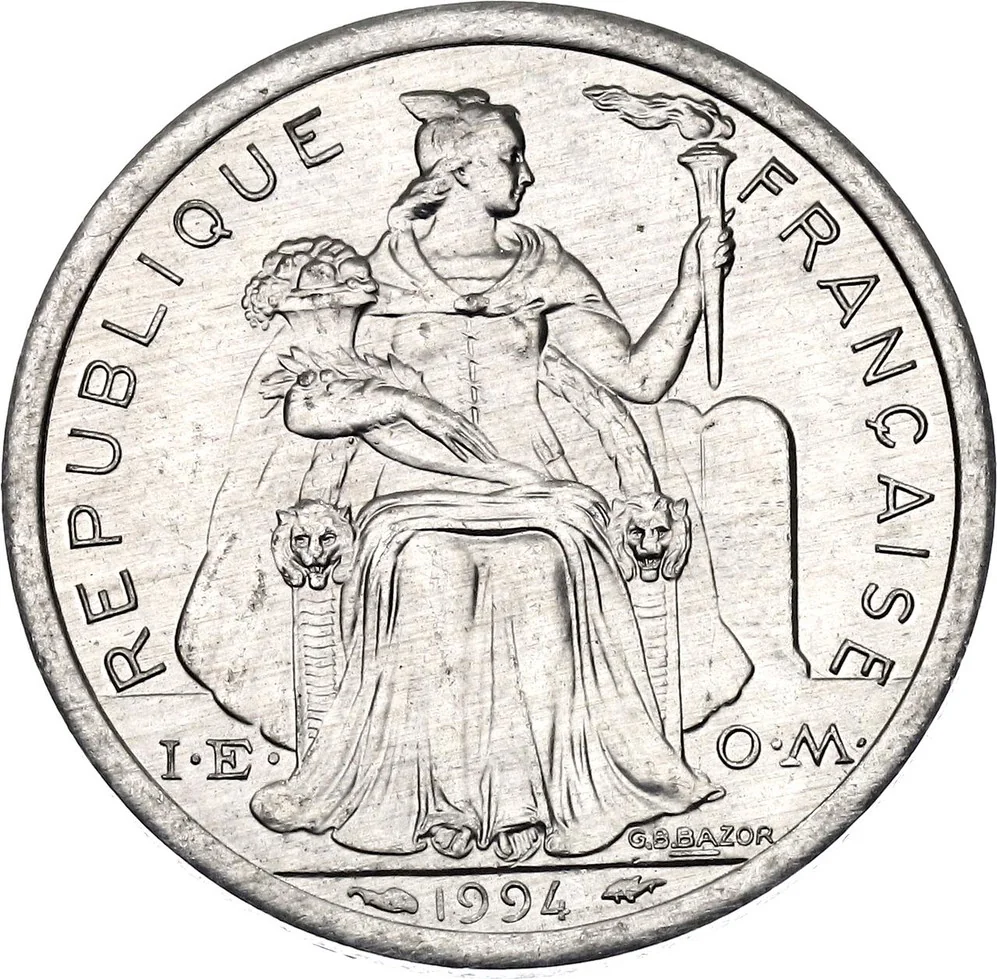
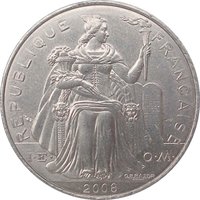
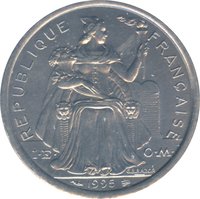
Liberty seated left on throne, holding a lit torch in her left hand and a cornucopia of fruit in her right arm.
Inscription:
REPUBLIQUE FRANÇAISE
I·E· O·M·
G.B.BAZOR
2007
I·E· O·M·
G.B.BAZOR
2007
Translation:
FRENCH REPUBLIC
JESUS OF NAZARETH, KING OF THE JEWS
G.B.BAZOR
2007
JESUS OF NAZARETH, KING OF THE JEWS
G.B.BAZOR
2007
Script: Latin
Engraver: Lucien Georges Bazor
Reverse
Description:
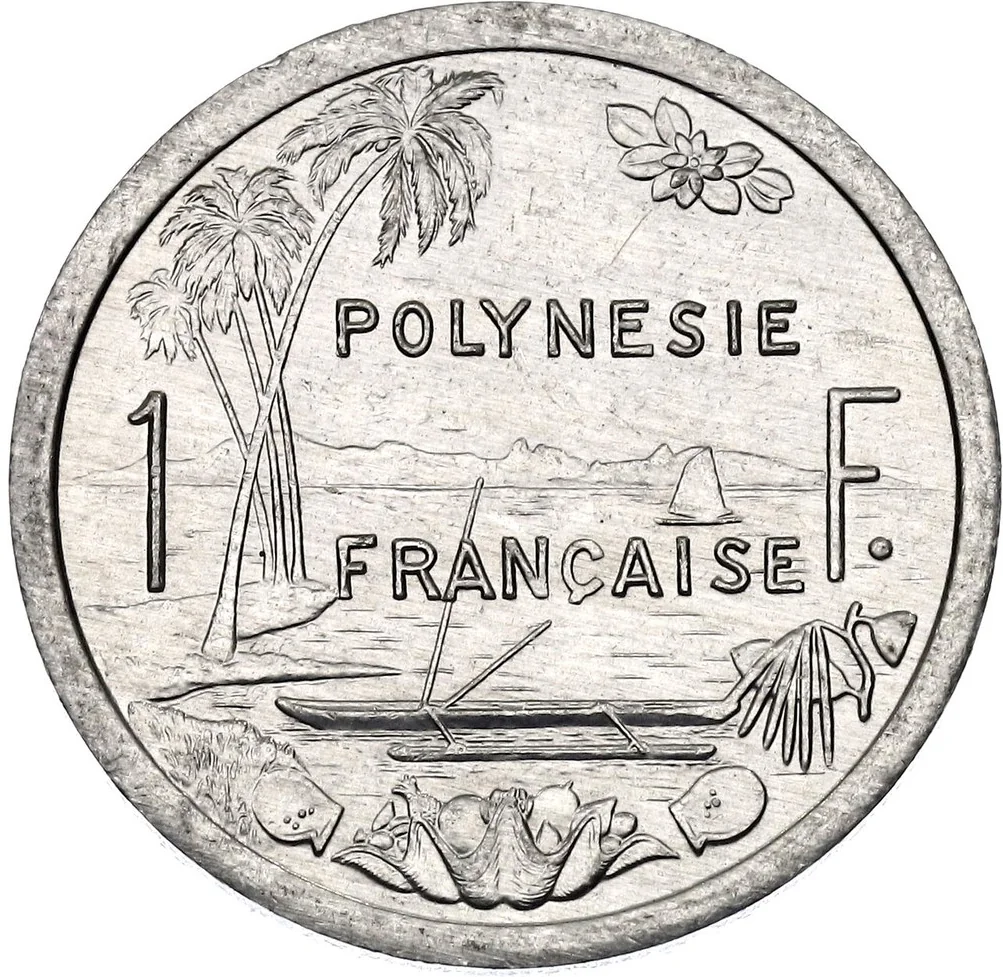
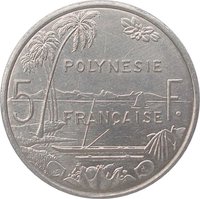
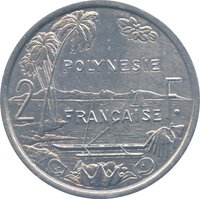
Palm trees left, sea with sailboat center, distant mountains. Outrigger boat and fruit in foreground.
Inscription:
POLYNESIE
1 F.
FRANÇAISE
1 F.
FRANÇAISE
Translation:
French Polynesia
1 Franc
1 Franc
Script: Latin
Language: French
Engraver: Lucien Georges Bazor
Edge
Plain
Categories
| Symbol> Allegory |
| Plant> Tree |
| Symbol> Cornucopia |
| Transportation> Watercraft |
Mints
| Name | Mark |
|---|---|
| Monnaie de Paris | — |
Mintings
| Year | Mint Mark | Mintage | Quality | Collection |
|---|---|---|---|---|
| 1975 | — | 2,000,000 | ||
| 1977 | — | 2,000,000 | ||
| 1979 | — | 1,500,200 | ||
| 1981 | — | 2,000,200 | ||
| 1982 | — | 1,000,200 | ||
| 1983 | — | 2,200,200 | ||
| 1984 | — | 1,500,200 | ||
| 1985 | — | 2,000,200 | ||
| 1986 | — | 2,000,000 | ||
| 1987 | — | 2,000,000 | ||
| 1989 | — | 1,000,000 | ||
| 1990 | — | 1,488,000 | ||
| 1991 | — | 1,440,000 | ||
| 1992 | — | 800,000 | ||
| 1993 | — | 2,272,000 | ||
| 1994 | — | 1,000,000 | ||
| 1995 | — | 1,040,000 | ||
| 1996 | — | 2,696,000 | ||
| 1997 | — | 1,104,000 | ||
| 1998 | — | 1,600,000 | ||
| 1999 | — | 2,560,000 | ||
| 2000 | — | 3,024,000 | ||
| 2001 | — | 2,920,000 | ||
| 2002 | — | 1,600,000 | ||
| 2003 | — | 4,200,000 | ||
| 2004 | — | 2,400,000 | ||
| 2005 | — | — | ||
| 2006 | — | 2,080,000 | ||
| 2007 | — | 3,360,000 | ||
| 2008 | — | 4,800,000 | ||
| 2009 | — | 3,240,000 | ||
| 2010 | — | — | ||
| 2011 | — | 2,160,000 | ||
| 2012 | — | 405,000 | ||
| 2013 | — | — | ||
| 2014 | — | 1,620,000 | ||
| 2015 | — | 2,106,000 | ||
| 2016 | — | — | ||
| 2017 | — | 2,025,000 | ||
| 2018 | — | 648,000 | ||
| 2019 | — | — | ||
| 2020 | — | — |
Historical background
In 1975, French Polynesia's currency situation was fundamentally defined by its political status as an overseas territory of France. Consequently, the legal tender was the French Pacific franc, officially the CFP franc (franc des Colonies Françaises du Pacifique), which had been created in 1945. This currency was issued by the Institut d'Émission d'Outre-Mer (IEOM) and was pegged at a fixed rate to the French franc, guaranteeing monetary stability and a direct financial link to the metropole. For the local economy, this meant that monetary policy, inflation control, and exchange rates were entirely managed by French authorities, with the territory having no independent central bank or currency.
The year 1975 fell within a period of significant economic transition for the territory, driven by the establishment of the Centre d'Expérimentation du Pacifique (CEP) in 1963. The French nuclear testing program injected substantial French public funds into the local economy, creating a boom in infrastructure and services and shifting the economic center of gravity toward Tahiti and the administrative hub of Papeete. This influx cemented the dominance of the CFP franc and deepened the territory's economic dependence on France, as the currency served as the conduit for these vital financial transfers and the salaries of a growing public sector.
Therefore, the currency landscape in 1975 was one of imposed stability and deep integration. While the fixed peg to the French franc shielded the territory from volatility and facilitated imports, it also meant that French Polynesia had no autonomous monetary tools to respond to local economic conditions. The CFP franc was a clear symbol of French sovereignty, a reality further underscored by the ongoing economic reliance on the nuclear testing program. This arrangement would remain largely unchanged until a formal revision of the peg in 1999, following the introduction of the European euro.
The year 1975 fell within a period of significant economic transition for the territory, driven by the establishment of the Centre d'Expérimentation du Pacifique (CEP) in 1963. The French nuclear testing program injected substantial French public funds into the local economy, creating a boom in infrastructure and services and shifting the economic center of gravity toward Tahiti and the administrative hub of Papeete. This influx cemented the dominance of the CFP franc and deepened the territory's economic dependence on France, as the currency served as the conduit for these vital financial transfers and the salaries of a growing public sector.
Therefore, the currency landscape in 1975 was one of imposed stability and deep integration. While the fixed peg to the French franc shielded the territory from volatility and facilitated imports, it also meant that French Polynesia had no autonomous monetary tools to respond to local economic conditions. The CFP franc was a clear symbol of French sovereignty, a reality further underscored by the ongoing economic reliance on the nuclear testing program. This arrangement would remain largely unchanged until a formal revision of the peg in 1999, following the introduction of the European euro.
🌱 Very Common