

2 francs – French Polynesia
Add to wishlist
France
Context
Years: 1973–2020
Country: France
Issuer: French Polynesia
Issuing organization: Overseas Institution of Issue
Period:
(1957—2003)
Currency:
(since 1945)
Demonetization: 30 November 2022
Total mintage: 57,482,100
Material
References
KM: #
Numista: #1350
Value
Exchange value: 2 XPF
Inflation-adjusted value: 15.08 XPF
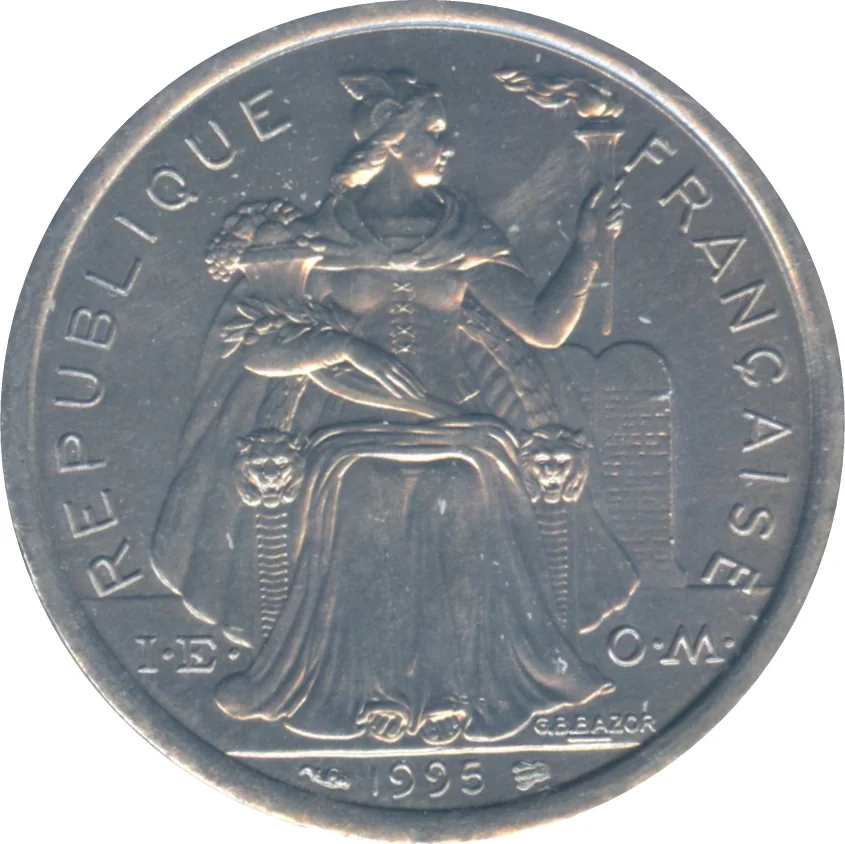
Obverse
Description:
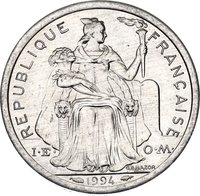
Liberty seated left on throne, holding a lit torch in her left hand and a cornucopia of fruit in her right arm.
Inscription:
REPUBLIQUE FRANÇAISE
I·E· O·M·
G.B.BAZOR
1995
I·E· O·M·
G.B.BAZOR
1995
Translation:
FRENCH REPUBLIC
JESUS, SAVIOR OF MANKIND
G.B.BAZOR
1995
JESUS, SAVIOR OF MANKIND
G.B.BAZOR
1995
Script: Latin
Engraver: Lucien Georges Bazor
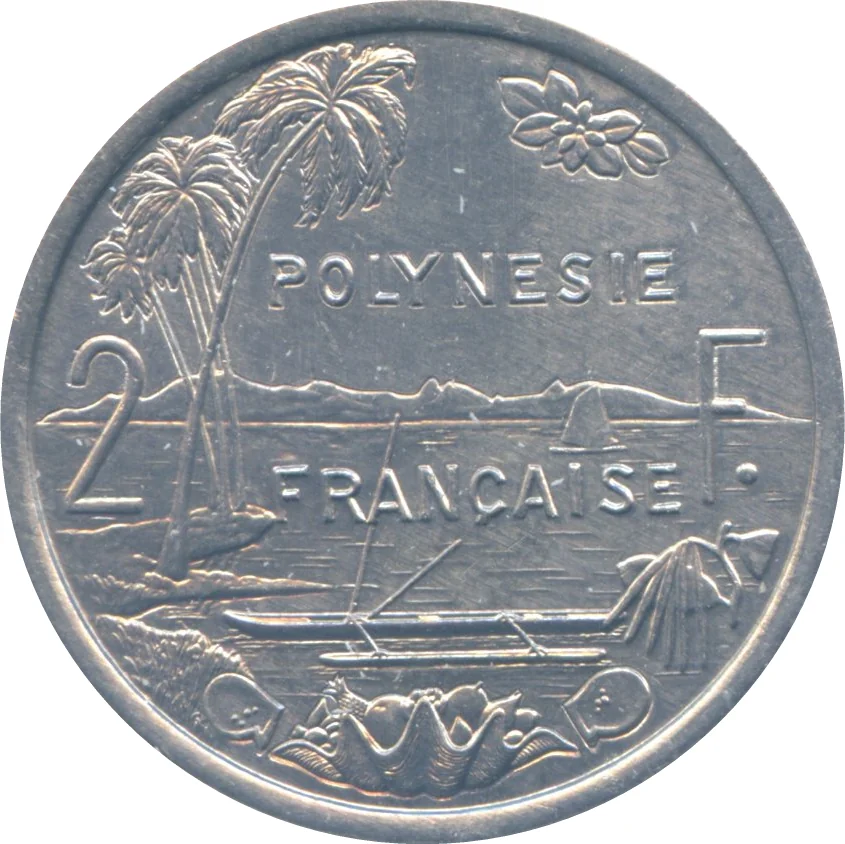
Reverse
Description:
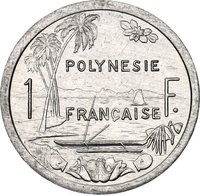
Palm trees left, sailboat on sea, distant mountains. Outrigger boat and fruit in foreground.
Inscription:
POLYNESIE
2 F.
FRANÇAISE
2 F.
FRANÇAISE
Translation:
French Polynesia
2 Francs
2 Francs
Script: Latin
Language: French
Engraver: Lucien Georges Bazor
Edge
Plain
Categories
| Symbol> Allegory |
| Plant> Tree |
| Symbol> Cornucopia |
| Transportation> Watercraft |
Mints
| Name | Mark |
|---|---|
| Monnaie de Paris | — |
Mintings
| Year | Mint Mark | Mintage | Quality | Collection |
|---|---|---|---|---|
| 1973 | — | 400,100 | ||
| 1975 | — | 1,000,000 | ||
| 1977 | — | 1,000,000 | ||
| 1979 | — | 2,000,200 | ||
| 1982 | — | 1,000,200 | ||
| 1983 | — | 1,500,200 | ||
| 1984 | — | 1,200,200 | ||
| 1985 | — | 1,400,200 | ||
| 1986 | — | 1,500,000 | ||
| 1987 | — | 1,000,000 | ||
| 1988 | — | 500,000 | ||
| 1989 | — | 1,000,000 | ||
| 1990 | — | 1,500,000 | ||
| 1991 | — | 1,500,000 | ||
| 1992 | — | — | ||
| 1993 | — | 1,376,000 | ||
| 1995 | — | 1,248,000 | ||
| 1996 | — | 2,200,000 | ||
| 1997 | — | 1,300,000 | ||
| 1998 | — | 560,000 | ||
| 1999 | — | 2,800,000 | ||
| 2000 | — | 1,580,000 | ||
| 2001 | — | 2,448,000 | ||
| 2002 | — | 2,480,000 | ||
| 2003 | — | 3,200,000 | ||
| 2004 | — | 2,960,000 | ||
| 2005 | — | 944,000 | ||
| 2006 | — | 1,600,000 | ||
| 2007 | — | 1,440,000 | ||
| 2008 | — | 1,920,000 | ||
| 2009 | — | 1,620,000 | ||
| 2010 | — | 2,400,000 | ||
| 2011 | — | 1,605,500 | ||
| 2012 | — | 591,500 | ||
| 2013 | — | — | ||
| 2014 | — | 1,664,000 | ||
| 2015 | — | 1,664,000 | ||
| 2016 | — | 468,000 | ||
| 2017 | — | 1,872,000 | ||
| 2018 | — | 1,040,000 | ||
| 2019 | — | — | ||
| 2020 | — | — |
Historical background
In 1973, French Polynesia's currency situation was intrinsically tied to its political status as an overseas territory of France. The sole legal tender was the CFP franc (Franc des Colonies Françaises du Pacifique), a currency created in 1945 and guaranteed by the French Treasury. This arrangement ensured monetary stability and fixed parity with the French franc, insulating the territory from local inflationary pressures but also ceding all monetary sovereignty to Paris. The economy, heavily reliant on French military spending related to the nuclear testing program at Moruroa and Fangataufa atolls, was thus underpinned by a predictable and externally managed currency system.
The year 1973 fell within a period of significant economic and social transformation for the territory. The ongoing nuclear tests, while a source of substantial revenue and infrastructure investment, also sparked growing political dissent and calls for greater autonomy. Monetarily, however, there was no serious challenge to the CFP franc system. The fixed exchange rate (1 French franc = 18.18 CFP francs, established in 1949) facilitated trade and investment with the metropole and was seen as a pillar of economic development. The currency's stability was particularly crucial for the nascent tourism industry, which was beginning to be promoted as a future economic pillar alongside the dominant military sector.
Therefore, the currency background in French Polynesia in 1973 is one of colonial-era continuity rather than change. The CFP franc system represented a core element of French administrative and economic control, providing stability but also symbolizing dependency. While political debates about autonomy and the environmental impact of nuclear testing were intensifying, the question of an independent currency was not a prominent issue. The monetary landscape would remain unchanged until the 1999 reform, which redefined the CFP franc to be pegged to the euro, reflecting France's own shift in monetary policy within the European Union.
The year 1973 fell within a period of significant economic and social transformation for the territory. The ongoing nuclear tests, while a source of substantial revenue and infrastructure investment, also sparked growing political dissent and calls for greater autonomy. Monetarily, however, there was no serious challenge to the CFP franc system. The fixed exchange rate (1 French franc = 18.18 CFP francs, established in 1949) facilitated trade and investment with the metropole and was seen as a pillar of economic development. The currency's stability was particularly crucial for the nascent tourism industry, which was beginning to be promoted as a future economic pillar alongside the dominant military sector.
Therefore, the currency background in French Polynesia in 1973 is one of colonial-era continuity rather than change. The CFP franc system represented a core element of French administrative and economic control, providing stability but also symbolizing dependency. While political debates about autonomy and the environmental impact of nuclear testing were intensifying, the question of an independent currency was not a prominent issue. The monetary landscape would remain unchanged until the 1999 reform, which redefined the CFP franc to be pegged to the euro, reflecting France's own shift in monetary policy within the European Union.
🌱 Very Common