

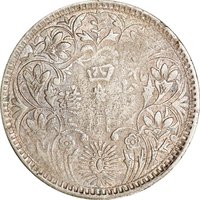
Obverse
Description:
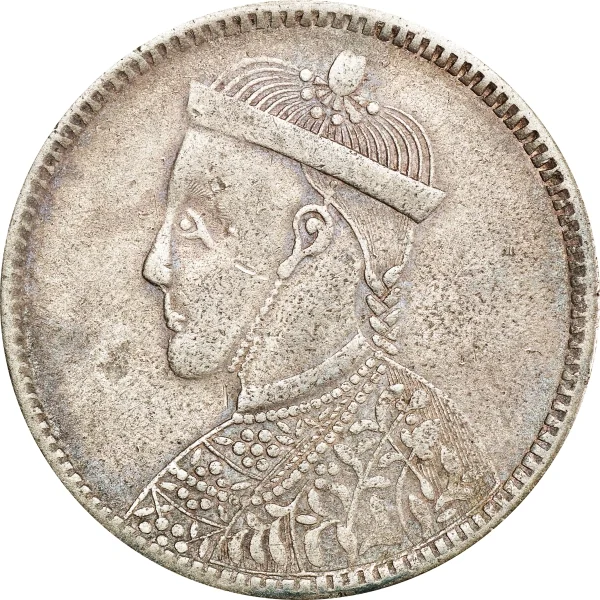
Guangxu bust in cap and floral robe, facing left.
Reverse
Description:
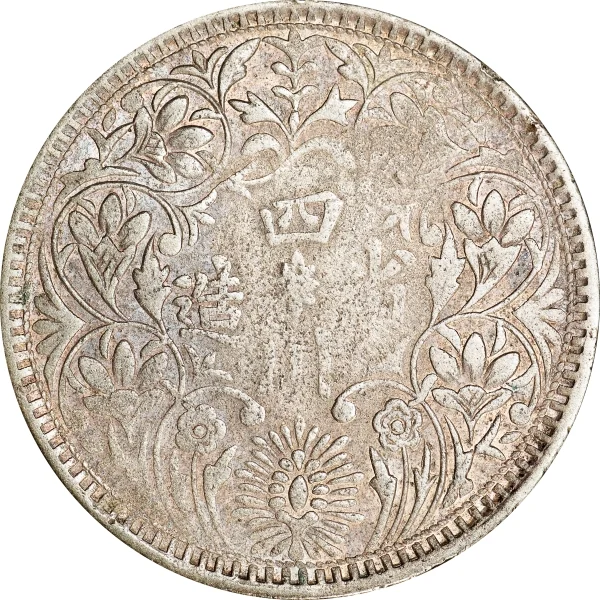
Four Chinese characters read vertically around a central flower, enclosed by a floral wreath.
Inscription:
四
造 省
川
造 省
川
Translation:
Made by the Ministry of Revenue of Sichuan.
Scripts: Chinese (traditional, regular script)
Language: Chinese
Edge
Reeded.
Mintings
| Year | Mint Mark | Mintage | Quality | Collection |
|---|---|---|---|---|
| — | — | — |
Historical background
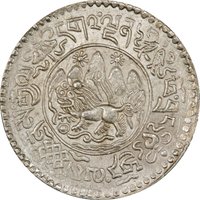
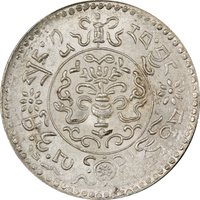
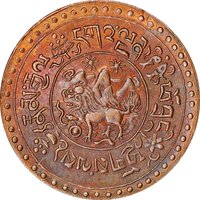
In 1939, the currency situation in Tibet was complex and transitional, reflecting the region's precarious political position between de facto independence and the looming influence of neighboring powers. The primary currency in circulation was the Tibetan srang, a silver coin minted by the government in Lhasa. However, the monetary system was not unified; alongside the srang, Indian rupees, Chinese silver dollars (particularly "Dayang" or "Fat Man" dollars from Sichuan and Yunnan), and even raw silver bullion circulated widely, especially in border trade. This created a multi-currency environment where exchange rates fluctuated based on silver content, trade flows, and merchant agreements.
The Tibetan government, seeking to assert economic sovereignty, had established a mint in 1932 and was actively producing its own coinage to reduce dependence on foreign silver. However, the economy remained fundamentally tied to silver, and the government lacked a central banking authority or paper currency, limiting its control over the money supply. Major trading firms and monastic institutions often acted as de facto banks, providing credit and influencing local exchange. The outbreak of the Second Sino-Japanese War in 1937 further complicated matters, disrupting traditional trade routes and affecting the inflow of Chinese silver, upon which much of the border economy relied.
Geopolitically, the currency landscape was a microcosm of Tibet's struggle for autonomy. The continued circulation of Chinese dollars symbolized historical ties and the Republic of China's persistent claims over the territory, while the prevalence of Indian rupees underscored Tibet's vital economic linkage to British India. In this pivotal year, the Tibetan monetary system was thus a fragmented and metallic-based one, caught between traditional practices, internal efforts at modernization, and the competing gravitational pulls of China and the British Empire in India.
The Tibetan government, seeking to assert economic sovereignty, had established a mint in 1932 and was actively producing its own coinage to reduce dependence on foreign silver. However, the economy remained fundamentally tied to silver, and the government lacked a central banking authority or paper currency, limiting its control over the money supply. Major trading firms and monastic institutions often acted as de facto banks, providing credit and influencing local exchange. The outbreak of the Second Sino-Japanese War in 1937 further complicated matters, disrupting traditional trade routes and affecting the inflow of Chinese silver, upon which much of the border economy relied.
Geopolitically, the currency landscape was a microcosm of Tibet's struggle for autonomy. The continued circulation of Chinese dollars symbolized historical ties and the Republic of China's persistent claims over the territory, while the prevalence of Indian rupees underscored Tibet's vital economic linkage to British India. In this pivotal year, the Tibetan monetary system was thus a fragmented and metallic-based one, caught between traditional practices, internal efforts at modernization, and the competing gravitational pulls of China and the British Empire in India.
💎 Extremely Rare