

3 Sho – Tibet
China
Context
Year: 1946
Tibetan (16th cycle) Year: 20
Country: China 
Issuer: Tibet
Period:
(1642—1959)
Currency:
(1792—1959)
Demonetized: Yes
Material
References
Y: #Click to copy to clipboard27
Numista: #31840
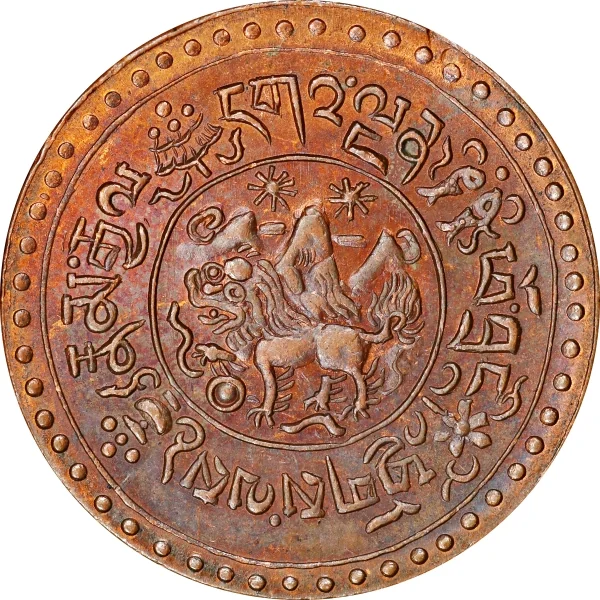
Obverse
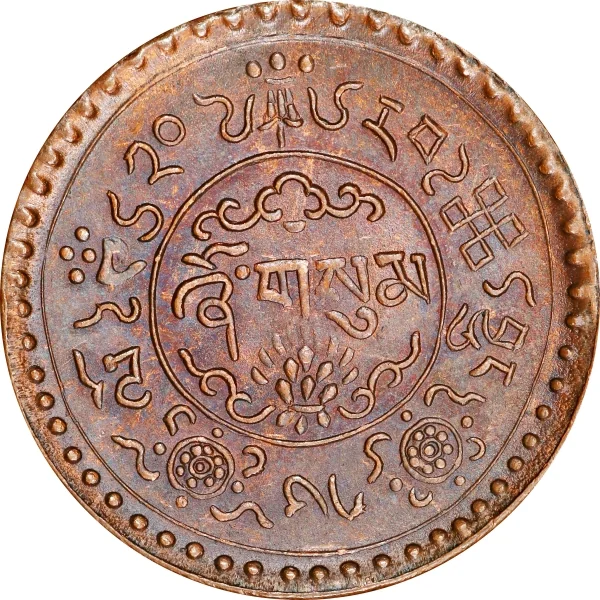
Reverse
Description:
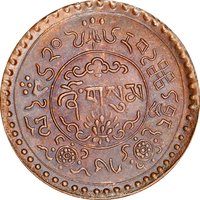
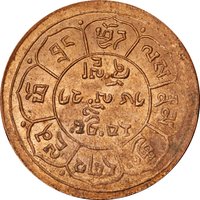
Tibetan characters with a cloud above and a triratna below, encircled by four Buddhist auspicious symbols: a parasol, conch shell, dharma wheel, and endless knot.
Inscription:
རབ་བྱུང་ ༡༦་ ལོ་ ༢༠་
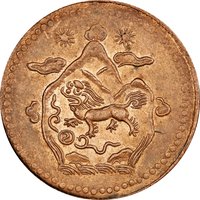
ཞོ་ གསུམ་
ཞོ་ གསུམ་
Translation:
Sixteenth Rabjung, year twenty,
three sho.
three sho.
Script: Tibetan
Language: Tibetan
Edge
Plain
Mintings
| Year | Mint Mark | Mintage | Quality | Collection |
|---|---|---|---|---|
| 1946 | — | — |
Historical background
In 1946, Tibet's currency situation reflected its unique political status as a de facto independent entity, though one contested by the Republic of China. The primary circulating currency was the Tibetan srang, a silver coin first minted in 1909, supplemented by smaller denomination skar and zho coins and paper notes issued by the Dalai Lama's government. This system was largely insular, with the Tibetan srang valued differently from Chinese yuan or Indian rupees, underscoring Lhasa's control over its own fiscal and monetary policy. However, the economy remained heavily agrarian and reliant on traditional trade, with limited modern banking infrastructure.
The region existed within a complex monetary zone, as Chinese yuan notes from the neighboring provinces of the Republic of China also circulated, particularly in eastern border areas. More significantly, the Indian rupee, especially the silver rupee coins of British India, played a crucial role in external trade and held substantial influence in major trade centers. This created a multi-currency environment where Tibetan, Chinese, and Indian currencies all had roles, with exchange rates fluctuating based on trade flows and the intrinsic silver content of the coins.
This period represented the final years of a distinct Tibetan monetary system before the major political changes to come. The Republic of China, under the Kuomintang, consistently asserted sovereignty and included Tibet in its official maps, but in 1946 it exercised no practical control over Lhasa's treasury or mint. The relative stability of the silver-based srang stood in contrast to the hyperinflation beginning to ravage the Chinese yuan due to the Chinese Civil War. However, Tibet's monetary isolation and economic fragility would soon face unprecedented challenges following the establishment of the People's Republic of China in 1949 and its subsequent projection of power into the region.
The region existed within a complex monetary zone, as Chinese yuan notes from the neighboring provinces of the Republic of China also circulated, particularly in eastern border areas. More significantly, the Indian rupee, especially the silver rupee coins of British India, played a crucial role in external trade and held substantial influence in major trade centers. This created a multi-currency environment where Tibetan, Chinese, and Indian currencies all had roles, with exchange rates fluctuating based on trade flows and the intrinsic silver content of the coins.
This period represented the final years of a distinct Tibetan monetary system before the major political changes to come. The Republic of China, under the Kuomintang, consistently asserted sovereignty and included Tibet in its official maps, but in 1946 it exercised no practical control over Lhasa's treasury or mint. The relative stability of the silver-based srang stood in contrast to the hyperinflation beginning to ravage the Chinese yuan due to the Chinese Civil War. However, Tibet's monetary isolation and economic fragility would soon face unprecedented challenges following the establishment of the People's Republic of China in 1949 and its subsequent projection of power into the region.
💎 Extremely Rare