

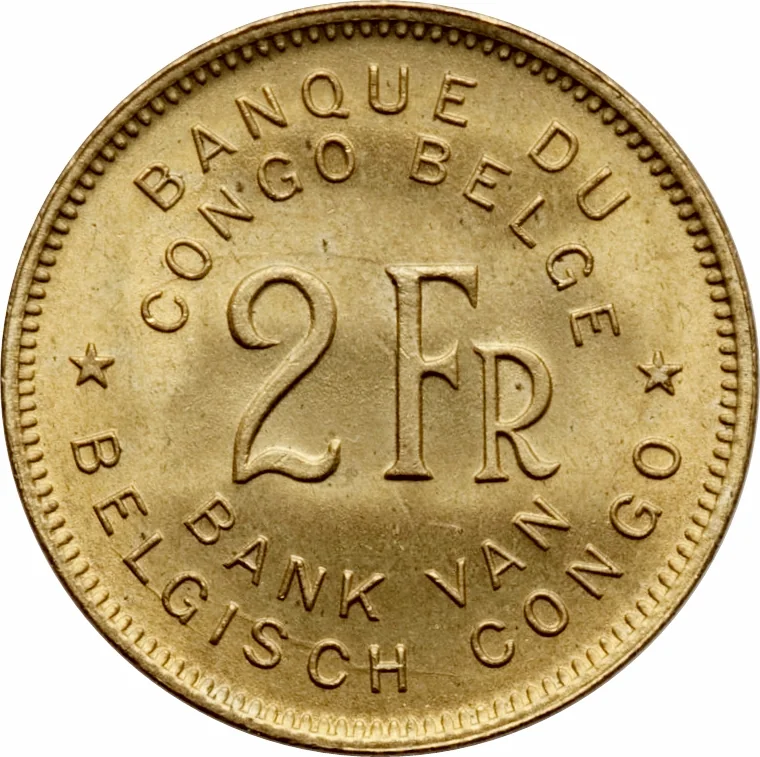
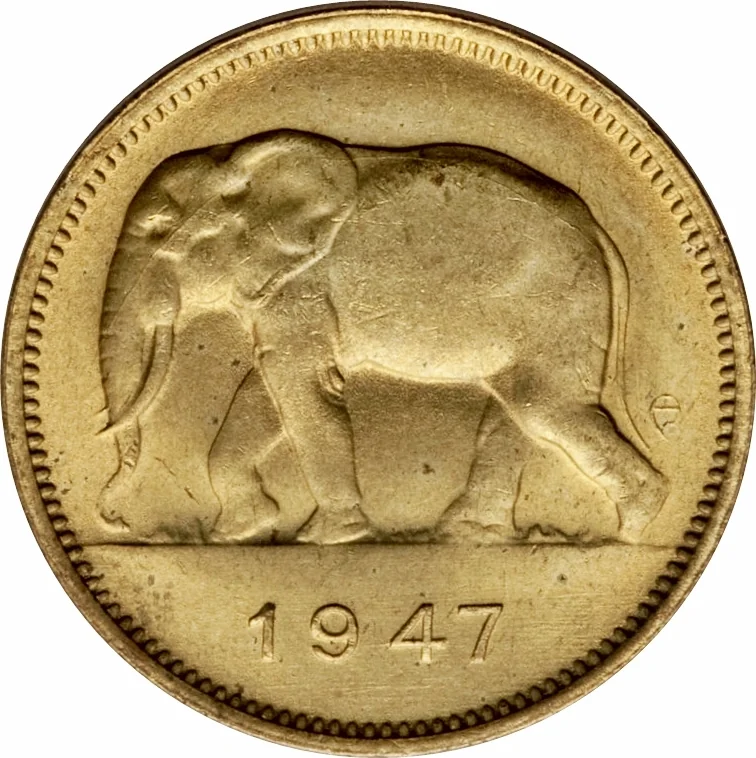
2 Francs – Belgian Congo
Context
Years: 1946–1947
Country: Rwanda and Urundi Belgian Congo
Issuer: Belgian Congo
Issuing organization: Bank of the Belgian Congo
Ruler: Leopold III
Currency:
(1908—1960)
Demonetized: Yes
Total mintage: 25,000,000
Material
References
KM: #Click to copy to clipboard28
Numista: #2963
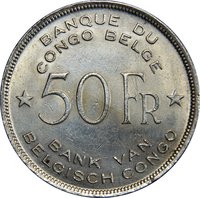
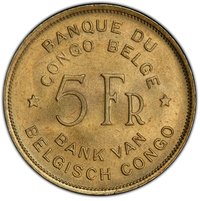
Obverse
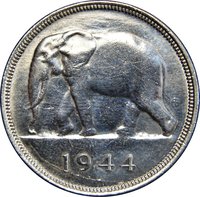
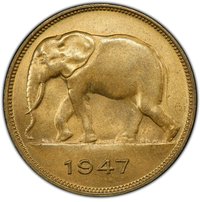
Reverse
Edge
Plain
Mints
| Name | Mark |
|---|---|
| Pretoria | — |
Mintings
| Year | Mint Mark | Mintage | Quality | Collection |
|---|---|---|---|---|
| 1946 | — | 13,000,000 | ||
| 1947 | — | 12,000,000 |
Historical background
In 1946, the Belgian Congo's currency system was firmly integrated into the Belgian monetary sphere, operating under the framework of the Belgian Franc Zone. The colony’s currency, the Congolese franc (FC), was introduced in 1887 and was legally pegged at par with the Belgian franc (BF), creating a fixed and stable exchange rate. This arrangement meant that the Congo's monetary policy was effectively set in Brussels, with the Banque du Congo Belge (Bank of the Belgian Congo) acting as the central issuing bank under the oversight of the Belgian government. The system was designed to facilitate trade and capital flows with the metropole, ensuring financial stability and administrative control.
The immediate post-World War II period, however, was a time of significant economic strain and transition. Like many colonial economies, the Congo experienced high inflation due to wartime disruptions and pent-up demand. The colony's vital exports of copper, cobalt, uranium, and other strategic minerals were in high demand for European reconstruction, generating substantial revenue but also contributing to internal price pressures. In response, Belgian authorities implemented strict exchange controls and maintained the fixed parity to manage the money supply and anchor the economy, prioritizing the rebuilding of Belgium itself.
Consequently, the currency situation in 1946 was one of controlled stability within a colonial framework. The Congolese franc was not a freely convertible currency but was fully dependent on and guaranteed by the Belgian treasury. This system provided predictability for the large Belgian corporations operating in the Congo but also underscored the colony's subordinate economic position. The monetary architecture reflected the broader colonial reality: the Congo’s financial health was inextricably linked to and directed by Belgian interests, a relationship that would remain largely unchanged until the turbulent period leading to independence in 1960.
The immediate post-World War II period, however, was a time of significant economic strain and transition. Like many colonial economies, the Congo experienced high inflation due to wartime disruptions and pent-up demand. The colony's vital exports of copper, cobalt, uranium, and other strategic minerals were in high demand for European reconstruction, generating substantial revenue but also contributing to internal price pressures. In response, Belgian authorities implemented strict exchange controls and maintained the fixed parity to manage the money supply and anchor the economy, prioritizing the rebuilding of Belgium itself.
Consequently, the currency situation in 1946 was one of controlled stability within a colonial framework. The Congolese franc was not a freely convertible currency but was fully dependent on and guaranteed by the Belgian treasury. This system provided predictability for the large Belgian corporations operating in the Congo but also underscored the colony's subordinate economic position. The monetary architecture reflected the broader colonial reality: the Congo’s financial health was inextricably linked to and directed by Belgian interests, a relationship that would remain largely unchanged until the turbulent period leading to independence in 1960.
🌱 Very Common