

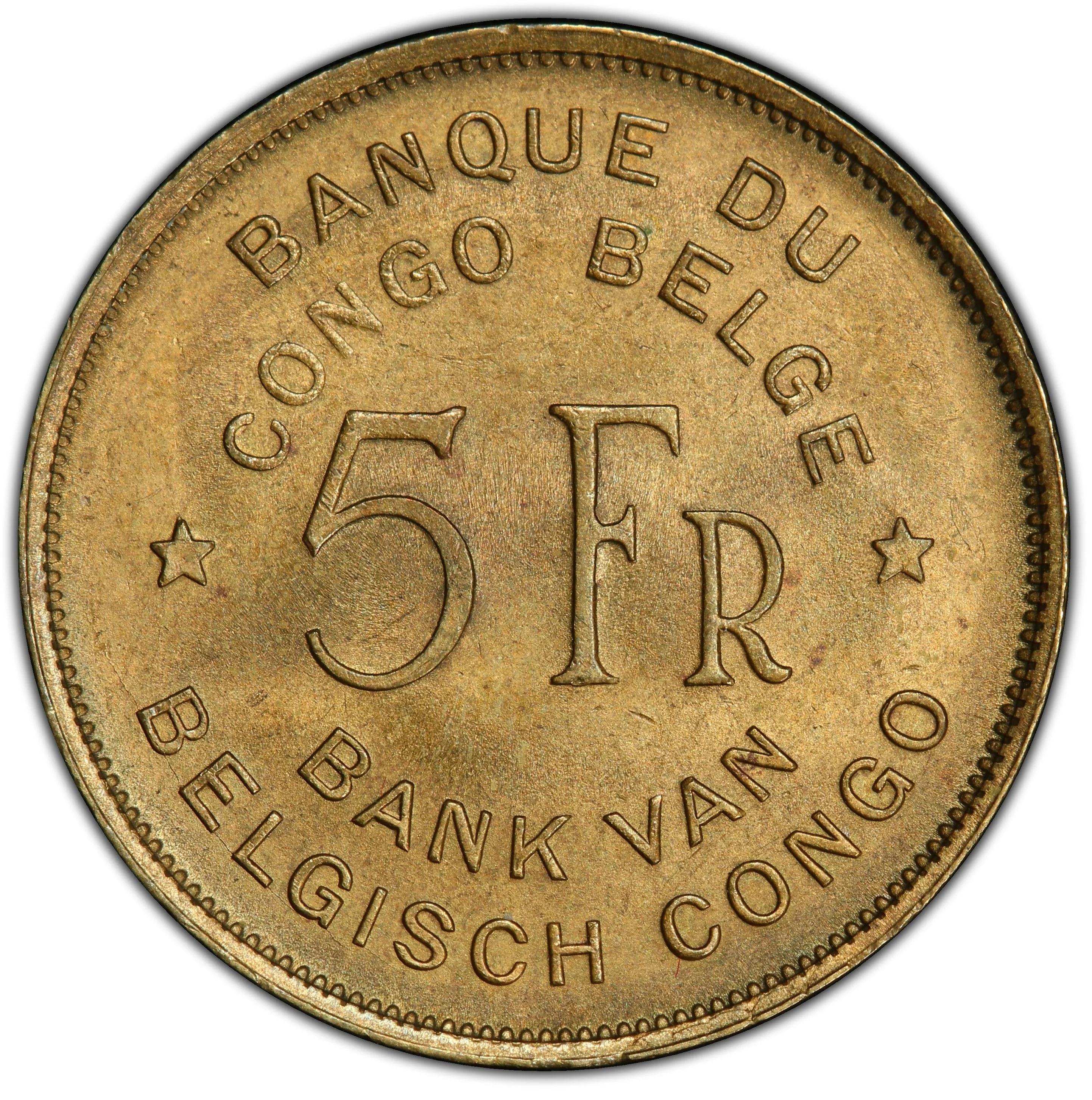
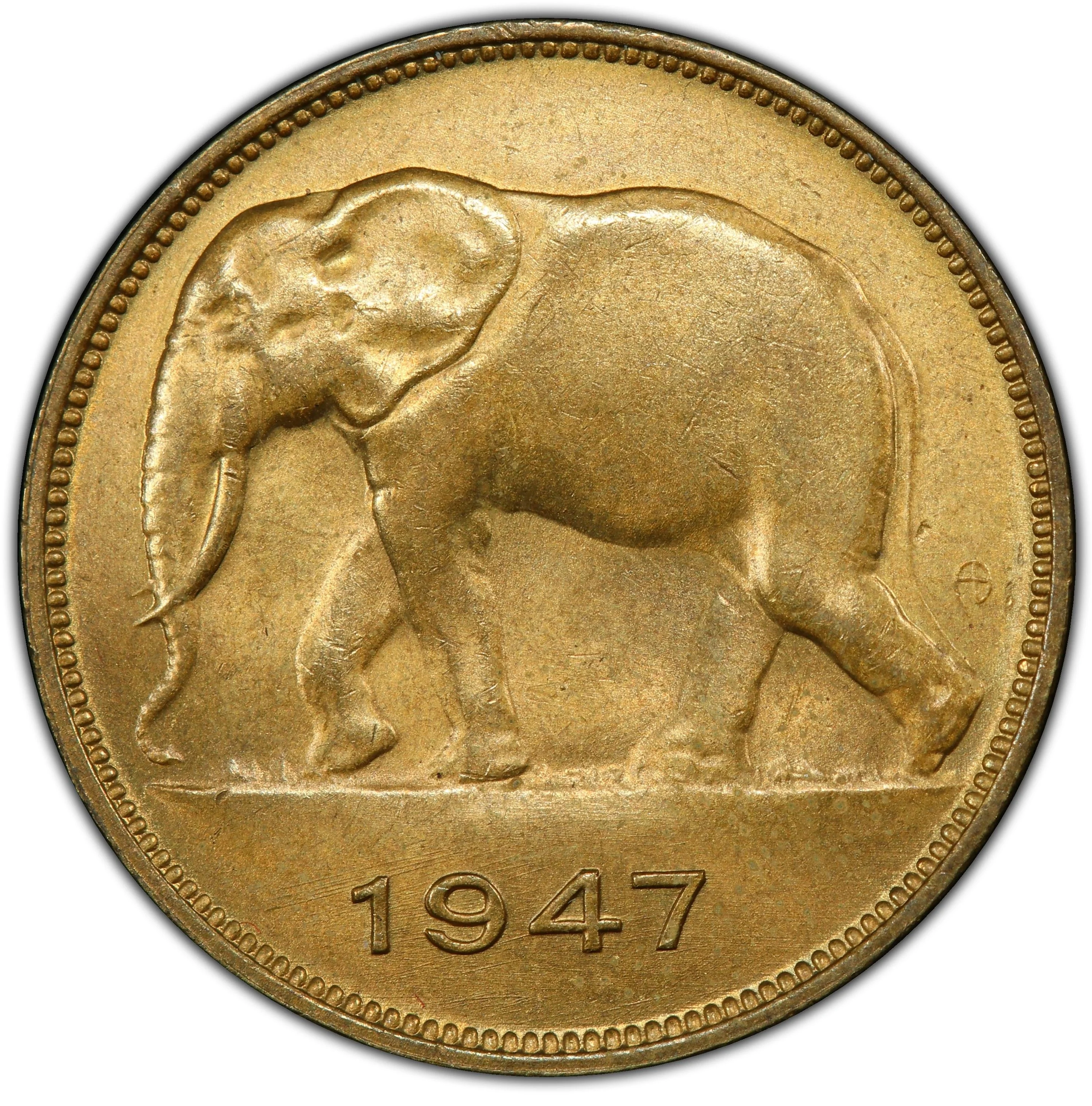
5 Francs – Belgian Congo
Context
Year: 1947
Country: Rwanda and Urundi Belgian Congo
Issuer: Belgian Congo
Issuing organization: Bank of the Belgian Congo
Ruler: Leopold III
Currency:
(1908—1960)
Demonetized: Yes
Total mintage: 10,000,000
Material
Diameter: 27 mm
Weight: 7.9 g
Thickness: 2 mm
Shape: Round
Composition: Brass
Standard: Silver quarter ounce
Magnetic: No
Technique: Milled
Alignment: Medal alignment
flip
References
KM: #Click to copy to clipboard29
Numista: #8017
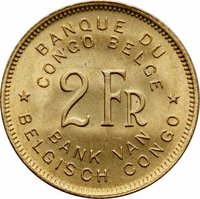
Obverse
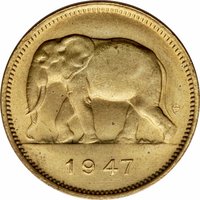
Reverse
Edge
Plain
Mints
| Name | Mark |
|---|---|
| Pretoria | — |
Mintings
| Year | Mint Mark | Mintage | Quality | Collection |
|---|---|---|---|---|
| 1947 | — | 10,000,000 |
Historical background
In 1947, the Belgian Congo operated under a monetary system tightly controlled by Belgium, centered on the Congolese franc (CF). This currency was not independent; it was pegged at a fixed parity to the Belgian franc and issued by a unique institution, the Banque Centrale du Congo Belge et du Ruanda-Urundi. This arrangement ensured that the colony's economy was fully integrated into and subordinate to the Belgian financial system, with monetary policy dictated from Brussels to serve broader imperial interests, including the facilitation of exports like copper, cobalt, and palm oil.
The post-World War II period saw significant inflationary pressures globally, and the Congo was no exception. Increased demand for its strategic resources and a growing wage economy in urban centers and mining districts led to rising prices. However, the fixed exchange rate and conservative fiscal management largely insulated the colony from hyperinflation, maintaining relative stability. This stability primarily benefited the colonial administration and European-owned enterprises, as it provided a predictable environment for repatriating profits and financing infrastructure projects tied to the export sector.
For the Congolese population, the currency system was a tool of colonial economic control. The imposition of a cash economy, including the payment of taxes in francs, forced many into the wage labour system on plantations and in mines. While the currency was stable in a macro sense, the low wages paid to Congolese workers and the high cost of imported goods meant that the benefits of this stability were unevenly distributed. Thus, in 1947, the currency situation reflected the broader colonial reality: a structurally efficient system designed for resource extraction, which reinforced economic disparity and entrenched European dominance over the Congolese economy.
The post-World War II period saw significant inflationary pressures globally, and the Congo was no exception. Increased demand for its strategic resources and a growing wage economy in urban centers and mining districts led to rising prices. However, the fixed exchange rate and conservative fiscal management largely insulated the colony from hyperinflation, maintaining relative stability. This stability primarily benefited the colonial administration and European-owned enterprises, as it provided a predictable environment for repatriating profits and financing infrastructure projects tied to the export sector.
For the Congolese population, the currency system was a tool of colonial economic control. The imposition of a cash economy, including the payment of taxes in francs, forced many into the wage labour system on plantations and in mines. While the currency was stable in a macro sense, the low wages paid to Congolese workers and the high cost of imported goods meant that the benefits of this stability were unevenly distributed. Thus, in 1947, the currency situation reflected the broader colonial reality: a structurally efficient system designed for resource extraction, which reinforced economic disparity and entrenched European dominance over the Congolese economy.
🌱 Common