

10 cash – Sinkiang Province
Add to wishlist
China
Context
Year: 1916
Islamic (Hijri) Year:: 1334
Country: China
Issuer: Sinkiang Province
Ruler: Hongxian
Currency:
(1939—1949)
Demonetized: Yes
Material
References
Y: #
Numista: #296083
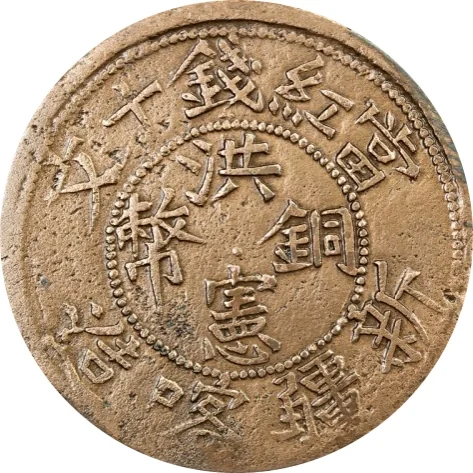
Obverse
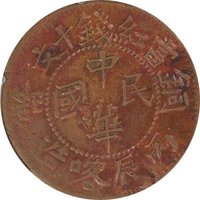
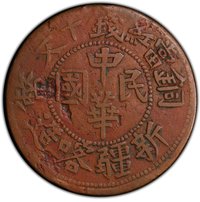
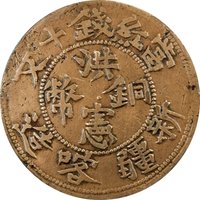
Description:
Four ideograms read vertically, right to left, among others.
Inscription:
文十錢紅當
洪
幣銅
憲
造喀疆新
洪
幣銅
憲
造喀疆新
Translation:
Ten Cash Coin, Red, Equivalent to
Hong
Copper Coin
Constitutional
Made in Xinjiang
Hong
Copper Coin
Constitutional
Made in Xinjiang
Language: Chinese
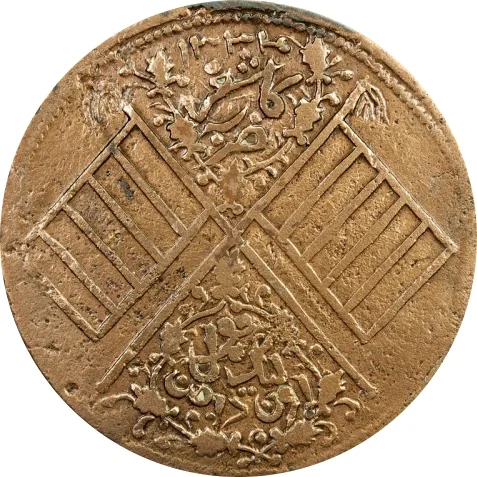
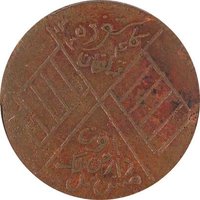
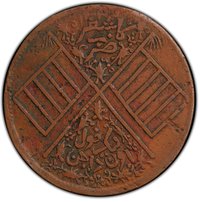
Reverse
Edge
Mintings
| Year | Mint Mark | Mintage | Quality | Collection |
|---|---|---|---|---|
| 1916 | — | — |
Historical background
In 1916, the currency situation in Sinkiang (Xinjiang) Province was characterized by extreme fragmentation and instability, a direct legacy of the late Qing dynasty and the ongoing turmoil of China's early Republican period. The province operated without a unified monetary standard, with multiple currencies circulating simultaneously. These included Chinese silver taels and yuan, Russian Tsarist rubles (which were dominant in the north and along trade routes due to strong commercial ties with Russian Turkestan), and a vast array of local notes issued by various authorities. The most prominent of these were the "Xinjiang Provincial Currency" notes issued by the Yang Zengxin administration from the provincial capital, Dihua (Ürümqi), but their acceptance and value varied greatly across the vast region.
The system was plagued by severe depreciation and regional disparities. Yang Zengxin's government, financially strained and isolated from central government support in Beijing, resorted to printing unbacked paper currency to cover military and administrative expenses. This led to rampant inflation, particularly for the provincial notes, which traded at a steep discount to silver coin. Meanwhile, in southern oases like Kashgar, locally minted silver tenga coins and notes issued by individual district magistrates or merchant houses held more sway than the provincial currency. The Russian ruble, backed by silver, was the most stable and preferred medium for significant trade, underscining the weakness of local fiduciary money.
This chaotic monetary environment severely hampered trade and economic integration within the province itself. It acted as a barrier to effective governance for Yang Zengxin, who struggled to project financial authority beyond his immediate sphere of control. The situation also reflected Xinjiang's precarious geopolitical position, caught between the weakening influence of the Chinese central government and the powerful economic pull of the Russian Empire. The currency chaos of 1916 was thus a symptom of Xinjiang's administrative fragmentation and its semi-autonomous status within a crumbling Chinese republic.
The system was plagued by severe depreciation and regional disparities. Yang Zengxin's government, financially strained and isolated from central government support in Beijing, resorted to printing unbacked paper currency to cover military and administrative expenses. This led to rampant inflation, particularly for the provincial notes, which traded at a steep discount to silver coin. Meanwhile, in southern oases like Kashgar, locally minted silver tenga coins and notes issued by individual district magistrates or merchant houses held more sway than the provincial currency. The Russian ruble, backed by silver, was the most stable and preferred medium for significant trade, underscining the weakness of local fiduciary money.
This chaotic monetary environment severely hampered trade and economic integration within the province itself. It acted as a barrier to effective governance for Yang Zengxin, who struggled to project financial authority beyond his immediate sphere of control. The situation also reflected Xinjiang's precarious geopolitical position, caught between the weakening influence of the Chinese central government and the powerful economic pull of the Russian Empire. The currency chaos of 1916 was thus a symptom of Xinjiang's administrative fragmentation and its semi-autonomous status within a crumbling Chinese republic.
✨ Legendary