

1 sar – Sinkiang Province
Add to wishlist
China
Context
Year: 1917
Chinese republican Year:: 6
Country: China
Issuer: Sinkiang Province
Period:
(1912—1949)
Demonetized: Yes
Material
References
Y: #
Numista: #27778
Value
Bullion value: $87.86
Obverse
Description:
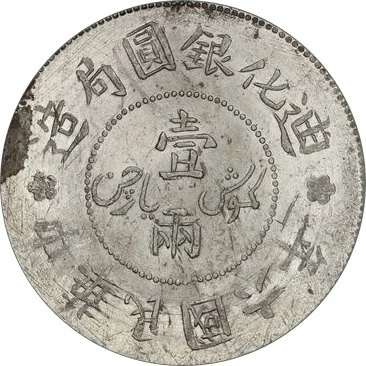
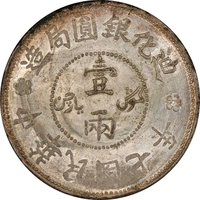
Two Chinese characters with Arabic text on both sides, encircled by more characters.
Inscription:
造局圓銀化迪
壹
عو ثر - پاژض
兩
年六國民華中
壹
عو ثر - پاژض
兩
年六國民華中
Translation:
Mint
One
Riyal - Fals
Two
Year 36 of the Republic of China
One
Riyal - Fals
Two
Year 36 of the Republic of China
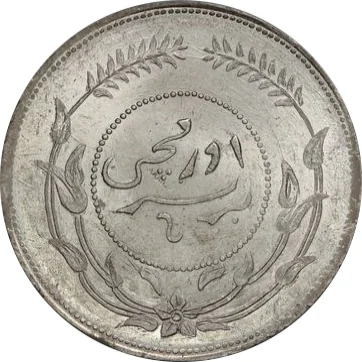
Reverse
Edge
Reeded
Mintings
| Year | Mint Mark | Mintage | Quality | Collection |
|---|---|---|---|---|
| 1917 | — | — |
Historical background
In 1917, the currency situation in Sinkiang (Xinjiang) Province was one of profound complexity and instability, reflecting the region's political fragmentation and economic isolation. Following the fall of the Qing Dynasty in 1911, the province was under the de facto autonomous rule of Governor Yang Zengxin, who maintained a fragile balance between Chinese authority, local Turkic Muslim populations, and Russian influence. The monetary system was not unified, consisting of a chaotic mix of legacy currencies. These included old Chinese silver taels and yuan, local notes issued by Yang's government and various merchant associations, and a substantial circulation of Russian Tsarist ruble notes and gold coins, due to extensive cross-border trade.
The outbreak of the Russian Revolution in 1917 critically exacerbated this instability. Overnight, the formerly dominant Tsarist ruble notes, held in vast quantities by Sinkiang's banks and merchants, began a rapid depreciation into near-worthlessness. This caused severe financial losses, a contraction in trade, and a crisis of confidence in paper currency generally. Governor Yang's administration, lacking substantial silver reserves, struggled to manage the crisis. His response was to increase the issuance of provincial paper notes, known as Xinjiang piao, but without adequate backing, this led to significant inflation and wide fluctuations in exchange rates between different towns and currencies.
Consequently, by the end of 1917, Sinkiang's economy was moving towards a de facto system of barter and a heightened reliance on physical silver and copper coins for significant transactions. The currency chaos underscored Yang Zengxin's tenuous control and the region's vulnerability to external shocks. This period set the stage for the prolonged monetary disorder that would characterize Xinjiang's economy for the next two decades, as successive rulers grappled with creating a stable provincial currency separate from the turbulent central Chinese financial systems.
The outbreak of the Russian Revolution in 1917 critically exacerbated this instability. Overnight, the formerly dominant Tsarist ruble notes, held in vast quantities by Sinkiang's banks and merchants, began a rapid depreciation into near-worthlessness. This caused severe financial losses, a contraction in trade, and a crisis of confidence in paper currency generally. Governor Yang's administration, lacking substantial silver reserves, struggled to manage the crisis. His response was to increase the issuance of provincial paper notes, known as Xinjiang piao, but without adequate backing, this led to significant inflation and wide fluctuations in exchange rates between different towns and currencies.
Consequently, by the end of 1917, Sinkiang's economy was moving towards a de facto system of barter and a heightened reliance on physical silver and copper coins for significant transactions. The currency chaos underscored Yang Zengxin's tenuous control and the region's vulnerability to external shocks. This period set the stage for the prolonged monetary disorder that would characterize Xinjiang's economy for the next two decades, as successive rulers grappled with creating a stable provincial currency separate from the turbulent central Chinese financial systems.
💎 Extremely Rare