

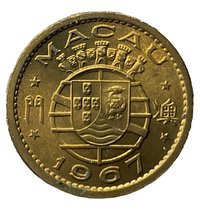
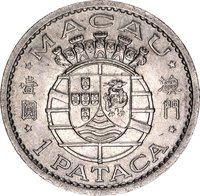
Obverse
Description:
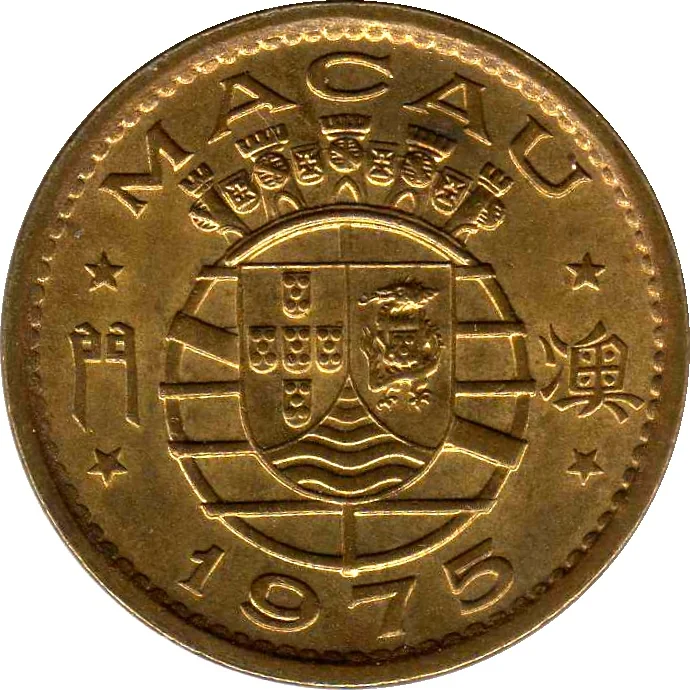
Crowned globe with shield, flanked by stars. Date below.
Inscription:
* MACAU *
門 澳
* 1975 *
門 澳
* 1975 *
Translation:
MACAU
PORTUGUESE PROVINCE OF MACAO
* 1975 *
PORTUGUESE PROVINCE OF MACAO
* 1975 *
Languages: Portuguese, Chinese
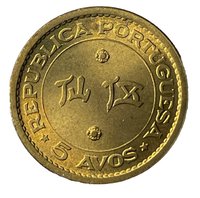
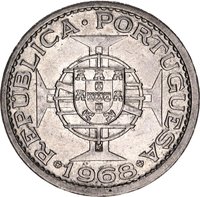
Reverse
Description:
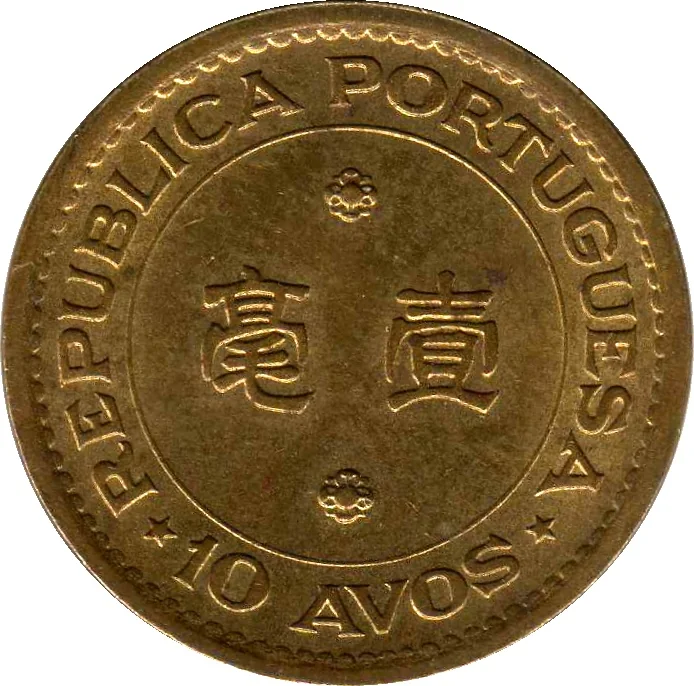
Dotted circle with central value.
Inscription:
REPUBLICA PORTUGUESA
毫 壹
*10 AVOS*
毫 壹
*10 AVOS*
Translation:
REPUBLIC OF PORTUGUESE
Hao One
*10 AVOS*
Hao One
*10 AVOS*
Languages: Chinese, Portuguese
Edge
Plain
Mints
| Name | Mark |
|---|---|
| Imprensa Nacional - Casa da Moeda | — |
Mintings
| Year | Mint Mark | Mintage | Quality | Collection |
|---|---|---|---|---|
| 1967 | — | 5,525,000 | ||
| 1968 | — | 6,975,000 | ||
| 1975 | — | 20,000,000 | ||
| 1976 | — | — |
Historical background
In 1967, Macau's currency situation was intrinsically linked to its unique political and economic position as a Portuguese-administered territory adjacent to a China in the throes of the Cultural Revolution. The year was dominated by the "12-3 Incident," a series of violent leftist riots and protests inspired by Hong Kong's contemporaneous disturbances, which severely challenged Portuguese authority. This political turmoil created significant economic uncertainty, disrupting commerce and testing the stability of the colony's monetary system, which operated on a dual-currency basis.
The official currency was the Macau pataca (MOP), but its circulation and value were heavily dependent on the Portuguese escudo and, more critically, the Hong Kong dollar (HKD). The pataca was pegged to the Portuguese escudo at a fixed rate, but in practice, the Hong Kong dollar circulated widely and was often preferred for major transactions due to its stronger international convertibility and the deep economic integration with Hong Kong. This created a de facto multi-currency environment where the stability of the pataca relied indirectly on the sterling peg of the Hong Kong dollar.
Despite the intense social unrest, the core currency arrangement remained functionally intact throughout 1967. The Portuguese administration, under pressure from Beijing after the riots, maintained the existing financial system to ensure economic continuity. Crucially, the Hong Kong dollar's continued circulation provided a vital anchor, preventing a monetary crisis. Therefore, while the political landscape was profoundly shaken, the currency situation demonstrated a pragmatic resilience, with the pataca's stability being underwritten by its unofficial but indispensable link to the Hong Kong dollar.
The official currency was the Macau pataca (MOP), but its circulation and value were heavily dependent on the Portuguese escudo and, more critically, the Hong Kong dollar (HKD). The pataca was pegged to the Portuguese escudo at a fixed rate, but in practice, the Hong Kong dollar circulated widely and was often preferred for major transactions due to its stronger international convertibility and the deep economic integration with Hong Kong. This created a de facto multi-currency environment where the stability of the pataca relied indirectly on the sterling peg of the Hong Kong dollar.
Despite the intense social unrest, the core currency arrangement remained functionally intact throughout 1967. The Portuguese administration, under pressure from Beijing after the riots, maintained the existing financial system to ensure economic continuity. Crucially, the Hong Kong dollar's continued circulation provided a vital anchor, preventing a monetary crisis. Therefore, while the political landscape was profoundly shaken, the currency situation demonstrated a pragmatic resilience, with the pataca's stability being underwritten by its unofficial but indispensable link to the Hong Kong dollar.
🌱 Very Common