

2 euro – Estonia
Add to wishlist
Circulating commemorative coins
Commemoration: Finno-Ugric peoples
Estonia
Obverse
Description:
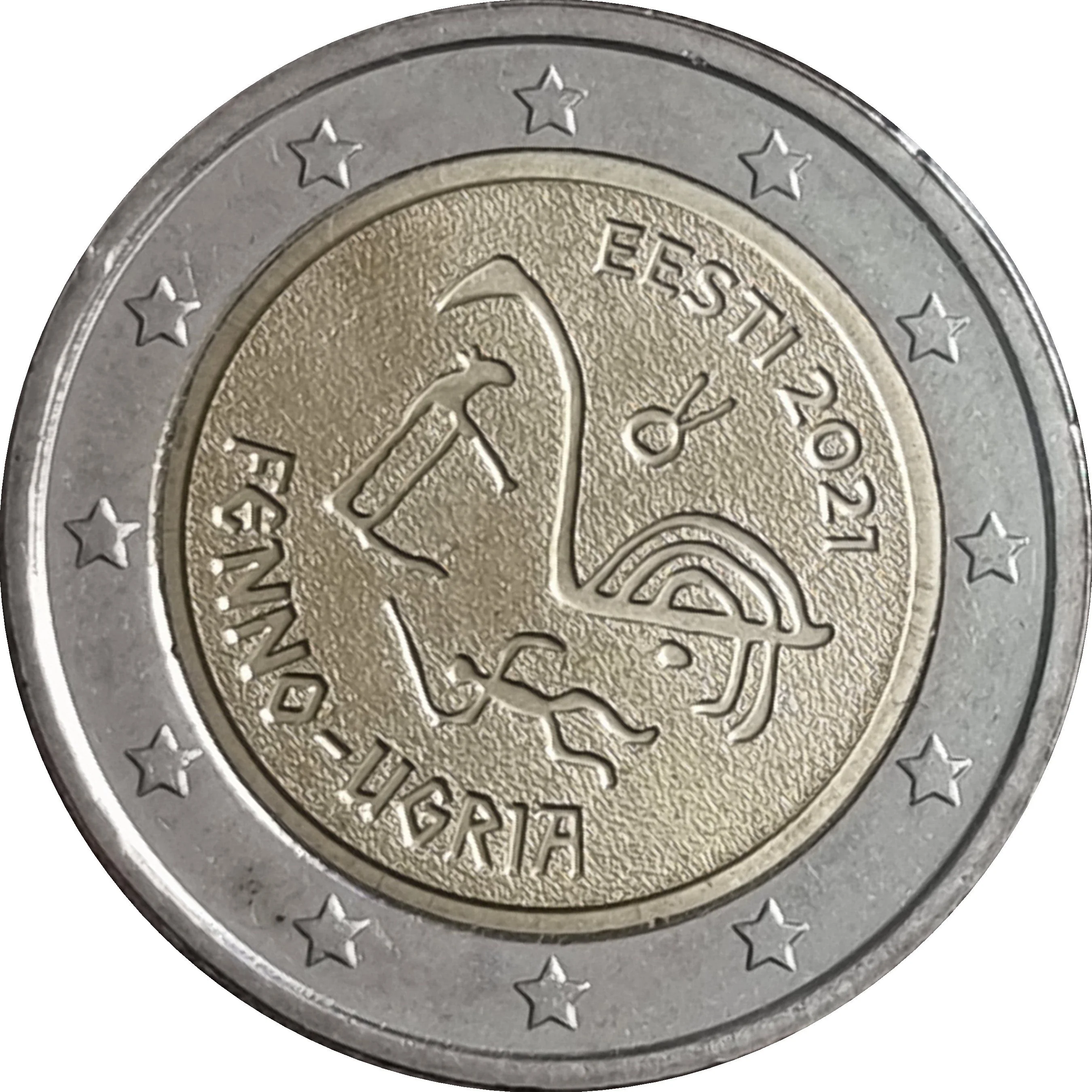
The national side features a water bird, central to Finno-Ugric art, alongside symbols of a hunter, elk, and sun from Lake Äänisjärv cave drawings, forming a symbolic circle of life. "EESTI 2021" appears at top right and "FENNOUGRIA" at bottom left. The outer ring bears the 12 stars of the European flag.
Inscription:
EESTI 2021
FENNO-UGRIA
FENNO-UGRIA
Translation:
ESTONIA 2021
FENNO-UGRIA
FENNO-UGRIA
Script: Latin
Designers: Al Paldrok, Madis Põldsaar
Reverse
Edge
"O" and "EESTI" repeated alternately upright and inverted.
Legend:
EESTI O EESTI O
Translation:
O Estonia, O Estonia
Language: Estonian
Categories
| Map |
Mints
| Name | Mark |
|---|---|
| Lithuanian Mint | — |
Mintings
| Year | Mint Mark | Mintage | Quality | Collection |
|---|---|---|---|---|
| 2021 | — | 1,000,000 |
Historical background
In 2021, Estonia was a fully integrated member of the Eurozone, having adopted the euro as its official currency on 1 January 2011. This meant the country had long abandoned its former national currency, the kroon, and monetary policy was set by the European Central Bank (ECB). The year was characterized by Estonia navigating shared Eurozone challenges, particularly managing the economic aftermath of the COVID-19 pandemic. As a small, open economy, Estonia benefited from the stability and low transaction costs of the single currency, which facilitated trade and investment within the EU, a crucial factor for its recovery.
However, 2021 also saw rising inflationary pressures across the Eurozone, which became a growing concern in Estonia by the year's end. While the ECB maintained an expansive monetary policy with historically low interest rates to support the broader European recovery, Estonia experienced inflation rates significantly above the Eurozone average. This was driven by soaring energy prices, supply chain disruptions, and a tight labor market leading to rapid wage growth. Consequently, the one-size-fits-all ECB policy began to feel increasingly misaligned with Estonia's overheating economy.
Domestically, there was no serious political debate about leaving the euro, as the currency was widely seen as a cornerstone of Estonia's economic security and European identity. The focus instead was on using national fiscal tools within the European framework. The government, led by Prime Minister Kaja Kallas, utilized EU recovery funds and adjusted its own fiscal policy to address inflation's impact on vulnerable groups, while the Bank of Estonia (Eesti Pank) emphasized the need for budgetary restraint. Thus, Estonia's currency situation in 2021 was defined by its role within the common monetary union, balancing the advantages of euro membership against the specific challenge of domestically high inflation within a shared currency area.
However, 2021 also saw rising inflationary pressures across the Eurozone, which became a growing concern in Estonia by the year's end. While the ECB maintained an expansive monetary policy with historically low interest rates to support the broader European recovery, Estonia experienced inflation rates significantly above the Eurozone average. This was driven by soaring energy prices, supply chain disruptions, and a tight labor market leading to rapid wage growth. Consequently, the one-size-fits-all ECB policy began to feel increasingly misaligned with Estonia's overheating economy.
Domestically, there was no serious political debate about leaving the euro, as the currency was widely seen as a cornerstone of Estonia's economic security and European identity. The focus instead was on using national fiscal tools within the European framework. The government, led by Prime Minister Kaja Kallas, utilized EU recovery funds and adjusted its own fiscal policy to address inflation's impact on vulnerable groups, while the Bank of Estonia (Eesti Pank) emphasized the need for budgetary restraint. Thus, Estonia's currency situation in 2021 was defined by its role within the common monetary union, balancing the advantages of euro membership against the specific challenge of domestically high inflation within a shared currency area.
Series: Estonia 2 euro commemoratives
🌱 Very Common