

1 dollar – United States
Add to wishlist
United States
Context
Years: 1971–1978
Issuer: United States
Period:
(since 1776)
Currency:
(since 1785)
Total mintage: 467,716,801
Material
References
KM: #
Numista: #1346
Value
Exchange value: 1 USD = $1.00
Inflation-adjusted value: 8.27 USD
Obverse
Description:
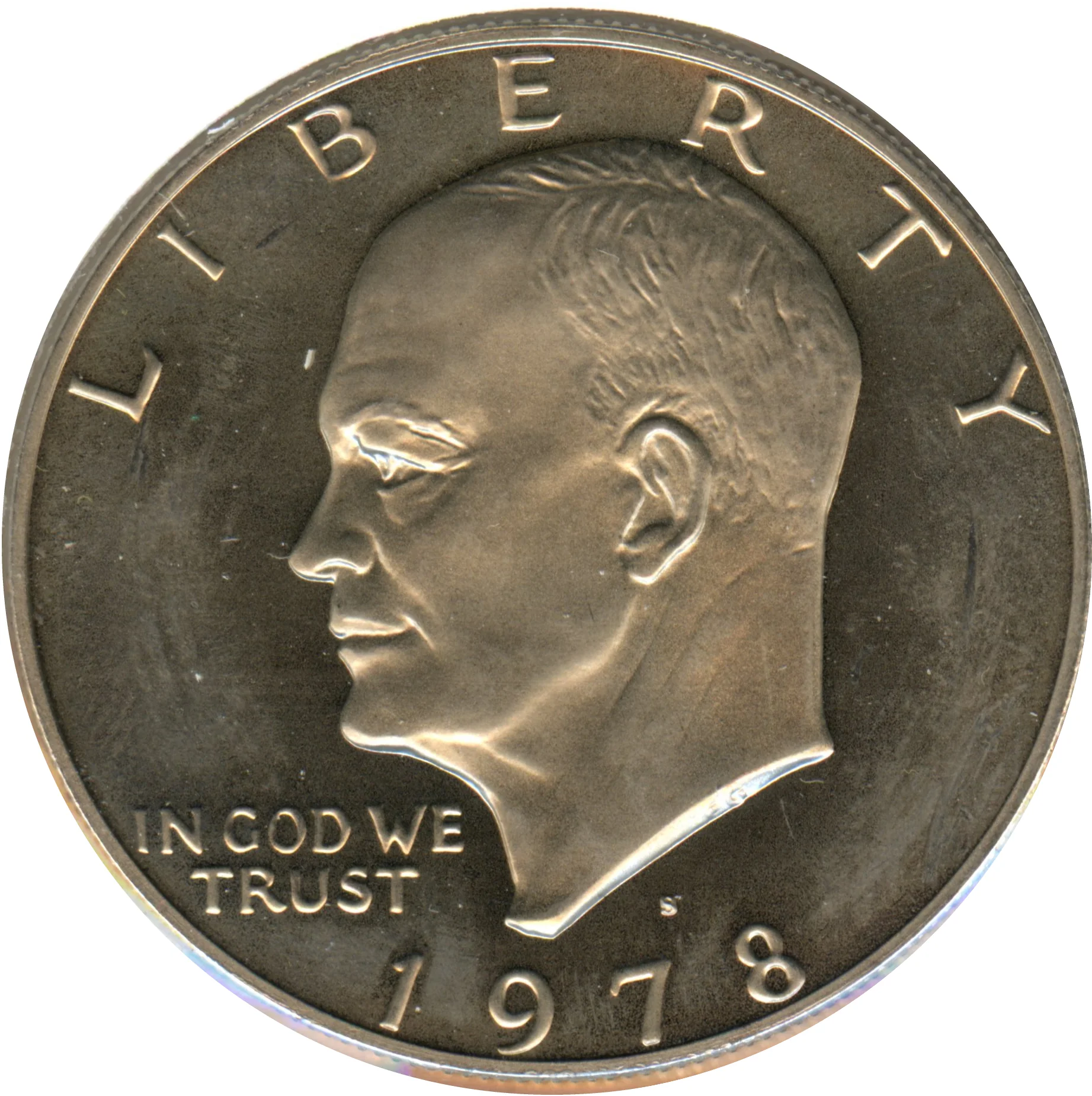
Dwight D. Eisenhower facing left, date below.
Inscription:
LIBERTY
IN GOD WE
TRUST
S
1978
IN GOD WE
TRUST
S
1978
Script: Latin
Engraver: Frank Gasparro
Reverse
Description:
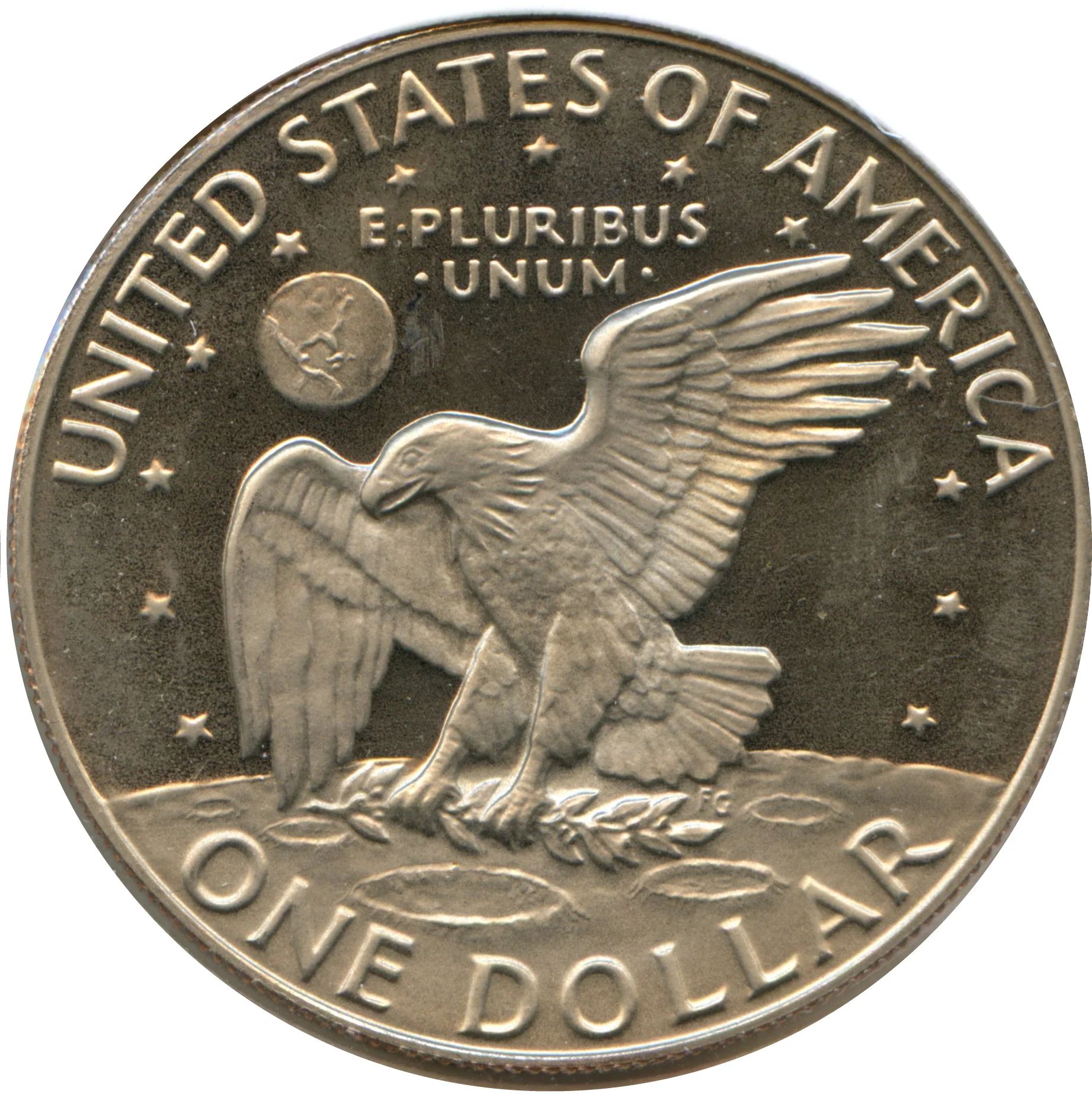
An eagle with an olive branch flies above the Moon, with Earth in the background.
Inscription:
UNITED STATES OF AMERICA
E PLURIBUS
UNUM
FG
ONE DOLLAR
E PLURIBUS
UNUM
FG
ONE DOLLAR
Translation:
UNITED STATES OF AMERICA
OUT OF MANY
ONE
FG
ONE DOLLAR
OUT OF MANY
ONE
FG
ONE DOLLAR
Script: Latin
Engraver: Frank Gasparro
Edge
Reeded
Categories
| Person> Politician |
| Person> Military leader |
| Animal> Bird> Eagle |
| Space |
| Symbol> Moon |
Mints
| Name | Mark |
|---|---|
| United States Mint of Philadelphia | — |
| United States Mint of Denver | D |
| United States Mint of San Francisco | S |
Mintings
| Year | Mint Mark | Mintage | Quality | Collection |
|---|---|---|---|---|
| 1971 | — | 47,799,000 | ||
| 1971 | D | 68,587,424 | ||
| 1972 | — | 75,890,000 | ||
| 1972 | D | 92,548,511 | ||
| 1973 | D | 2,000,000 | ||
| 1973 | S | 2,769,624 | Proof | |
| 1973 | — | 2,000,056 | ||
| 1974 | — | 27,366,000 | ||
| 1974 | D | 35,466,000 | ||
| 1974 | S | 2,617,350 | Proof | |
| 1977 | — | 12,596,000 | ||
| 1977 | D | 32,983,006 | ||
| 1977 | S | 3,251,152 | Proof | |
| 1978 | D | 33,012,890 | ||
| 1978 | S | 3,127,788 | Proof | |
| 1978 | — | 25,702,000 |
Historical background
In 1971, the United States faced a mounting international monetary crisis rooted in the Bretton Woods system established after World War II. This system had fixed global currencies to the U.S. dollar, which was in turn convertible to gold at $35 per ounce for foreign governments. However, by the late 1960s, persistent U.S. trade deficits, heavy military and social spending, and a loss of competitive advantage had led to an overabundance of dollars in foreign hands. Nations like France and West Germany began exchanging their dollar reserves for gold, causing a severe drain on U.S. gold stocks, which fell from over $20 billion in the 1950s to roughly $10 billion by 1971.
Domestically, President Richard Nixon was confronting "stagflation"—a troubling combination of rising inflation and economic stagnation. The fixed exchange rate system was seen as a constraint, as it prevented the devaluation of the dollar to make U.S. exports more competitive. Facing a run on gold and pressure on the dollar, Nixon convened his top economic advisors at Camp David in secret. On August 15, 1971, he announced a sweeping New Economic Policy, with its centerpiece being the unilateral suspension of the dollar's convertibility into gold. This dramatic move, known as the "Nixon Shock," effectively ended the Bretton Woods system and severed the final link between major world currencies and a tangible gold standard.
The immediate aftermath saw the world's currencies transition to a regime of floating exchange rates, where market forces largely determined their value. While the move protected U.S. gold reserves and provided short-term economic stimulus, it also ushered in an era of greater currency volatility and global inflation in the following years. The decision fundamentally reshaped the global financial order, establishing the U.S. dollar as a fiat currency—backed by government decree and confidence in the U.S. economy rather than by gold—and cementing its role as the world's dominant reserve currency.
Domestically, President Richard Nixon was confronting "stagflation"—a troubling combination of rising inflation and economic stagnation. The fixed exchange rate system was seen as a constraint, as it prevented the devaluation of the dollar to make U.S. exports more competitive. Facing a run on gold and pressure on the dollar, Nixon convened his top economic advisors at Camp David in secret. On August 15, 1971, he announced a sweeping New Economic Policy, with its centerpiece being the unilateral suspension of the dollar's convertibility into gold. This dramatic move, known as the "Nixon Shock," effectively ended the Bretton Woods system and severed the final link between major world currencies and a tangible gold standard.
The immediate aftermath saw the world's currencies transition to a regime of floating exchange rates, where market forces largely determined their value. While the move protected U.S. gold reserves and provided short-term economic stimulus, it also ushered in an era of greater currency volatility and global inflation in the following years. The decision fundamentally reshaped the global financial order, establishing the U.S. dollar as a fiat currency—backed by government decree and confidence in the U.S. economy rather than by gold—and cementing its role as the world's dominant reserve currency.

🌱 Very Common