

1 dollar – United States
Add to wishlist
United States
Context
Years: 1979–1999
Issuer: United States
Period:
(since 1776)
Currency:
(since 1785)
Total mintage: 550,399,740
Material
References
KM: #
Numista: #3548
Value
Exchange value: 1 USD = $1.00
Inflation-adjusted value: 4.92 USD
Obverse
Description:
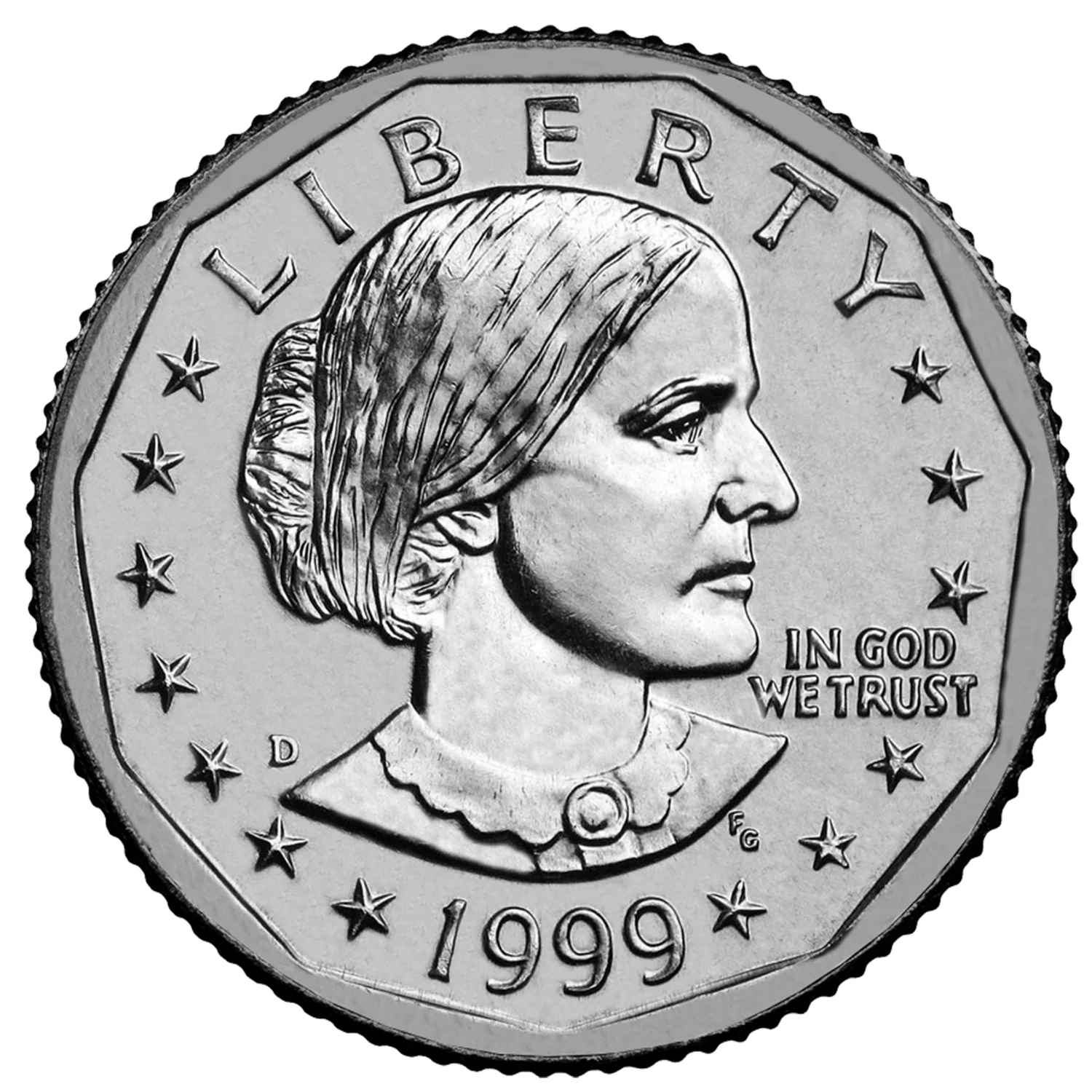
Susan B. Anthony, facing right, with date below.
Inscription:
LIBERTY
IN GOD
WE TRUST
S
FG
1979
IN GOD
WE TRUST
S
FG
1979
Script: Latin
Engraver: Frank Gasparro
Reverse
Description:
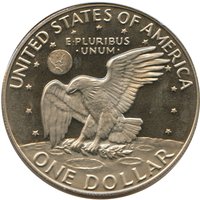
Apollo 11 insignia: an eagle with an olive branch above the Moon, Earth in the background, with denomination below.
Inscription:
UNITED STATES OF AMERICA
E·PLURIBUS
·UNUM·
FG
ONE DOLLAR
E·PLURIBUS
·UNUM·
FG
ONE DOLLAR
Translation:
UNITED STATES OF AMERICA
OUT OF MANY
ONE
FG
ONE DOLLAR
OUT OF MANY
ONE
FG
ONE DOLLAR
Script: Latin
Engraver: Frank Gasparro
Edge
Reeded
Mints
| Name | Mark |
|---|---|
| United States Mint of Denver | D |
| United States Mint of Philadelphia | P |
| United States Mint of San Francisco | S |
Mintings
| Year | Mint Mark | Mintage | Quality | Collection |
|---|---|---|---|---|
| 1979 | D | 288,015,744 | ||
| 1979 | P | — | ||
| 1979 | S | 109,576,000 | ||
| 1979 | S | 3,677,175 | Proof | |
| 1980 | D | 41,628,708 | ||
| 1980 | P | 27,610,000 | ||
| 1980 | S | 20,422,000 | ||
| 1980 | S | 3,547,030 | Proof | |
| 1981 | S | 4,063,083 | Proof | |
| 1981 | D | 3,250,000 | In sets | |
| 1981 | P | 3,000,000 | In sets | |
| 1981 | S | 3,492,000 | In sets | |
| 1999 | D | 11,776,000 | ||
| 1999 | P | 29,592,000 | ||
| 1999 | P | 750,000 | Proof |
Historical background
In 1979, the United States was grappling with a severe bout of "stagflation"—a toxic combination of stagnant economic growth and high inflation that confounded traditional economic policy. Consumer price inflation surged to a staggering 13.3% for the year, eroding purchasing power and public confidence. This inflationary crisis was fueled by a decade of loose monetary policy, soaring energy prices following the 1979 oil shock triggered by the Iranian Revolution, and a pervasive sense that the Federal Reserve, under Chairman G. William Miller, lacked the resolve to control the money supply. The U.S. dollar, consequently, was under intense pressure in foreign exchange markets, falling sharply against major currencies like the German Deutschemark and Japanese Yen, which undermined its role as the world's premier reserve currency.
The situation reached a critical point in the fall of 1979, compelling newly appointed Federal Reserve Chairman Paul Volcker to enact a dramatic shift in monetary policy. On October 6, the Fed announced it would no longer target interest rates but would instead focus on controlling the growth of the money supply itself, a move aligned with monetarist theory. This policy shift deliberately allowed interest rates to soar to unprecedented levels, with the federal funds rate eventually exceeding 20%. The immediate goal was to break the inflationary psychology that had become entrenched in the economy, signaling a new era of painful but necessary monetary restraint.
The currency situation of 1979, therefore, represents a pivotal turning point in U.S. economic history. Volcker's harsh medicine successfully tamed inflation in the following years, but at the short-term cost of a severe recession in 1980-82. The era marked the end of the post-war Keynesian consensus and established the primacy of inflation-fighting as the Fed's primary mandate. The strong-dollar policy that emerged in the mid-1980s had its roots in the decisive, credibility-restoring actions taken during this period of crisis, fundamentally reshaping the global financial landscape for decades to come.
The situation reached a critical point in the fall of 1979, compelling newly appointed Federal Reserve Chairman Paul Volcker to enact a dramatic shift in monetary policy. On October 6, the Fed announced it would no longer target interest rates but would instead focus on controlling the growth of the money supply itself, a move aligned with monetarist theory. This policy shift deliberately allowed interest rates to soar to unprecedented levels, with the federal funds rate eventually exceeding 20%. The immediate goal was to break the inflationary psychology that had become entrenched in the economy, signaling a new era of painful but necessary monetary restraint.
The currency situation of 1979, therefore, represents a pivotal turning point in U.S. economic history. Volcker's harsh medicine successfully tamed inflation in the following years, but at the short-term cost of a severe recession in 1980-82. The era marked the end of the post-war Keynesian consensus and established the primacy of inflation-fighting as the Fed's primary mandate. The strong-dollar policy that emerged in the mid-1980s had its roots in the decisive, credibility-restoring actions taken during this period of crisis, fundamentally reshaping the global financial landscape for decades to come.
🌱 Very Common