

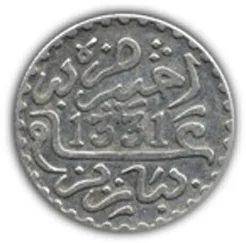
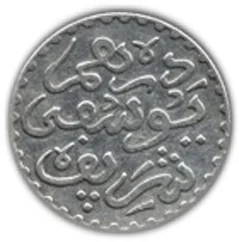
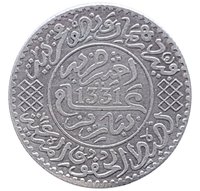
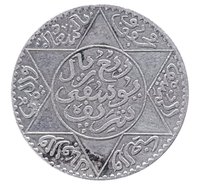
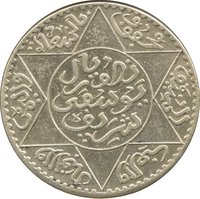
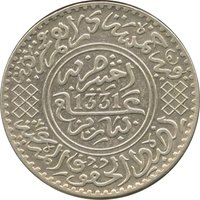
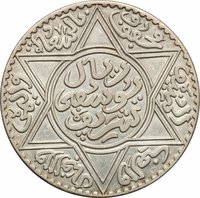
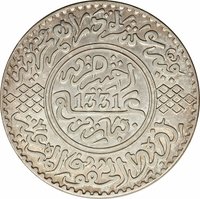
1 dirham – Morocco
Add to wishlist
Morocco
Context
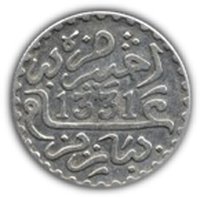
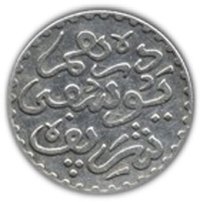
Year: 1913
Islamic (Hijri) Year:: 1331
Issuer: Morocco
Ruler: Yusef
Currency:
(1882—1921)
Subdivision: 1 dirham = ⅒ Rial
Demonetized: Yes
Total mintage: 500,000
Material
References
Y: #
Numista: #28730
Value
Exchange value: 0.1 MAH
Bullion value: $5.29
Mints
| Name | Mark |
|---|---|
| Monnaie de Paris | — |
Mintings
| Year | Mint Mark | Mintage | Quality | Collection |
|---|---|---|---|---|
| 1913 | — | — | Proof | |
| 1913 | — | 500,000 |
Historical background
In 1913, Morocco's currency situation was a complex reflection of its political fragmentation and foreign encroachment. The country, while nominally independent under Sultan Moulay Abd al-Hafid, was in a state of severe financial distress and de facto partition following the 1912 Treaty of Fes. This treaty established a French protectorate over most of Morocco and a Spanish protectorate in the north, with the international zone of Tangier maintaining its own distinct economic rules. Consequently, there was no unified national monetary system; instead, a chaotic mix of domestic and foreign coins circulated, including the traditional silver dirham, the gold benduqi, and a plethora of Spanish pesetas, French francs, British sovereigns, and Maria Theresa thalers.
The primary domestic currency was the silver rial (or ryal), a large, weighty coin whose value was intrinsically tied to its metal content and thus fluctuated with global silver prices. This volatility, combined with rampant counterfeiting and clipping of coins, created significant instability for trade and government finance. The Alawite dynasty's chronic budget deficits, exacerbated by massive indemnities paid to European powers after military defeats, led to severe inflation and a deep loss of confidence in the state's fiscal management. The Moroccan Mint (Dar as-Sikkah) struggled with obsolete technology and could not produce a reliable, standardized coinage in sufficient quantities.
This monetary disorder was a key instrument and symptom of colonial control. France, having taken charge of the Sultan's treasury, immediately began plans to replace the heterogeneous system with a modern, decimal currency pegged to the French franc—a project realized in 1921 with the introduction of the Moroccan franc. Thus, in 1913, Morocco was at the precise pivot point between a medieval, commodity-based monetary tradition and the impending imposition of a centralized, colonial financial system designed to integrate the protectorate into France's economic sphere.
The primary domestic currency was the silver rial (or ryal), a large, weighty coin whose value was intrinsically tied to its metal content and thus fluctuated with global silver prices. This volatility, combined with rampant counterfeiting and clipping of coins, created significant instability for trade and government finance. The Alawite dynasty's chronic budget deficits, exacerbated by massive indemnities paid to European powers after military defeats, led to severe inflation and a deep loss of confidence in the state's fiscal management. The Moroccan Mint (Dar as-Sikkah) struggled with obsolete technology and could not produce a reliable, standardized coinage in sufficient quantities.
This monetary disorder was a key instrument and symptom of colonial control. France, having taken charge of the Sultan's treasury, immediately began plans to replace the heterogeneous system with a modern, decimal currency pegged to the French franc—a project realized in 1921 with the introduction of the Moroccan franc. Thus, in 1913, Morocco was at the precise pivot point between a medieval, commodity-based monetary tradition and the impending imposition of a centralized, colonial financial system designed to integrate the protectorate into France's economic sphere.
Series: 1913 Morocco circulation coins
⭐ Rare