

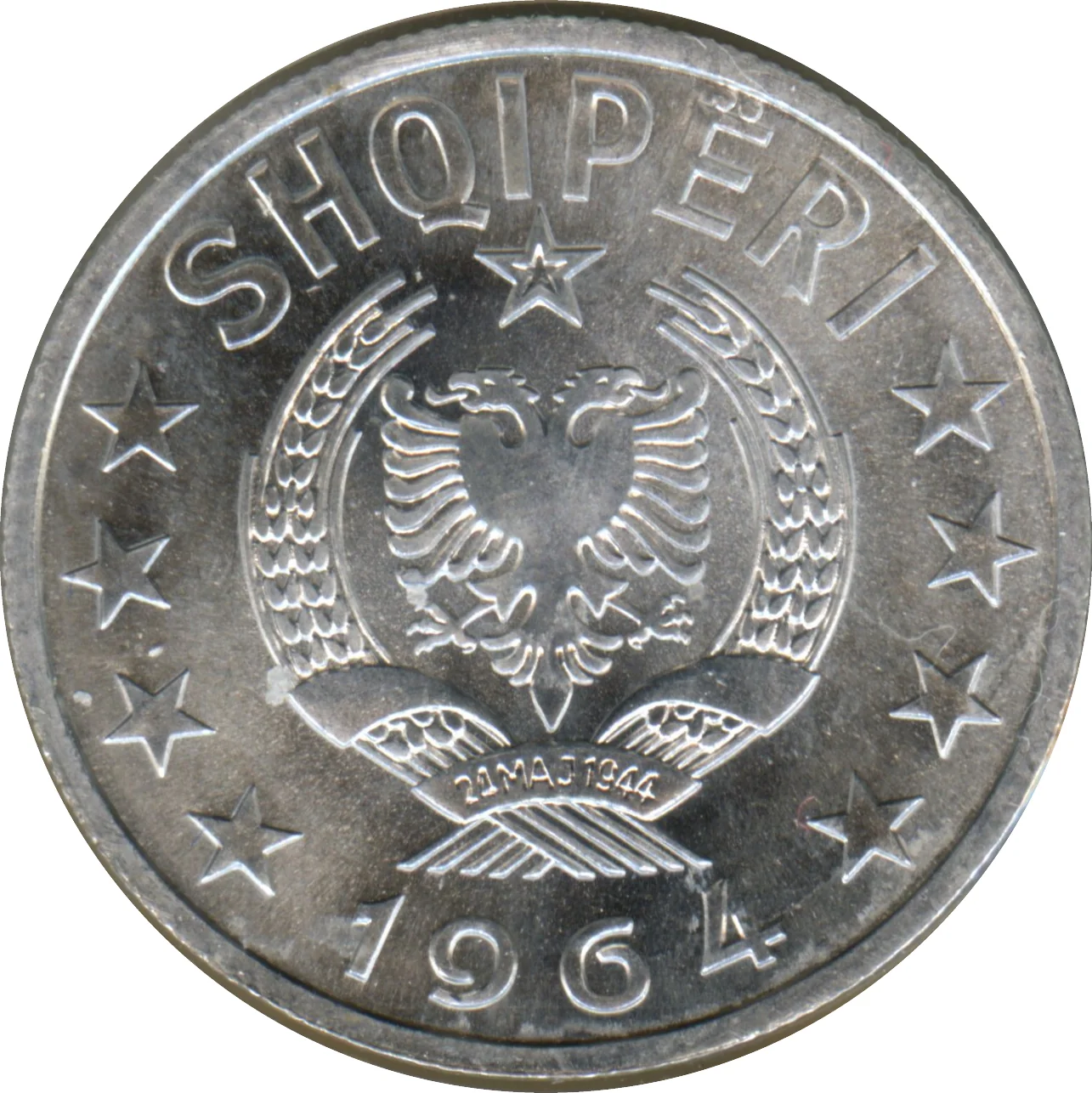
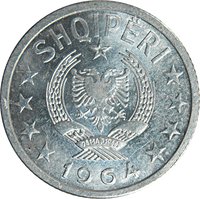
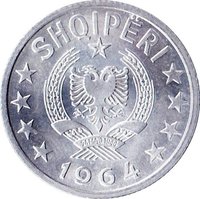
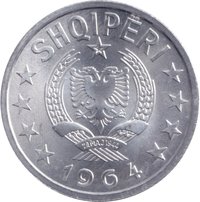
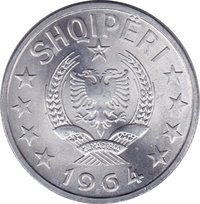
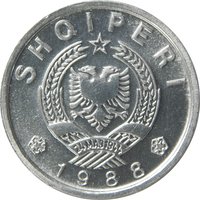
Obverse
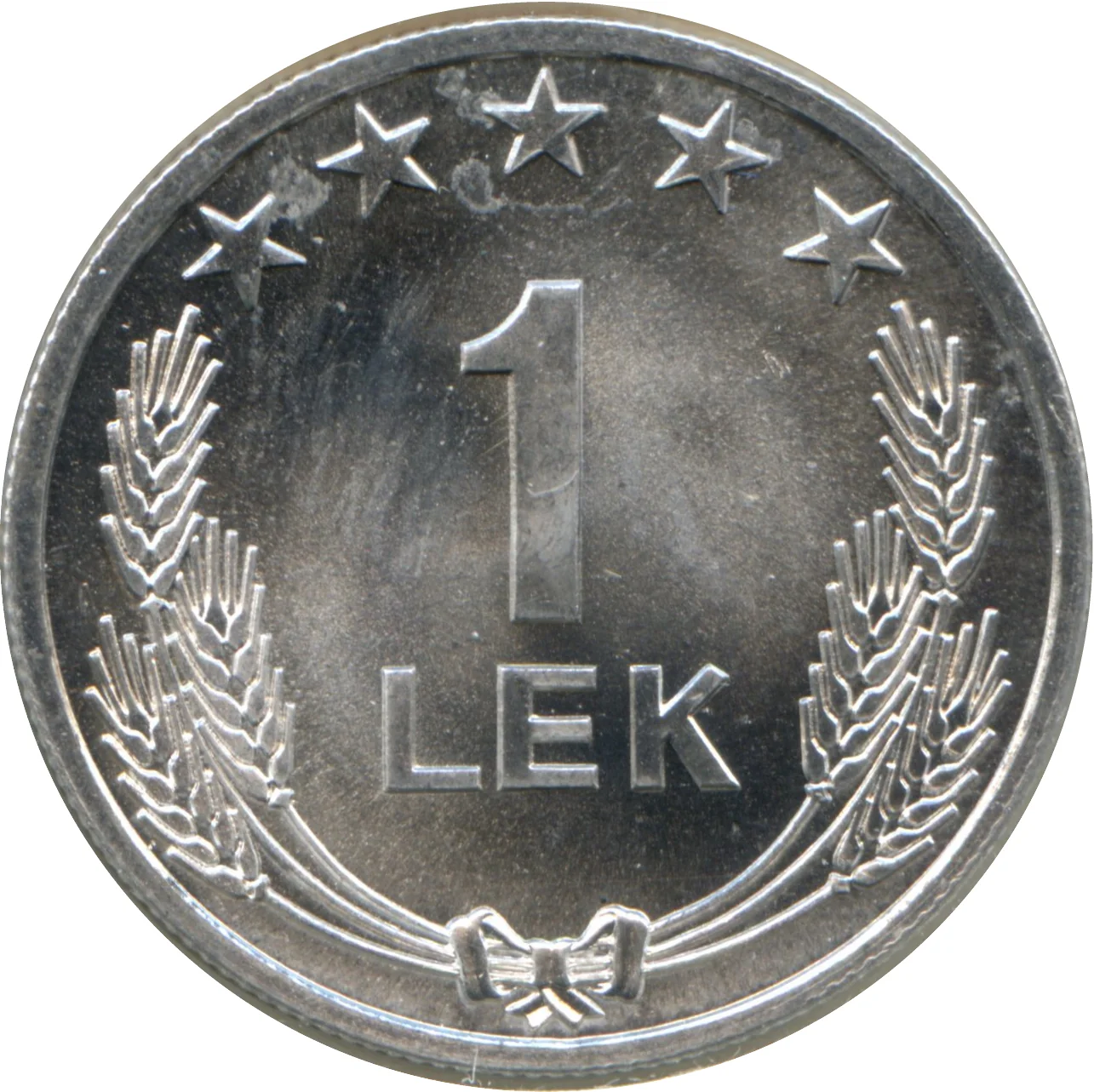
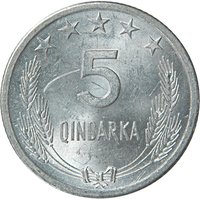
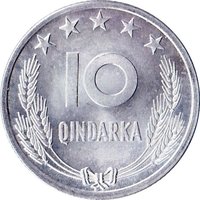
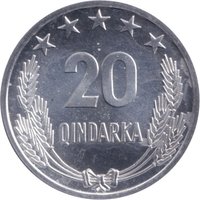
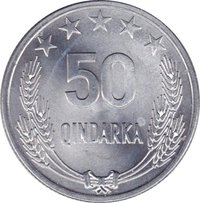
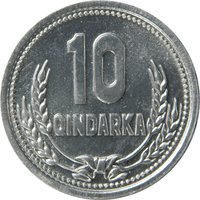
Reverse
Edge
Reeded
Categories
| Animal> Bird |
| Symbols> Coat of Arms |
| Symbol> Double-headed eagle |
Mintings
| Year | Mint Mark | Mintage | Quality | Collection |
|---|---|---|---|---|
| 1964 | — | — |
Historical background
In 1964, Albania’s currency situation was defined by its extreme political and economic isolation. Following its break with the Soviet Union in 1961 and a decade before establishing tentative ties with China, the country was in a period of strict autarky under Enver Hoxha’s Stalinist regime. The national currency, the Albanian lek, was a purely domestic instrument with no meaningful convertibility on international markets. Its value and circulation were entirely controlled by the state, with an official exchange rate set by decree rather than by any market mechanism, primarily for symbolic accounting purposes with its few remaining trade partners.
The economy was centrally planned and dominated by state-owned enterprises, with monetary policy subservient to the physical output targets of the Five-Year Plans. The State Bank of Albania (Banka e Shtetit Shqiptar) issued currency and provided credit according to the plan’s directives, not in response to economic demand. Money functioned mainly as a unit of account and a means of distributing wages for purchasing rationed consumer goods, as the range of available commodities was severely limited. There was no private foreign exchange market, and possession of foreign currency by individuals was illegal and severely punished.
Consequently, the currency situation was one of artificial stability but economic scarcity. The official lek exchange rate was pegged at 5 leks to 1 Soviet ruble until the rift, after which it was likely adjusted rhetorically against a basket of inconvertible currencies. In reality, the black market for foreign currency or desirable goods, though dangerous, hinted at the lek’s true depreciated value relative to the outside world. The system in 1964 was therefore rigidly controlled, designed to enforce economic self-reliance and prevent any external financial influence, reflecting the regime’s overarching priority of political control over economic vitality.
The economy was centrally planned and dominated by state-owned enterprises, with monetary policy subservient to the physical output targets of the Five-Year Plans. The State Bank of Albania (Banka e Shtetit Shqiptar) issued currency and provided credit according to the plan’s directives, not in response to economic demand. Money functioned mainly as a unit of account and a means of distributing wages for purchasing rationed consumer goods, as the range of available commodities was severely limited. There was no private foreign exchange market, and possession of foreign currency by individuals was illegal and severely punished.
Consequently, the currency situation was one of artificial stability but economic scarcity. The official lek exchange rate was pegged at 5 leks to 1 Soviet ruble until the rift, after which it was likely adjusted rhetorically against a basket of inconvertible currencies. In reality, the black market for foreign currency or desirable goods, though dangerous, hinted at the lek’s true depreciated value relative to the outside world. The system in 1964 was therefore rigidly controlled, designed to enforce economic self-reliance and prevent any external financial influence, reflecting the regime’s overarching priority of political control over economic vitality.
Series: 1964 Albania circulation coins
🌱 Common