

5 Cents – East Africa
Context
Year: 1964
Issuer: East Africa
Period:
Currency:
(1921—1967)
Demonetized: Yes
Total mintage: 7,600,000
Material
Diameter: 25 mm
Weight: 5.67 g
Thickness: 1.8 mm
Shape: Round with a round hole
Composition: Bronze
Magnetic: No
Technique: Milled
Alignment: Medal alignment
flip
References
KM: #Click to copy to clipboard39
Numista: #5819
Obverse
Description:
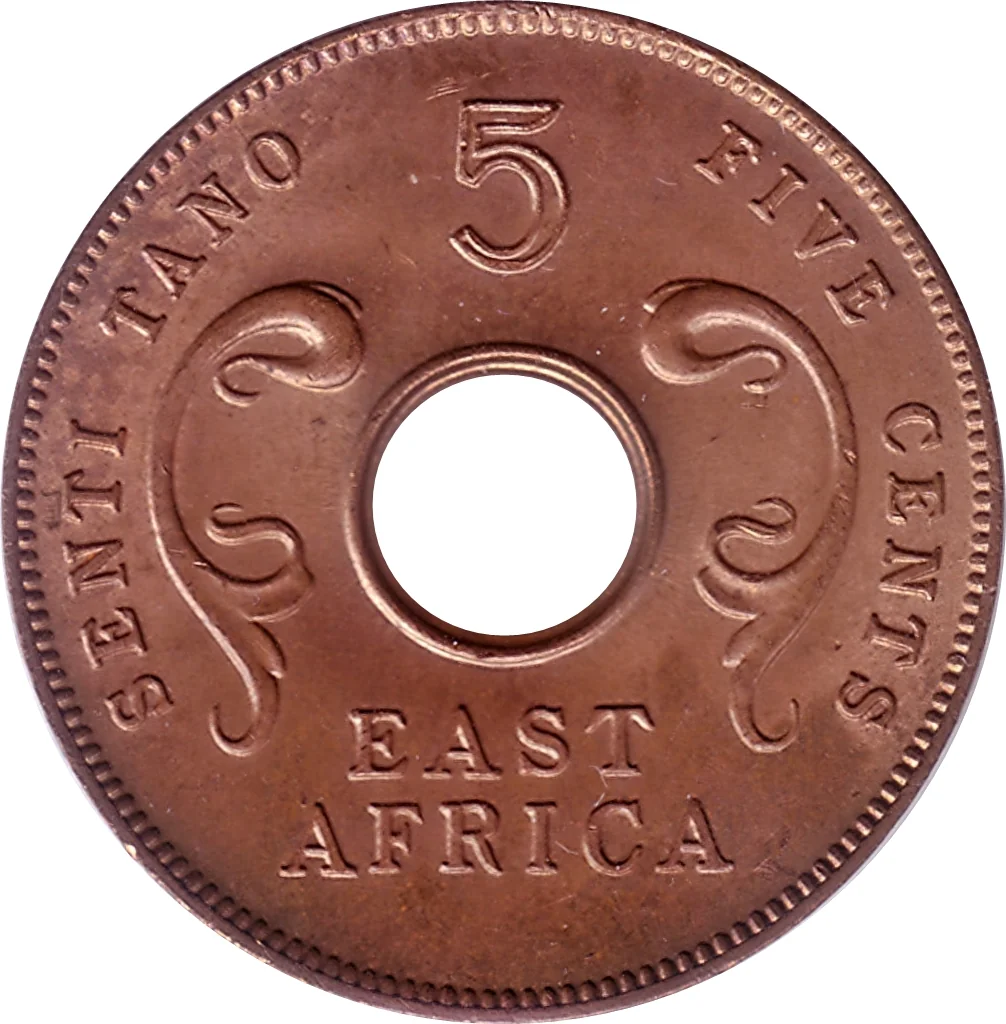
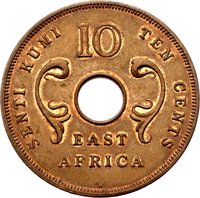
Country name below, denomination above and right of center hole.
Inscription:
SENTI TANO FIVE CENTS
5
EAST
AFRICA
5
EAST
AFRICA
Script: Latin
Reverse
Description:
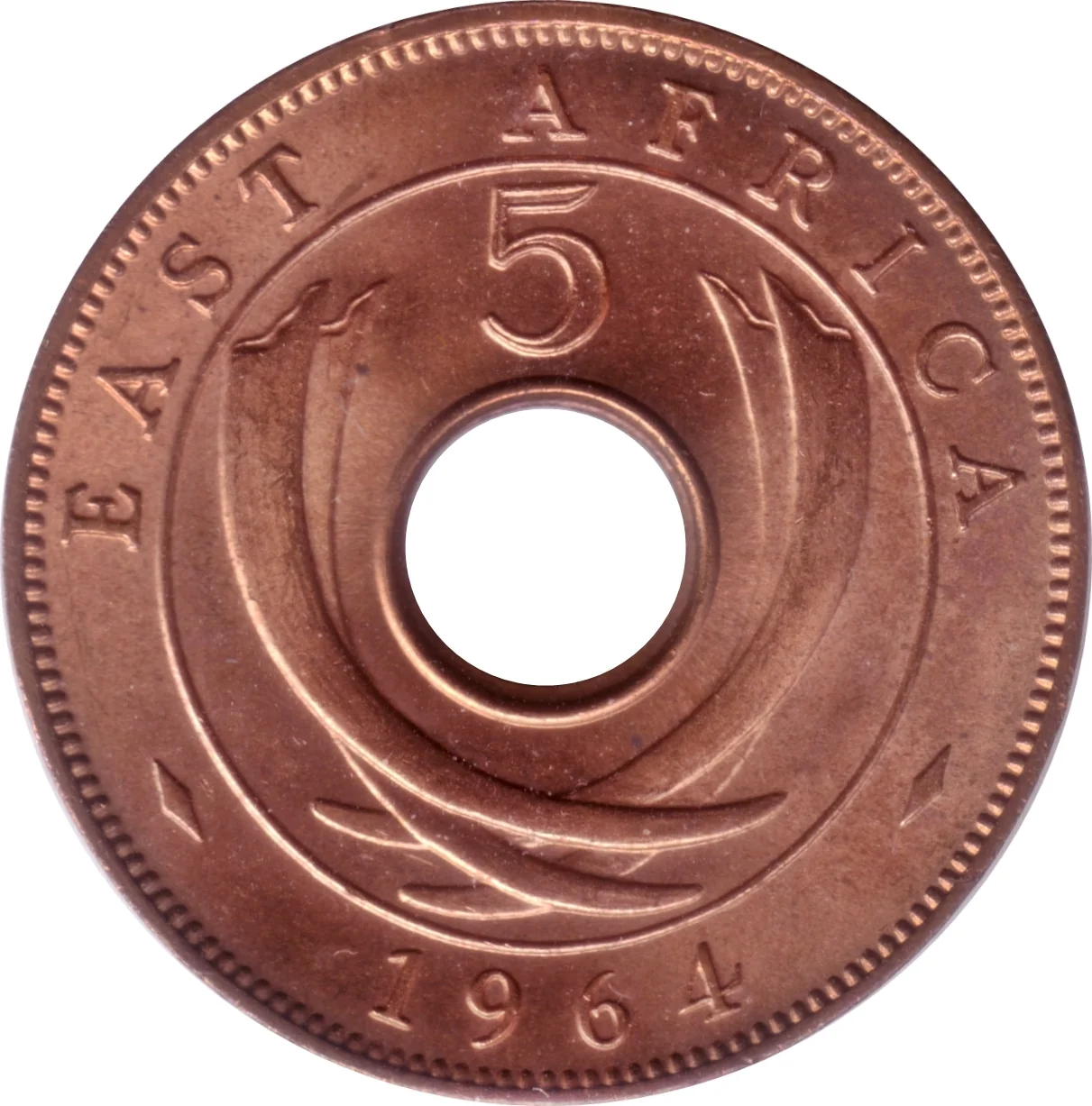
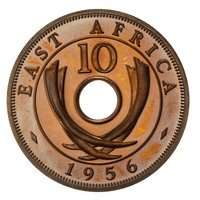
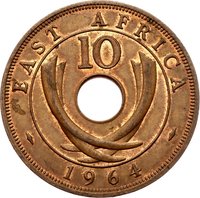
Curved tusks frame central hole. Country and denomination above, year below.
Inscription:
EAST AFRICA
5
1964
5
1964
Script: Latin
Edge
Plain
Mints
| Name | Mark |
|---|---|
| Royal Mint (Tower Hill) | — |
Mintings
| Year | Mint Mark | Mintage | Quality | Collection |
|---|---|---|---|---|
| 1964 | — | 7,600,000 |
Historical background
In 1964, East Africa stood at a monetary crossroads, shaped by its colonial past and newly won independence. The region operated under the East African Currency Board (EACB), a sterling-exchange system established in 1919. This system pegged the East African shilling at a fixed rate to the British pound sterling, guaranteeing convertibility and ensuring monetary stability. The EACB served Kenya, Uganda, Tanganyika (which united with Zanzibar in April 1964 to form Tanzania), and also Zanzibar, Aden, and British Somaliland. While effective for trade and price stability, the arrangement was inherently colonial, with currency issuance and monetary policy ultimately controlled from London, limiting the sovereign economic options of the new nations.
The political independence achieved by Tanganyika (1961), Uganda (1962), and Kenya (1963) created immediate pressure for monetary sovereignty. Leaders viewed a shared, London-influenced currency as incompatible with national development plans and the need for independent central banks to direct credit, manage foreign exchange, and respond to local economic conditions. However, there was also a strong counter-current favoring regional integration. The EACB was seen as a successful model of cooperation, facilitating seamless trade and movement of capital within East Africa, which many hoped to preserve and build upon within the new East African Common Services Organization.
Consequently, 1964 was a year of tense deliberation and transition. While the EACB continued to function, it was living on borrowed time. The three mainland nations were actively negotiating the board's future, caught between the pragmatic benefits of a stable, unified currency and the powerful political imperative for full monetary control. The year ended without a definitive resolution, but the direction was clear: the colonial currency system was unsustainable. The eventual breakup would come within the next few years, with each country establishing its own central bank and national currency—the Kenyan shilling (1966), the Tanzanian shilling (1966), and the Ugandan shilling (1966)—marking the end of a unified East African monetary area.
The political independence achieved by Tanganyika (1961), Uganda (1962), and Kenya (1963) created immediate pressure for monetary sovereignty. Leaders viewed a shared, London-influenced currency as incompatible with national development plans and the need for independent central banks to direct credit, manage foreign exchange, and respond to local economic conditions. However, there was also a strong counter-current favoring regional integration. The EACB was seen as a successful model of cooperation, facilitating seamless trade and movement of capital within East Africa, which many hoped to preserve and build upon within the new East African Common Services Organization.
Consequently, 1964 was a year of tense deliberation and transition. While the EACB continued to function, it was living on borrowed time. The three mainland nations were actively negotiating the board's future, caught between the pragmatic benefits of a stable, unified currency and the powerful political imperative for full monetary control. The year ended without a definitive resolution, but the direction was clear: the colonial currency system was unsustainable. The eventual breakup would come within the next few years, with each country establishing its own central bank and national currency—the Kenyan shilling (1966), the Tanzanian shilling (1966), and the Ugandan shilling (1966)—marking the end of a unified East African monetary area.
🌱 Common