

1 real – Honduras
Add to wishlist
Honduras
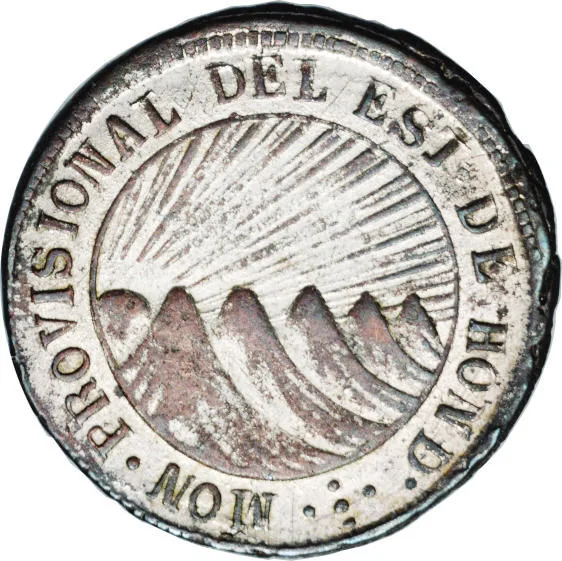
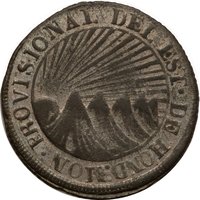
Obverse
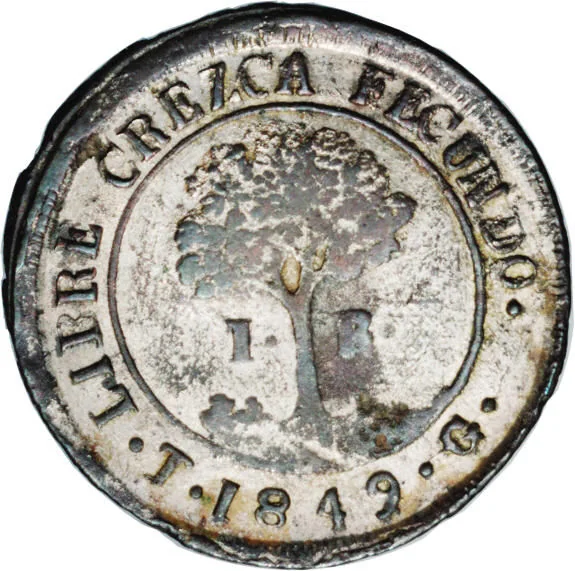
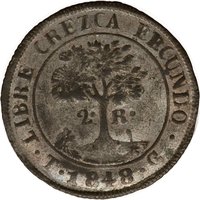
Reverse
Edge
Mints
| Name | Mark |
|---|---|
| Casa Nacional de la Moneda | T |
Historical background
In 1845, Honduras existed as a state within the Federal Republic of Central America, a fragile union that was in its final death throes. The national currency envisioned by the federation had failed to take hold, leaving a chaotic monetary landscape. The primary circulating coin was the Central American Republic real, but its supply was inconsistent and insufficient for commerce. This vacuum was filled by a confusing mix of foreign coins, most notably Peruvian and Bolivian silver pesos (often called "pesos fuertes"), Spanish colonial coins, and even Mexican reales, all circulating simultaneously at varying and fluctuating values depending on their weight and fineness.
This reliance on foreign specie created chronic economic instability. The government of President Coronado Chávez (1845-1847) faced severe fiscal shortages, unable to control the money supply or guarantee its value. Internal trade was hampered by the need for constant assay and negotiation, while the export economy, heavily reliant on precious metals like silver and gold from the mines of Tegucigalpa, was vulnerable to global price shifts. The lack of a sovereign currency also symbolized the weakness of the state itself, as it could not perform one of the fundamental acts of a nation: issuing and regulating its own money.
Consequently, the monetary disorder of 1845 was both a symptom and a cause of Honduras's fragmented political reality. As the federation formally dissolved the following year (1846-1848), establishing monetary sovereignty became an urgent task for the newly independent republic. The situation set the stage for Honduras's subsequent and protracted struggles to establish a stable national currency, a process that would involve repeated experiments with coinage and the persistent intrusion of foreign money, particularly the US dollar, well into the future.
This reliance on foreign specie created chronic economic instability. The government of President Coronado Chávez (1845-1847) faced severe fiscal shortages, unable to control the money supply or guarantee its value. Internal trade was hampered by the need for constant assay and negotiation, while the export economy, heavily reliant on precious metals like silver and gold from the mines of Tegucigalpa, was vulnerable to global price shifts. The lack of a sovereign currency also symbolized the weakness of the state itself, as it could not perform one of the fundamental acts of a nation: issuing and regulating its own money.
Consequently, the monetary disorder of 1845 was both a symptom and a cause of Honduras's fragmented political reality. As the federation formally dissolved the following year (1846-1848), establishing monetary sovereignty became an urgent task for the newly independent republic. The situation set the stage for Honduras's subsequent and protracted struggles to establish a stable national currency, a process that would involve repeated experiments with coinage and the persistent intrusion of foreign money, particularly the US dollar, well into the future.
✨ Legendary