

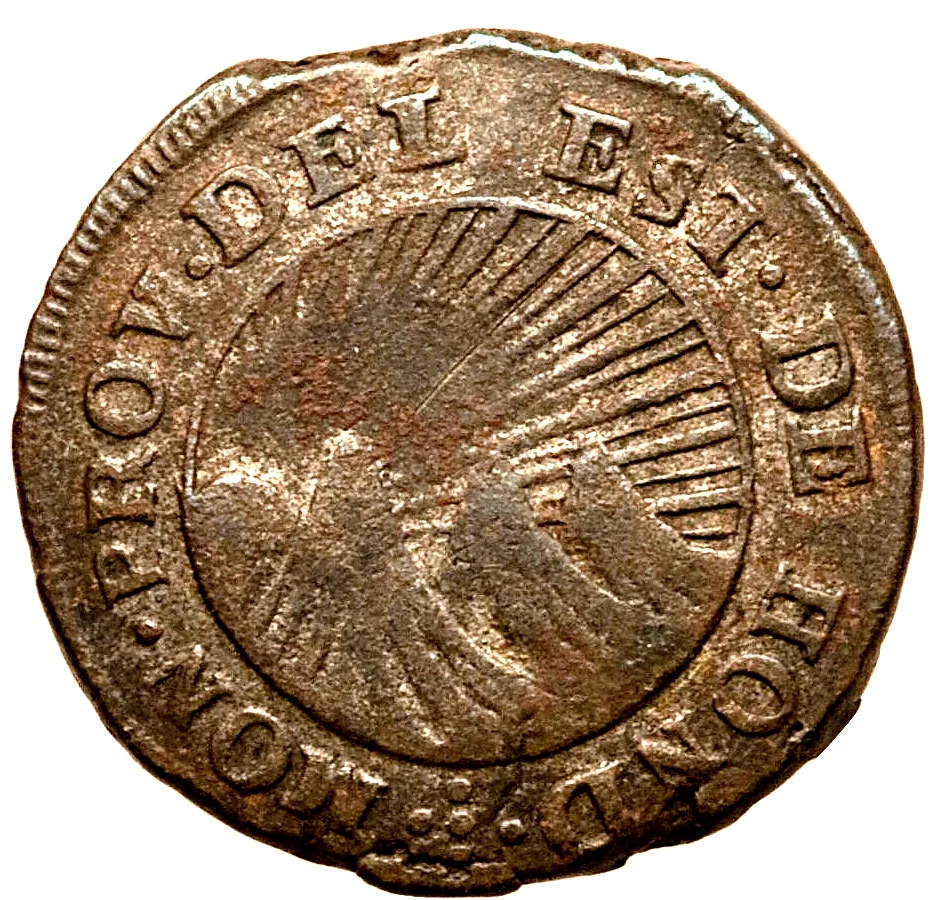
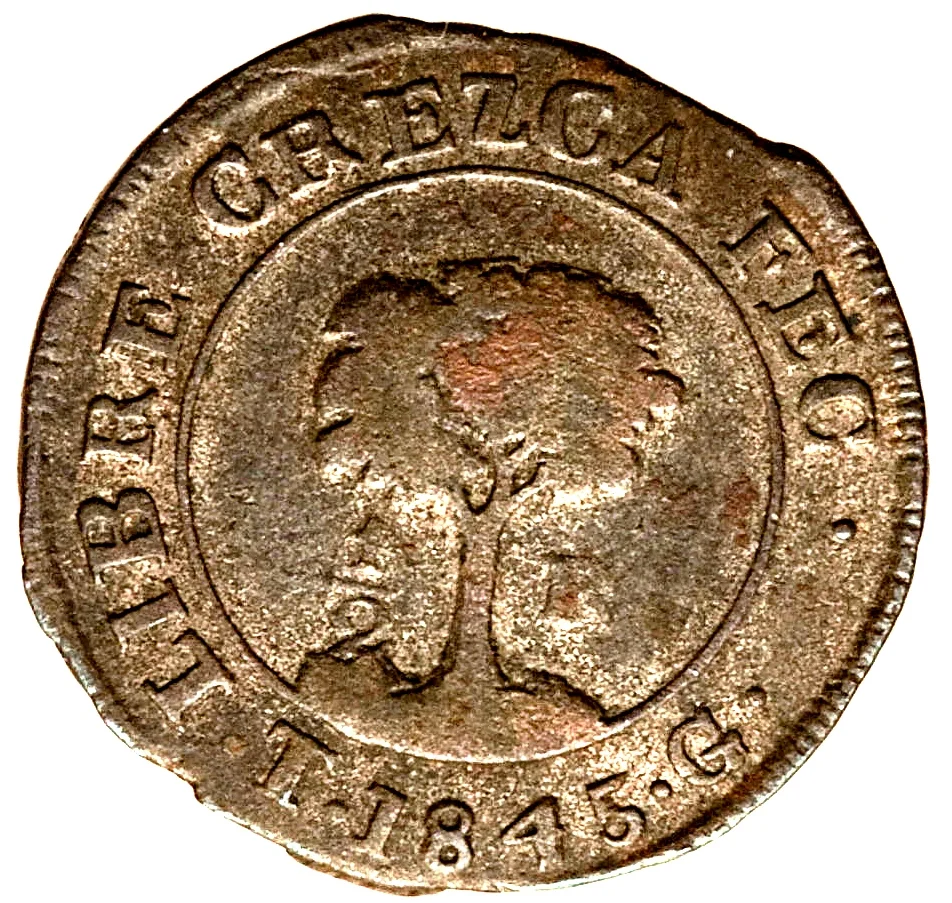
½ real – Honduras
Add to wishlist
Honduras
Context
Years: 1844–1845
Issuer: Honduras
Period:
(since 1862)
Currency:
(1800—1861)
Demonetization: 24 May 1862
Material
Diameter: 16 mm
Shape: Irregular round
Technique: Milled
Alignment: Medal alignment
flip
References
KM: #
Numista: #75506
Obverse
Reverse
Edge
Mints
| Name | Mark |
|---|---|
| Casa Nacional de la Moneda | T |
Historical background
In 1844, Honduras was navigating its early post-independence period as a constituent state within the Federal Republic of Central America, a federation that was in its final years of dissolution. The national currency landscape was chaotic and fragmented. While the federal government in Guatemala City had officially minted silver reales and gold escudos, their circulation was limited and inconsistent across the mountainous and poorly connected territory of Honduras. The collapse of central federal authority led to a severe shortage of official coinage, crippling everyday commerce and state finances.
To address this acute shortage, Honduran authorities and local merchants resorted to the widespread use of foreign coins, primarily Spanish colonial reales and Mexican silver pesos, which circulated by weight and assay. This practice created a complex and unreliable system where the value of transactions depended on the specific origin, wear, and metal content of each coin. Furthermore, the Honduran state, under President Francisco Ferrera, attempted to assert economic sovereignty by authorizing the issuance of its own copper coinage. These low-value cuartillas and medios reales were intended to facilitate small daily transactions but often suffered from public distrust and counterfeiting.
The fundamental monetary problem of 1844 was therefore one of authority and uniformity. With the federation failing and no strong central bank, Honduras lacked the institutional power to impose a uniform, trusted currency. The economy relied on a patchwork of foreign silver, depreciating local copper, and even barter in remote regions. This instability reflected the broader political turmoil of the era, as currency disorder both resulted from and contributed to the weak fiscal foundation of the nascent Honduran state, which would fully dissolve from the federation just two years later, in 1846.
To address this acute shortage, Honduran authorities and local merchants resorted to the widespread use of foreign coins, primarily Spanish colonial reales and Mexican silver pesos, which circulated by weight and assay. This practice created a complex and unreliable system where the value of transactions depended on the specific origin, wear, and metal content of each coin. Furthermore, the Honduran state, under President Francisco Ferrera, attempted to assert economic sovereignty by authorizing the issuance of its own copper coinage. These low-value cuartillas and medios reales were intended to facilitate small daily transactions but often suffered from public distrust and counterfeiting.
The fundamental monetary problem of 1844 was therefore one of authority and uniformity. With the federation failing and no strong central bank, Honduras lacked the institutional power to impose a uniform, trusted currency. The economy relied on a patchwork of foreign silver, depreciating local copper, and even barter in remote regions. This instability reflected the broader political turmoil of the era, as currency disorder both resulted from and contributed to the weak fiscal foundation of the nascent Honduran state, which would fully dissolve from the federation just two years later, in 1846.
✨ Legendary